
Venezuelans Won’t Get Liberty Until We “Get” Liberty
Long-awaited freedom won’t be realized if we fail to address the power inequalities that plagued us long before chavismo
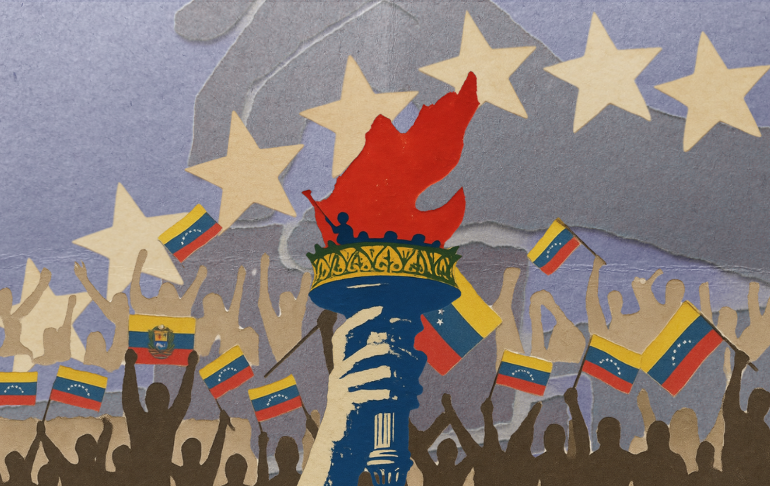
When Maduro was taken and arrested on January 3rd, many Venezuelans brought out the good stuff. The old bottle of rum or whiskey they’d been saving for a special occasion, believing the incursion would inevitably lead to the return of liberty in Venezuela. Nine months later, the “transition” has not been what most Venezuelans wanted. Hundreds of political prisoners were released, but that is not enough. A few laws are being reformed, but not the institutions that carry them out. Delcy remains in power despite no lawful statute allowing it nor any sort of popular mandate for her to be the head of the Venezuelan State.
Many who brought out the good whiskey have soured on the transition, or at the very least lost their shiny optimism. But the mistake was not just to believe in a future that now seems a bit naive, but to yearn for the return of a past which was the precursor to our current tragic state.
The quest for a more liberal society
Yes, we were better off before the 2000s, but we’ve never had a truly free society without clientelism or corruption. Chavismo may have perfected the art of corruption in Venezuela, but they certainly did not invent it. Venezuela, since its inception, has not been able to ameliorate the very Latin American issue of inequalities of power. We tend to forget about the problem during oil bonanzas. Everyone is doing better, right? Why worry? Then the oil price inevitably falls, the party stops, the lights turn on and we see the naked truth that we are in a horrible state of disrepair.
Many say that the Venezuelan problem is economic (lack of diversification or investment in non-oil industries), political (once high polarization and weak rule of law), or even cultural (a tendency towards el guiso). But within these lies a deeper philosophical issue: for a society that claims to love liberty and our libertadores as much as we do, we don’t actually understand what it takes to create a liberal society.
This is hardly a Venezuela-specific issue, but we are a unique case in that so much of our self-perception is based on the idea of a people who achieved freedom from the yoke of Spanish tyranny, only to then continue to liberate other countries in South America, making Simón Bolívar the most famous person in the history of the continent.
What room is there to become “more liberal” once all citizens are recognized by the law and there is universal suffrage?
To understand what it means to be a liberal society, perhaps it would be best to understand what it means to be a more liberal society. When the classical liberal revolutions of the 18th and 19th centuries took place, it was the divine right of kings that fell. The power was taken from an individual and shared amongst parliaments, which were at the time controlled almost exclusively by rich landowners (including our own first few republics). Still, this was unquestionably a redistribution of power from the individual to the few. It took a long time, but eventually this distribution of power from the one to the few became a distribution of power from the few to the many. Nowadays, democratic societies are expected to allow every single citizen to vote, but this is a reality that is younger than the oldest person alive today. When English supercentenarian Ethel Caterham in the UK was born in 1909, her mother would not have been allowed to vote.
Liberal societies today hardly even question the idea that all people should be equal in respect to the law and that we ought to have a voice in the decisions of our country through voting. So what room is there to become “more liberal” once all citizens are recognized by the law and there is universal suffrage?
It’s true that the distribution of power in liberal countries these days is much improved when compared to 100 years ago, but is it better than 50 years ago? The laws may say that all people are equal, but systems don’t seem to provide that result. Even in societies where they have nominally distributed power amongst all citizens, the power has not been really distributed amongst them nearly as well. Throughout the current Trump presidency, there have been a string of pardons for white-collar criminals who have paid patronage to Trump and his family, including the former president of Honduras convicted of drug trafficking, or a Venezuelan oligarch indicted for allegedly bribing a Puerto Rico governor.
This is a clear example of a two-tiered justice system in which if you put the right money in the right pockets, you get preferential treatment.
A post-WW2 recipe?
I use these examples to show that although there is nothing ontologically wrong with wealth inequality, especially if the rich earned that money honestly, in practice inequality in resources leads to inequality in power and inevitably abuse of that power. This is the state of Venezuela now, but it was also the state of Venezuela long before Chávez caught a whiff of power and what ultimately led a majority of voters to choose a murderer and traitor over the “democracy” that was in place.
The issue, after nearly three decades of chavismo, is that although they entered power on the basis of railing against resource and power inequalities, in the time since they’ve been in charge they’ve done nothing to ameliorate those same inequalities. The people in government have simply taken the seats of the previously corrupt politicians and become even more clientelist, leading to greater inequalities in power and resources than ever before (on top of just a generally poorer country).
The vast majority of Venezuelans can clearly see what chavismo is now, even many who used to vote for it. And though we are still not through with it, we ought to give serious consideration to what we want to replace it with. Do we want a return to bipartidismo and clientelism with high inequality? Just hoping that the price of oil rises so we can keep our population happy whilst oligarchs accrue more and more power? Or do we actually want to achieve the liberty we say we value so much?
We can imitate post-WWII States who decreased inequalities by taxing the incomes of extremely wealthy people at extremely high rates whilst maintaining a belief in free markets, property and the rule of law.
When we get rid of chavismo, we will have an even greater challenge ahead. We’ll have the challenge of rebuilding a country destroyed by decades of mismanagement, a country filled with people who have gotten their wealth by enchufándose into a corrupt system that has oppressed the voice of its people. And we’ll have to decide how we want to go about bringing back liberty. I suggest we act like the previous liberal revolutions we venerate, and distribute more power from the few to the many.
So what is the solution to power inequalities and resource inequalities?
Thankfully, there is no need to reinvent the wheel. We can copy the policies of post-WWII countries (US, Japan, France, UK, Germany, etc) who decreased inequalities in their countries by taxing the incomes of extremely wealthy people at extremely high rates whilst maintaining a belief in free markets, property and the rule of law. This has the added benefit of diversifying government incomes away from just oil revenue or sales taxes, which are regressive and hurt consumers and small businesses (I could go on and on about the economic benefits, but I’ll stick to the institutional ones here). I specify the post-WWII liberal societies here and not the communist ones, because although communist countries seek to ameliorate resource inequalities they end up increasing power inequalities which lead to just as much abuse, if not even more than hyper-capitalistic oligarchic societies.
But before we can consider which policies we ought to copy from which societies, we must adopt the attitudes and political beliefs which made those policies implementable in the first place.
The world, not just Venezuela, is at a crossroads between greater authoritarianism or greater liberalism. If we are leaders of liberalism in our continent, as we have historically perceived ourselves to be, then we ought to understand the nature of liberalism and how we ought to achieve it. If we do not have a vision of how to recreate our institutions and our general idea of what a liberal society even is, then we will surely return to the sad state we are in right now, even after we get rid of the kleptocrats sitting in Miraflores.
The solution is simple, but it’s not easy. Entrenched interests are just that; entrenched. But if the people of the country yearn for liberty and we manage to understand what it takes to attain it, then it can be done through hard work and dedication, as ultimately all worthwhile goals are achieved.
Caracas Chronicles is 100% reader-supported.
We’ve been able to hang on for 22 years in one of the craziest media landscapes in the world. We’ve seen different media outlets in Venezuela (and abroad) closing shop, something we’re looking to avoid at all costs. Your collaboration goes a long way in helping us weather the storm.
Donate