Economic Transparency According to Delcy Rodríguez
The “Venezuela Renace” plan puts official numbers back on the table. A long history of opacity still breeds suspicion

Following Delcy’s Tuesday rollout of her 10-year plan, Economic VP Calixto Ortega Sánchez led a technical briefing alongside the economic team. Left to right: Héctor Obregón (PDVSA president), Anabel Pereira (Economy & Finance minister and E-Government chief), Ortega, Luis Pérez (BCV acting president), and Christiam Hernández (BCV board member and Deputy Finance minister for banking).
More than a decade ago, the economics profession—and civil society at large—began raising its voice to demand that the central government fulfill its obligation to publish official statistics.
One of the earliest battles was calling, month after month, for compliance with Central Bank of Venezuela (BCV) Resolution No. 08-04-01 (Official Gazette No. 38,902, April 3, 2008), which required the previous month’s National Consumer Price Index (INPC) and inflation rate to be published within the first ten days of each month. Later, we began demanding the release of other statistics that had likewise vanished from government portals. An emblematic case was the scarcity index, which stopped being published after hitting a record high of 28% in January 2014. The blackout was justified by claiming that, in the words of then-BCV President Nelson Merentes, “the scarcity index should be held by the government; it is not a political index… We do not want indices to become political tools that favor some and harm others.”
Because government authorities turned a blind eye and a deaf ear to demands for data disclosure, Transparencia Venezuela filed an abstention lawsuit against the BCV president, arguing that he was “the official legally and expressly vested with the authority to publish the country’s macroeconomic statistics, a duty he has failed to exercise.” After the Supreme Tribunal of Justice (TSJ) dismissed the suit in August 2015—claiming the plaintiffs had not proven they requested the data directly from the BCV before going to court—Transparencia Venezuela sued the BCV again in September 2015. To avoid a repeat of the earlier ruling, the second filing attached formal letters requesting the information.
In March 2016, the TSJ shelved part of the case because the BCV had released some inflation and GDP figures. However, the court denied the petition regarding the scarcity index, arguing that the plaintiffs had not explained what the information would be used for—a rationale closely aligned with what Merentes had stated two years earlier.
By the first half of 2018, delays in publishing official statistics had become the rule rather than the exception.
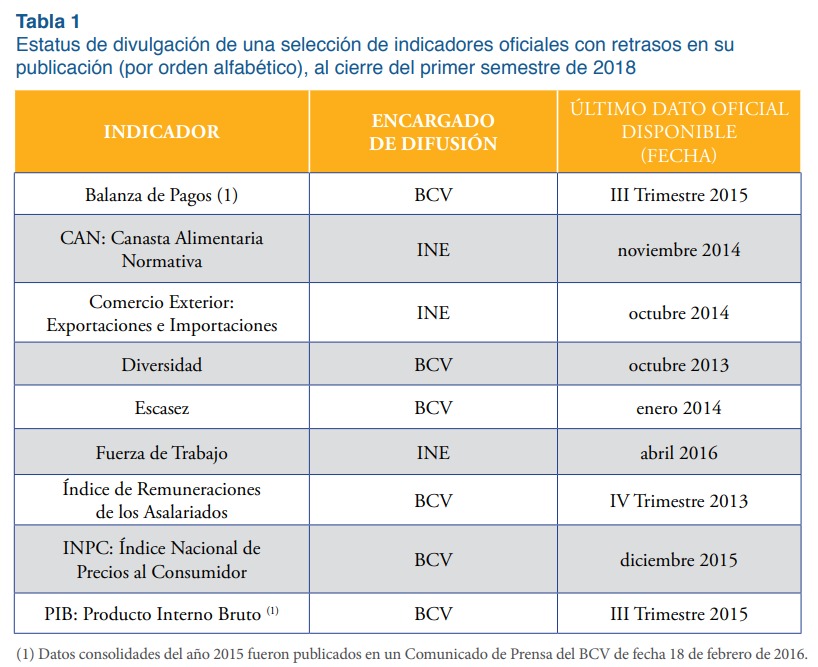
To fill the statistical void, non-state initiatives emerged. For instance, the most widely used benchmarks for tracking the rising cost of basic food and household baskets came from the Center for Documentation and Social Analysis of the Venezuelan Teachers’ Federation (Cendas-FVM). Meanwhile, the Venezuelan Finance Observatory (OVF), operating as an independent alternative benchmark, published its own consumer price index, economic activity index, and wage index, among others. Last year, however, the OVF was forced to halt publication following a wave of arrests and persecution against those involved in the initiative.
“I want to believe that the publication of the Venezuela Renace program marks the beginning of a rebirth of transparency. Yet transparency only acquires real value when it is sustained over time and transcends any political color.”
Fast-forward to November 2026, and “VENEZUELA RENACE: Programa nacional para la recuperación y la prosperidad” (Venezuela Reborn: National Program for Recovery and Prosperity) is published.
A colleague shared the document with me on WhatsApp, and I confess I opened it with skepticism.
Yet I was surprised by the scope of the document, and two elements stand out. First, unexpectedly, Venezuelans were able to reconnect with a substantial body of figures presented in a formal, orderly, and centralized manner.
Second, I applaud—albeit with some caution—its commitment to the periodic and timely publication of key economic and financial statistics, framed as a core milestone for a “normalization phase” that “will focus on restoring macroeconomic stability and rebuilding trust among domestic producers, investors, and international partners.”
I want to believe that this marks the beginning of a rebirth of transparency. Yet transparency should not be understood as a single milestone, but as a journey: a practice that only acquires true value when it is sustained over time and transcends any political color. Achieving that requires a genuine separation of powers and permanent oversight by civil society.
So I dare say that the rebirth of transparency is on the horizon, though it has not yet begun—and all of us will have a role to play in moving in the right direction.
Caracas Chronicles is 100% reader-supported.
We’ve been able to hang on for 22 years in one of the craziest media landscapes in the world. We’ve seen different media outlets in Venezuela (and abroad) closing shop, something we’re looking to avoid at all costs. Your collaboration goes a long way in helping us weather the storm.
Donate