
Useful Voices: How Maduro Exploits the US Debate on Venezuela
Maduro & Co. instructed its network of media and trolls to multiply arguments from Democrats and liberal media that match the dictatorship’s talking points

On September 1, at an international press conference convened in response to threats from the U.S. government, Nicolás Maduro declared: “The Miami mafia has seized political power in the White House and the State Department; they have imposed their extremist Miami-centric vision and have ‘Miamisized’ U.S. foreign policy toward all of Latin America and the Caribbean; because threatening Venezuela is threatening the entire continent.”
This statement fits with a script distributed through Siscom, the messaging system used by Venezuela’s Ministry for Communication and Information to send orders to media and digital activists. “The U.S. warmongering maneuver is driven by extremist sectors in South Florida, representing less than 10% of the U.S. population, who seek to impose their agenda on the entire country, ignoring the majorities who oppose wars and want the government to focus on internal problems,” reads a paragraph from the document.
La Hora de Venezuela obtained several of these scripts, distributed between March and September 2025 to 40,000 users participating in more than 600 Siscom groups. The main messages: the entire nation is enlisting as if it were Vietnam, while at the same time there is an atmosphere of calm and normalcy. But the scripts also aim to influence public discourse in the United States, by contrasting the “Miami lobby” with America First and MAGA, framing a military escalation against Venezuela as a useless cost in the face of its internal problems.
The propaganda apparatus takes phrases from U.S. politicians, analysts, and media outlets and amplifies to validate its propaganda and disinformation narratives.
On December 3, 2025, Democratic Representative Jim McGovern announced that he would introduce a resolution to force a vote in Congress against the Trump administration’s “crazy escalations” against Venezuela. “No one, except the president and his billionaire allies, wants this war,” McGovern stated.
A few hours later, Madelein García, a journalist for Telesur—the international propaganda channel dependent on the Venezuelan Ministry for Communication and Information—quoted and translated McGovern’s post. It wasn’t necessary for journalists, media outlets, or communicators allied to his government to claim that Washington was divided: it was enough to amplify the message of a congressman speaking from within the U.S. political system, while avoiding the sound of propaganda.
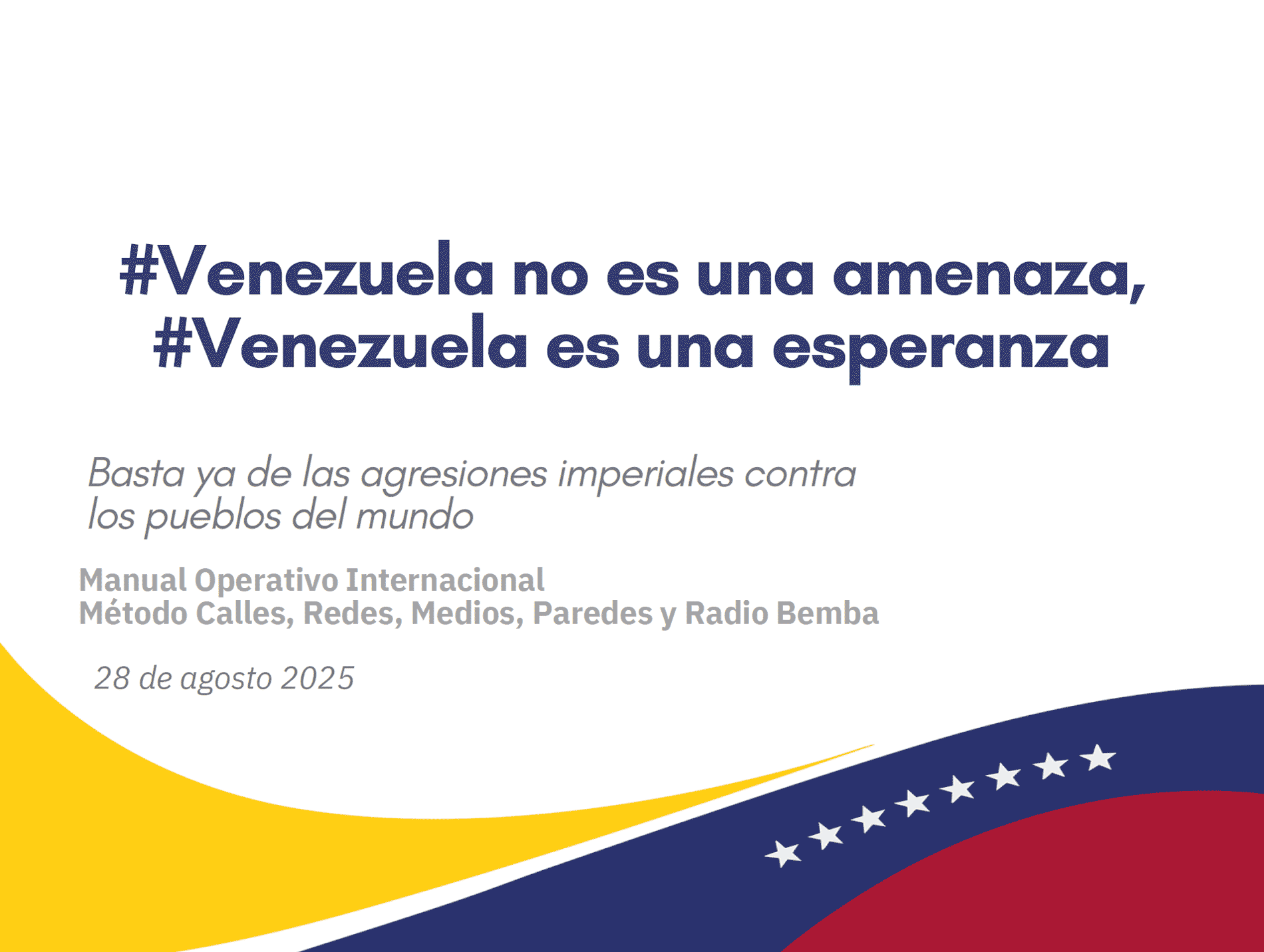
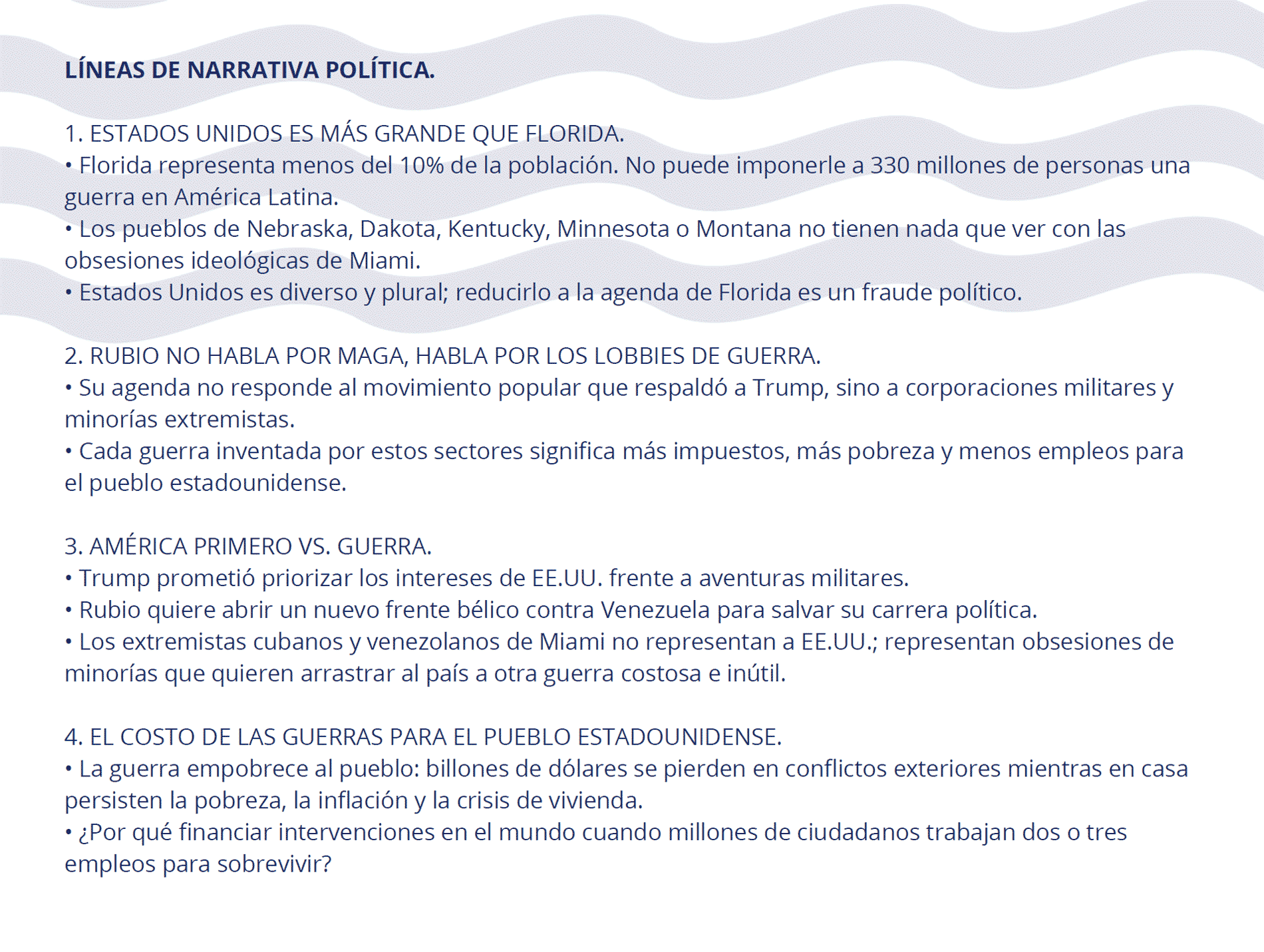
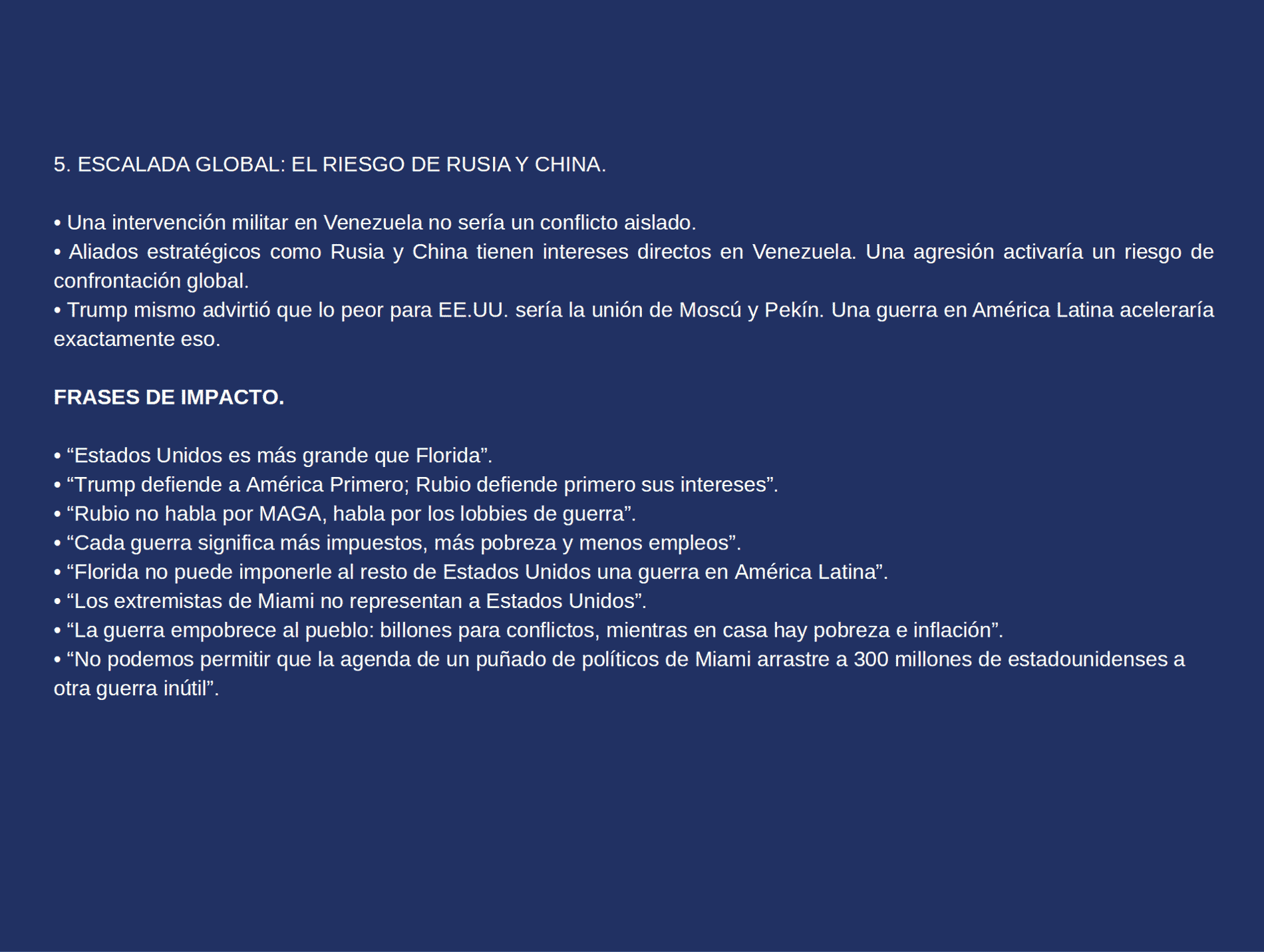
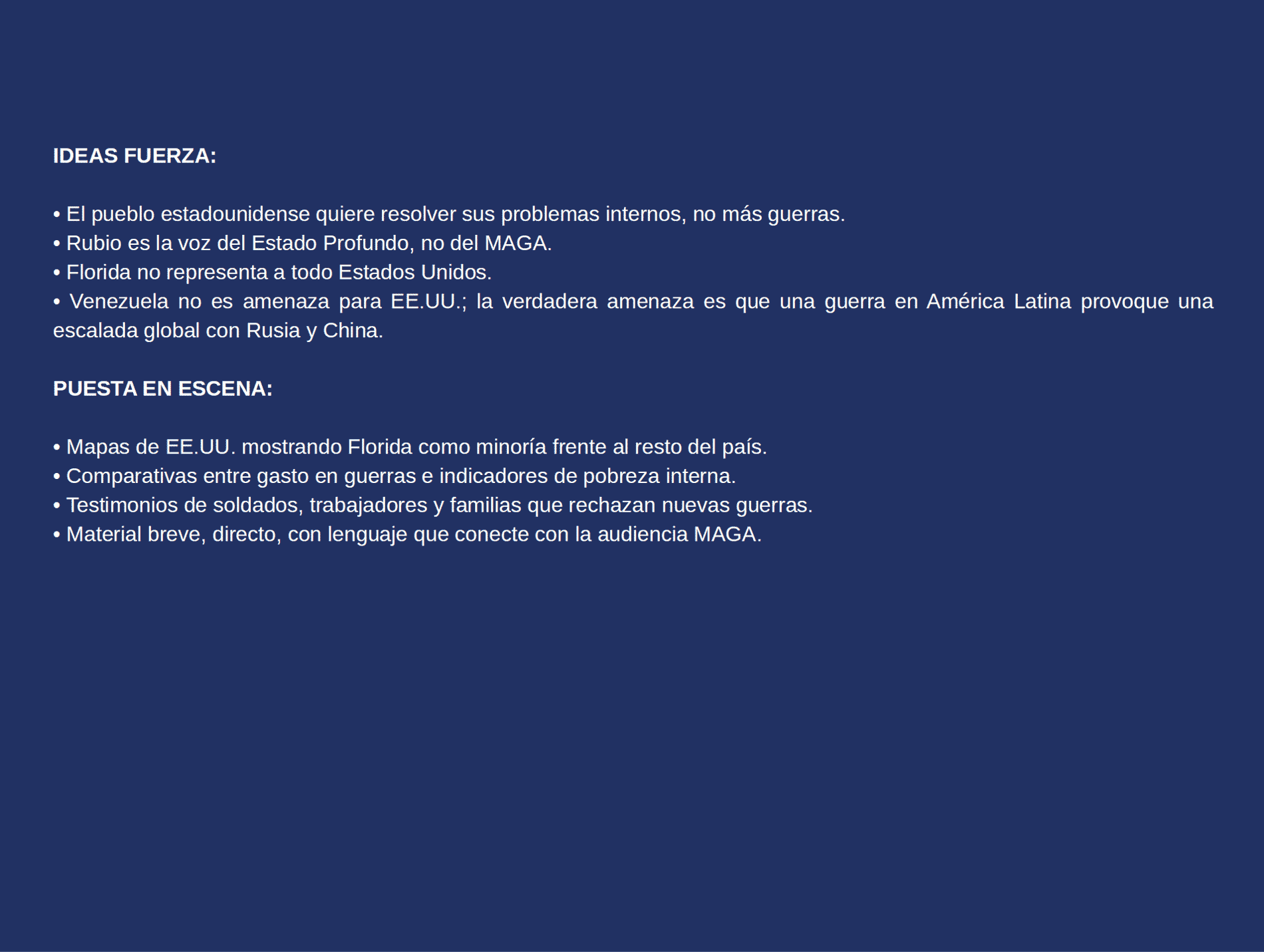
In general, McGovern’s statement echoed talking points included in an operational manual formatted as a slide presentation that had been circulated months earlier through Siscom, on August 29, by Johannyl Rodríguez, Venezuela’s vice minister of Communication and Information. Page 7 of that script includes, for example, phrases such as “Rubio does not speak for MAGA; he speaks for the war lobbies” and “His agenda does not respond to the popular movement that backed Trump, but rather to military corporations and extremist minorities.”
García’s quote of McGovern served as external validation for narratives that the Maduro administration is trying to position. There was no need for sympathetic journalists, outlets, or communicators to talk about divisions in Washington over Venezuela: amplifying a Democratic lawmaker from within the U.S. political system was enough to make the framing sound less like official propaganda.
Days earlier, on November 29, 2025, Democratic Senator Chuck Schumer had also questioned the policy toward Venezuela, arguing that it didn’t align with the “America First” principle, alluding to the unnecessary expenditure of resources and internal priorities.
Schumer’s argument also resonated with ideas already laid out in the August 29 presentation: the split between America First and war, and the cost of escalation for ordinary citizens. Among the lines in the script sent by the Maduro Ministry of Communication official includes lines such as: “Trump promised to prioritize U.S. interests over military adventures,” “War impoverishes the people: trillions of dollars are lost in foreign conflicts while poverty, inflation, and the housing crisis persist at home,” and “Why fund interventions around the world when millions of citizens work two or three jobs just to survive?”
Venezuela News, an “unofficial” mouthpiece for pro-Maduro propaganda—and a frequent amplifier of disinformation—reported Schumer’s statements as further proof that figures in the Democratic leadership are questioning the coherence and legitimacy of an escalation against Venezuela.
On September 2, Juan González—former director for the Western Hemisphere at the Council of National Security during the Biden administration—questioned the logic of the military deployment in the Caribbean: “So the U.S. government is using false information to justify a terrorist designation and then spending at least $7 million a day to have a carrier strike group kill 11 traffickers…?” Days later, the Venezuelan News Agency (AVN) turned it into a headline (“Former Biden advisor denounces false information and million-dollar waste”). González’s comment was also reported by Venezuela News and Globovisión.
Once again, the framing was perfect for amplifying the script’s narratives, without the need to manufacture the message through Maduro’s propaganda apparatus.
Creating discord between Maga and Rubio
Alongside narratives about America First and the unnecessary use of U.S. public resources, the scripts distributed by Siscom also lay out another divisive line: portraying U.S. policy toward Venezuela as the result of an internal fracture, in which a minority—associated with Secretary of State Marco Rubio and several Florida Cuban politicians—drags the country into an escalation unwanted by the rest of the population.
These guidelines aim to intervene in the U.S. public conversation from within, seeking to sow discord by amplifying pre-existing tensions between the MAGA (Make America Great Again) movement and parts of Washington’s political apparatus.
The same script sent by Siscom on August 29, for example, defines staging guidelines for content that includes “short, direct material that connects with the MAGA audience.” Another section features “impact phrases” such as “Rubio does not speak for MAGA; he speaks for the war lobbies,” “Trump defends America First; Rubio puts his interests first,” or “Florida cannot impose a war in Latin America on the rest of the United States.”
Extra News Mundo, another “unofficial” source of Venezuelan propaganda, and “Unleash Dracarys,” (pseudonym used by Dayra Rivas, Director of Digital Media at Information Ministry), published a video to multiply the reaction of right wing activist Laura Loomer -who opposes military action in Venezuela- against an interview to Cuban American congresswoman María Elvira Salazar, a supporter of Machado. The video reiterates the “MAGA vs. Florida” trope recommended in the Siscom script: Cuban politicians in Florida are trying to impose a war on Trump.
Everyone is happy
Regarding the story line of “everything is fine in Venezuela and nobody is afraid of Trump,” the Maduro propaganda took advantage of a December 4 photo essay in The New York Times, which opens with a video of a group of Caracas residents dancing salsa in a nightclub and showcases scenes of concerts, baseball games, and Christmas celebrations in a country seemingly at peace. At the same time, the piece warns that the surveillance by security forces has stifled open expression of dissent and concludes with a question: whether this tranquility can truly be believed.
A summarized version of the article, published on The New York Times’ Instagram account, received over a thousand comments, at least half of which were negative or dismissive. The carousel opened with the same video of Venezuelans dancing salsa, but the final point of the report—the question of whether this calm is real—was relegated to the background. Its celebratory tone resonated with several pieces of reassuring propaganda that began appearing more frequently.
Since mid-November, at least five videos of Venezuelans dancing and celebrating were shared through Nicolás Maduro’s official Telegram channel. In one of them, Maduro was seen dancing and calling for a party every day of the week. All of this content was massively and coordinatedly amplified by state media and digital activist networks, in line with the Street, Networks, Media, Walls, and Word of Mouth Method signed by Maduro, that broadly defines the government’s information operation.
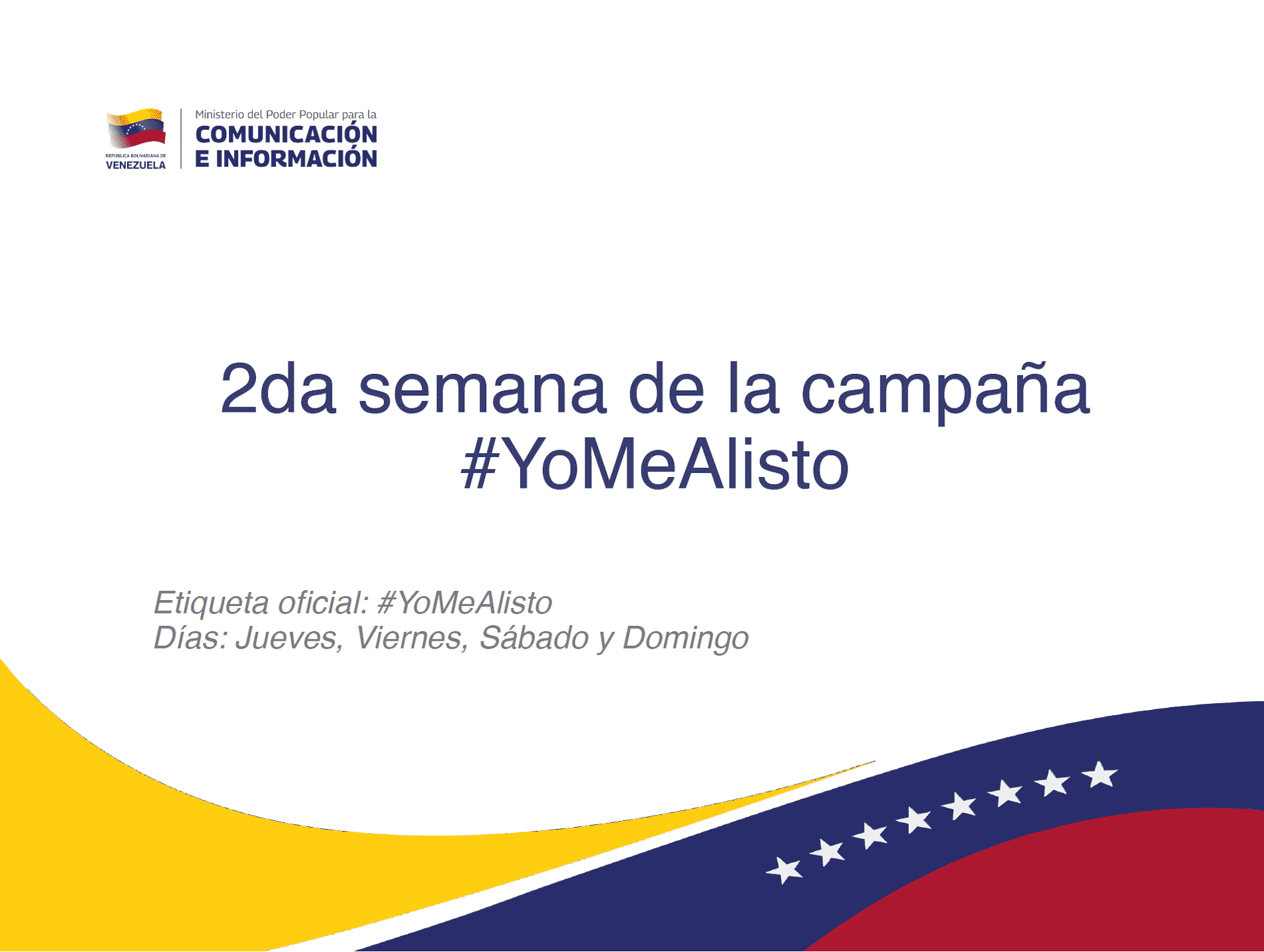
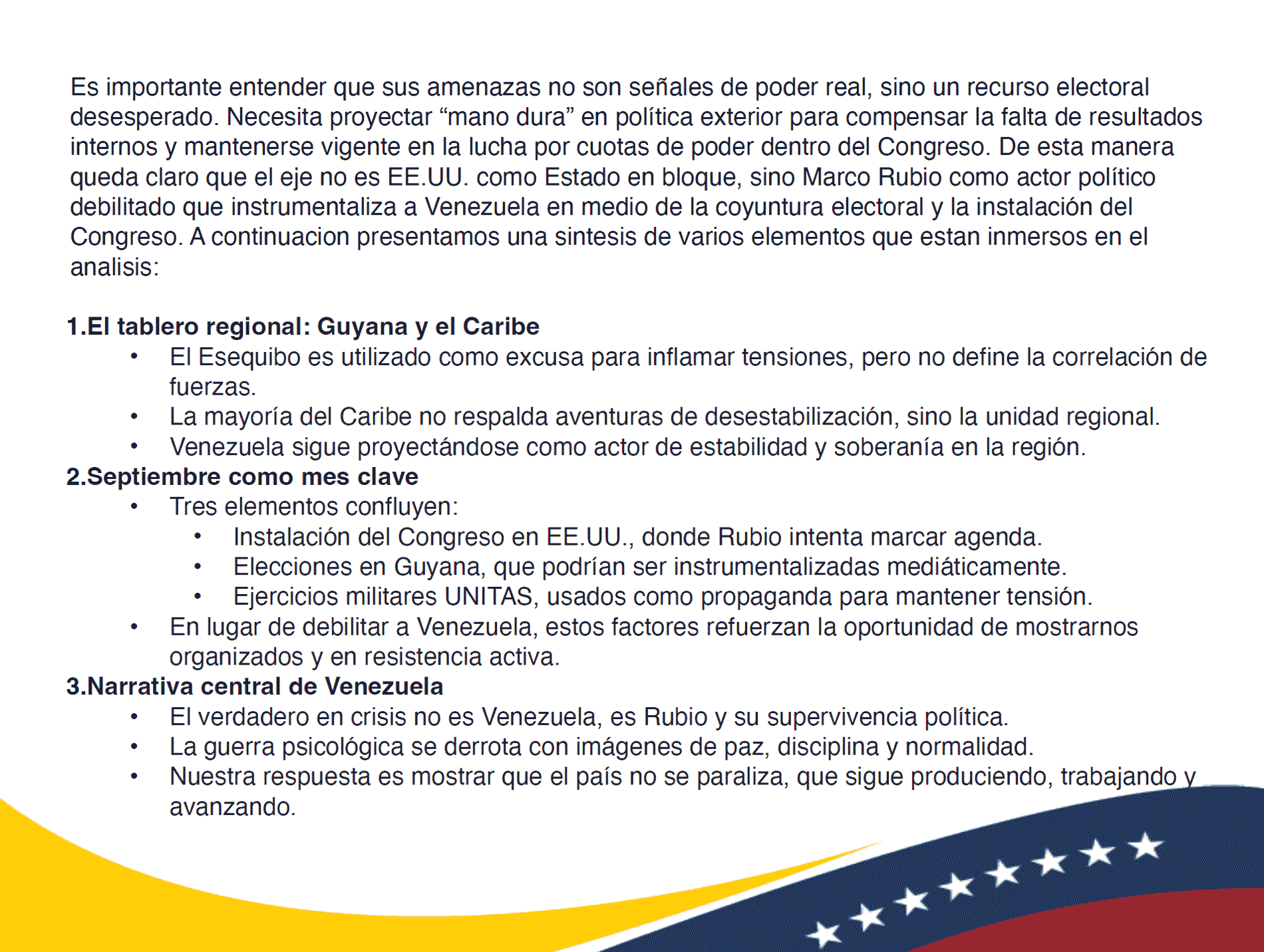
That same approach also appears laid out as an operational line in another playbook circulated through Siscom. In a presentation sent on August 26, ahead of the launch of the #YoMeAlisto campaign, it explains: “Psychological warfare is defeated with images of peace, discipline, and normality,” and “Our response is to show that the country does not grind to a halt, that it continues producing, working, and moving forward.”
Even more explicit was the exploitation of another New York Times article, published on November 26, 2025, which compiled criticisms from former diplomats, experts, and opposition figures regarding statements attributed to María Corina Machado. The article warns that, amid the Trump administration’s military deployment in the Caribbean, some voices fear that false claims are being exaggerated or disseminated to justify intervention, and mentions “debunked claims” on issues of drug trafficking and security.
The report also echoed propaganda lines included in government scripts that present the “war on drugs” as a pretext for continuing the escalation and militarization of the Caribbean. In the script sent on August 29, for example, one line appears particularly clear: “The Cartel of the Suns is a media fabrication to justify aggression,” along with others that maintain that the U.S. uses this framework to promote regime change and expand its presence in the region.
Screenshots of that New York Times article were quickly seized upon by a network of propaganda video creators. The campaign attempted to reinforce a line already present in Siscom documents: to discredit María Corina Machado, presenting her as a source of disinformation that is pushing the United States toward intervention. An opportune corollary to the more than 80 hoaxes and disinformation incidents directed against Machado from Maduro’s communications apparatus in 2024 and 2025.
Journalism in Venezuela operates in a hostile environment for the press, with dozens of legal instruments designed to punish speech, such as the laws “against hate,” “against fascism,” and “against the blockade.” This content was produced by journalists who are in Venezuela and is being published with full awareness of the threats and constraints that, as a result, have been imposed on the dissemination of information from within the country.
Caracas Chronicles is 100% reader-supported.
We’ve been able to hang on for 22 years in one of the craziest media landscapes in the world. We’ve seen different media outlets in Venezuela (and abroad) closing shop, something we’re looking to avoid at all costs. Your collaboration goes a long way in helping us weather the storm.
Donate