
Venezuelan Media Tries to Take Advantage of Limited Relief
Despite reluctance and mixed signals from within chavismo, the Rodríguez government has eased some pressure on journalists
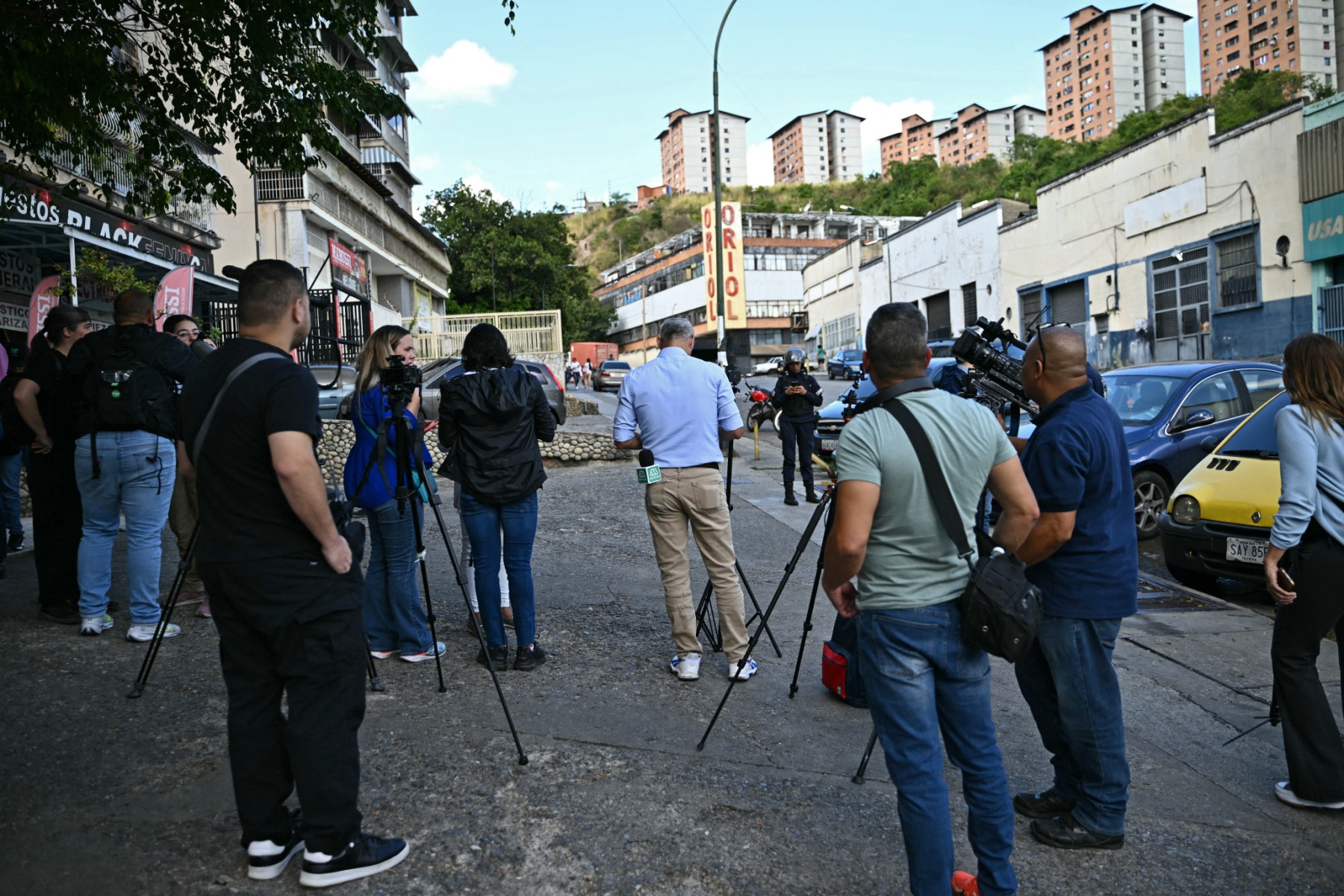
Journalists wait near the El Helicoide -a facility and prison owned by the Venezuelan government and used for both regular and political prisoners of the Bolivarian National Intelligence Service (SEBIN)- in Caracas on January 8, 2026. Venezuelan authorities are releasing a "large number" of prisoners, some of them foreigners, five days after US forces ousted authoritarian leader Nicolas Maduro, parliament speaker Jorge Rodriguez said on January 8. (Photo by Ronaldo SCHEMIDT / AFP)
Three months after the Maduro raid and the rise of Delcy Rodríguez as “caretaker president,” Venezuelan society has witnessed how those unexpected events have shaken up the country. One of the sectors most impacted has been the independent press, which in the aftermath of the 2024 presidential election was at a low point.
“Since January 3rd… we can do things or dare to do things that we couldn’t do until December of 2025”, according to Gaby Rojas, co-director of Tal Cual. “Working conditions opened up to a minimum, because before that, even doing reporting wasn’t possible as the risk was too high. That risk has now diminished but not disappeared”.
Luis Ernesto Blanco, Editorial Director of Runrunes, agrees with her and offers some specific details of how small changes have taken place: “We dare now to do coverage of demonstrations, joining families of political prisoners in their demand for justice, we start appearing in digital spaces showing our faces and signing the stories we write with our names. Our sources also started to talk, explain and demand again… However, all of that can be reversed at any moment.”
One of the questions raised after the so-called “Rodrigato” took over was the possible relationship between the Rodríguez siblings and Venezuelan media in general. Well, in the first days of March, there were a couple of small but notable events that hinted at the chance for a rapprochement coming from the State’s communicational hegemony.
First up, there’s the interview given by National Assembly President Jorge Rodríguez to journalist Luis Olavarrieta, in which he assured journalists that they can do their work now without any reprisals. Shortly after, independent outlets were allowed to cover Delcy Rodríguez’s meeting with US Interior Secretary Doug Burgum (but not without hassle) after many years of not being let in into Miraflores Palace.
“They are valuable gestures, but I don’t know if they are necessarily honest. But they are there and we have to take advantage of them not just to raise the political cost of any attempt to increase repression again, but because it’s the moment to make demands,” says Blanco.
Digital activists, human rights groups and media organizations are demanding that CONATEL lifts the blocking of more than 200 websites.
Rojas considers those gestures were done mostly out of necessity: “I see those more like actions that they (the government) have to do in order to safeguard their position. They’re neither deliberate nor unilateral. It’s pretty obvious that there are some disadvantageous conditions in the negotiation between the interim Venezuelan government and the US, in a situation marked by economic and political interests, landing in these actions that can be called gestures, actions that they have to do in order to demonstrate something”.
On March 13, there was another sign of the hegemony playing nice: a meeting took place between several representatives of the media (including press union SNTP and journalists’ guild CNP) with members of the Program for Peace and Co-existence, an internal dialogue initiative officially launched by Delcy Rodríguez back in late January.
Requests from the independent media included halting the persecution of journalists, allowing those with pending legal cases to be benefited under the Amnesty Law and more access to official sources. After a second meeting one week later, three working groups were established and will start discussions on related themes after Holy Week.
“The possibility that a group of journalists and independent media outlets could sit down with a group of vice-ministers was something quite rare and that stands out, not because it deserves praise but because too many years have passed where that channel (of communication) was completely broken”, Rojas (who attended the meeting, as well as Blanco) told Caracas Chronicles.
The laws are still there
But all of this was overshadowed by a recent proposal of a brand new register for digital outlets: a chavista influencer, Indira Urbaneja, member of the Program for Peace and Coexistence, considered that some “digital portals” were publishing “not quite actual” news and because their ownership is of unknown origin, this does not allow them to “assume responsibility.” Urbaneja called for a debate on this proposal.
The SNTP clearly rejected this proposal: “Demanding a mandatory register to digital outlets does not respond to any technical necessity, but to a logic of control. In the internet, where there’s no spectrum limitations, the imposing of registers or authorizations is equal to restricting who can exercise freedom of speech.”
Urbaneja’s proposal came out as a response to an earlier request from digital activists, human rights groups and media organizations to State telecom regulator CONATEL to lift the blocking of more than 200 websites (including many independent media outlets like El Pitazo, ArmandoInfo, Runrunes and others). Also, social media platform X remains mostly blocked in Venezuela since August 2024.
Rojas and Blanco agree that the blocking of websites can be solved quickly. As Blanco explains, “it doesn’t depend on modifying any law, decree, resolution or anything. It’s just a phone call to Internet operators to lift the blocking.” Rojas says that lifting it would immediately demonstrate true political will, as CONATEL is just an enforcer.
Mario Silva, host of the long-running TV show La Hojilla that has traditionally attacked media and opposition politicians, informed that his show would be reduced to only one hour.
Another point in common shared by many Venezuelan journalists is the need to dismantle the legal framework established by the State in recent years to curb freedom of speech. The SNTP has called for the derogation of the infamous Anti-Hate Law, passed in 2017, reforming the RESORTEME Law (which regulates radio, TV and all electronic media).
Rojas considers such a review should be made as soon as possible. Blanco believes certain factions within chavismo could resist: “It’s clear that there is both an interest to oppose giving concessions and pressure, especially from the US. On the subject of recovering freedom of speech, when it comes down to laws, I can imagine an internal struggle.”
Meanwhile, the interim government has made swift changes in the higher positions of its communication department. Miguel Pérez Pirela, one of the most well-known faces of State media, is the new information minister, while Enrique Quintana Sifontes is back as the director-general of CONATEL, a post he held between 2009 and 2018.
In the perspective of Rojas, these changes are secondary to something more important:
“Let’s talk about institutions again… the Communication and Information Ministry has a role which is neither to chase the media nor control access to information. Regardless of whoever holds the job, MinCI is doing a role that doesn’t suit its remit… in the case of CONATEL, it shouldn’t be just an enforcer of decisions coming from the government but a technical entity which is autonomous and subjected to other obligations.”
Another set of changes come from VTV, the main State broadcaster. Mario Silva, host of the long-running TV show La Hojilla, a traditional space to attack media and opposition politicians, informed that his show would be reduced to only one hour. Boris Castellanos, one of the main faces of VTV’s news, would leave the channel. Both said VTV is in the middle of major changes to its programming grid, while most shows still airing have leveled down their previous strident tone, according to Blanco.
“Journalism is not the enemy, it’s a legitimate exercise of asking questions that the country needs, without doubt, to listen,” Jorge Rodríguez told Luis Olavarrieta.
And then there’s Venevision, the biggest and oldest private TV channel in the country. In late January, VV’s newscast Noticias Venevisión covered the visit of opposition leader and 2025 Nobel Prize Winner María Corina Machado to Washington DC, including her meeting with Secretary of State Marco Rubio. Until a few weeks ago, for lack of a better word, this was inconceivable.
As retaliation, Venevisión was removed from both the Open Digital Television (TDA) and the FTA free-satellite TV platforms after Interior Minister Diosdado Cabello complained about this in his weekly VTV show Con El Mazo Dando. Yet later, Venevisión aired a live interview with María Oropeza, a member of Machado’s political party Vente Venezuela that had just been released from prison after 18 months. In recent days, Venevisión has covered the current electric emergency. One of those reports caused Ernesto Villegas, a former minister who presides over Delcy’s peace commission, to complain about the intentions behind this.
Interestingly enough, Villegas’ statement brings up this quote from Jorge Rodríguez’s interview with Luis Olavarrieta, where he discussed the “new political moment” that her sister Delcy coined after Maduro’s removal: “Journalism is not the enemy, it’s a legitimate exercise of asking questions that the country needs, without doubt, to listen.”
A chance to rebuild the public sphere?
Rojas offers some optimism wrapped in caution: “I have more than 20 years working in the media… and I think we have seen the process worsen to the level of suffocation, of throwing the towel, of saying there’s nothing left to do and despair that has been learned. But we also understood that we can’t abandon spaces and that’s necessary. Information isn’t a thing, it’s a fundamental social good to build a society.”
Blanco considers that “this is a chance that we cannot waste. If we have the chance to cover information without fearing for our safety and our freedom, if we can keep powers in check without the need to leave the country, it’s something important not only for journalists but also for audiences.”
Highly influential German philosopher Jürgen Habermas recently died at age 97, leaving behind his public sphere theory as one of the most important in communication studies. He believed private individuals are capable of forming public opinion, and that through discussion and debate, they can influence political representatives to address and solve problems.
Venezuelans saw first-hand the slow but steady erosion of our public sphere through the years because of a State that took away the means to be properly informed and hindered the work of those dedicated to do so. Citizens became less aware of not only what happened beyond their private spheres but unable to have their concerns heard.
It’s too early to say, but there’s now a slight possibility of building it back again.
Caracas Chronicles is 100% reader-supported.
We’ve been able to hang on for 22 years in one of the craziest media landscapes in the world. We’ve seen different media outlets in Venezuela (and abroad) closing shop, something we’re looking to avoid at all costs. Your collaboration goes a long way in helping us weather the storm.
Donate