
Nelson Garrido Saw What Venezuela Left Outside the Frame
The legendary photographer and contracultural shaman, who died on August 20, invoked the grotesque to question our myths
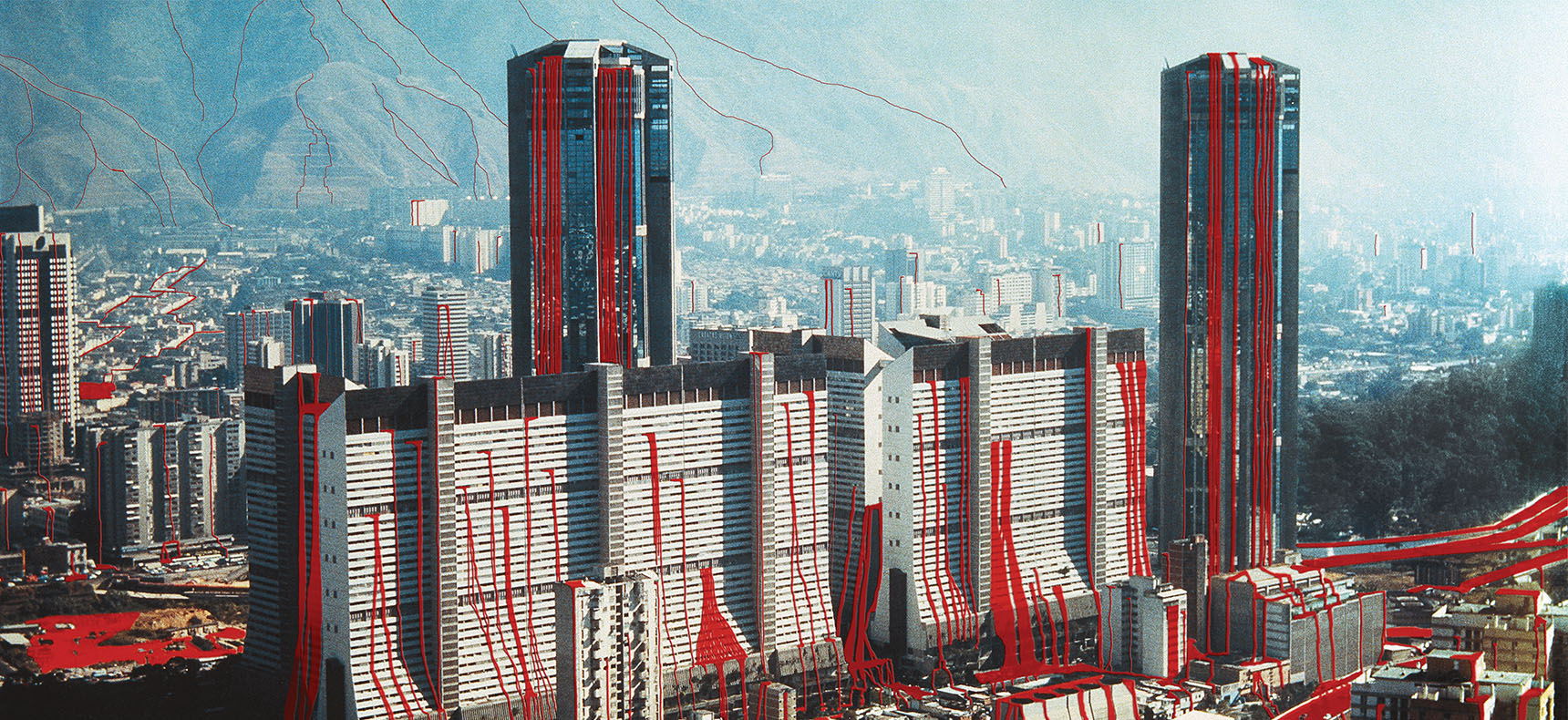
When you first glance at Nelson Garrido’s Caracas Sangrante (Bleeding Caracas, 1996, the photomontage featured above), the first thing you notice is the aerial view of the towers of Parque Central. Unlike in more familiar depictions, you don’t see the buildings from the front, but from their often-hidden backs, where the skyscrapers interact with older buildings and seem to emerge from the earth. Then, however, you notice the stains of red, dripping from the towers and spilling onto the highway, as if the modern buildings had mortally wounded their surroundings.
Garrido created this work as a sort of protest. He mentioned that the city of Caracas invited fellow photographers to submit their vision of the city. However, after seeing other artists submit images of macaws and parks, he was enraged. For him, the city at the moment was marked by questions of the crumbling project of modernity and, most importantly, violence. Later in his life, he reflected that this work served as a warning for the future of the country. In fact, that piece became a symbol of how the 1990s felt, and how those years were foretelling our 21st century.
Nelson Garrido unexpectedly died yesterday, shortly before his 74th birthday. In a post on X, his brother Víctor mentioned that Nelson’s health had rapidly deteriorated over the last three months. His death brings to a close a career devoted to showing the parts of Venezuelan reality that others preferred to keep outside the frame.
His work existed in a liminal space between Bosch’s Northern Renaissance excess and 20th-century punk, always questioning reality and forcing viewers to confront ideas that were often too uncomfortable to acknowledge.
Unafraid of the grotesque, the kitsch or the ugly, Garrido used them to expose the contradictions beneath the images Venezuela constructed of itself, developing what he called estética de lo feo. In that sense, Caracas Sangrante was, more than a warning, a testament to artistic purpose: to turn the camera toward what the postcard left out.
The Grotesque and The Sublime
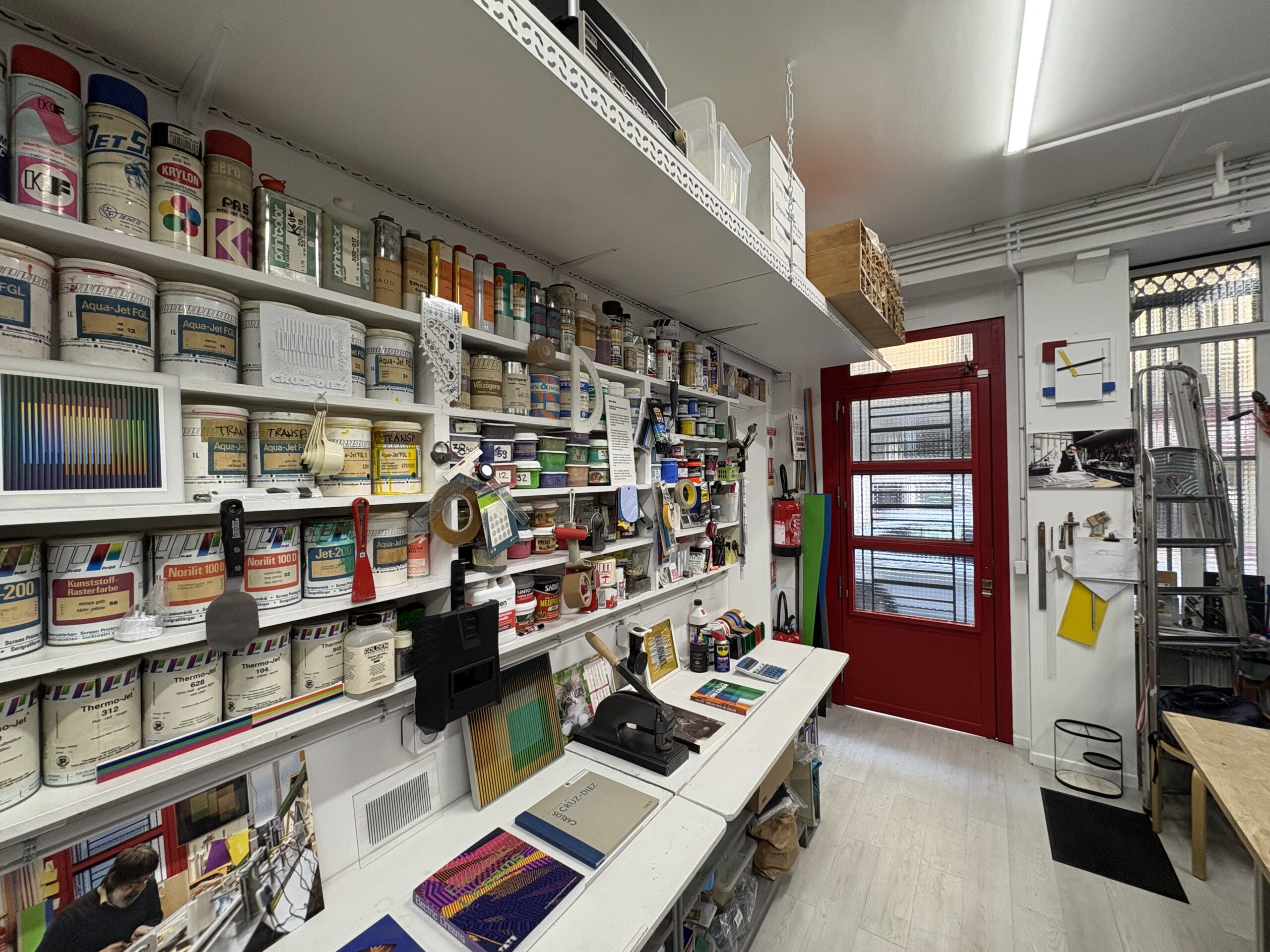
Born in Caracas in 1952, Garrido spent his youth outside of Venezuela, traveling between Italy, France and Chile, following his father’s work in diplomacy. He began to study architecture at the Central University in Caracas and graphic design at the Tecnológico Superior Sucre. However, he was always interested in photography; he recalled making blurry images with his dad’s camera when he was young. Yet, he started really learning the craft in 1966, during a brief residency at the Cruz-Diez atelier in Paris. For him, that experience was fundamental to his work as an artist. In an interview, he mentioned that, after Cruz-Diez told him to watch Buñuel’s movie Un Chien Andalou, he marveled at the juxtaposition of the grotesque and the sublime.
He recalled, for instance, that after seeing the movie, he recorded a home video with a Super 8 camera during a family trip to Pescara, in which he showed both a rabbit being killed and his family eating the rabbit. The project almost got him sent to a psychiatrist, but, for him, it was the beginning of his artistic vision. Ever since, his work combined elements that were not supposed to coexist: beauty and ugliness, religion and the carnivalesque, violence and humor, high art and kitsch. For instance, one of his first major series featured portraits of the decaying corpses of dogs on the side of the highway, like the one on the cover of rock band Sentimiento Muerto’s last album. Another featured grotesque images of the deaths of Catholic saints that were infused with violence and sometimes hints of dark humor.
As the country entered the Chávez era, Garrido’s attention increasingly turned toward the symbols, myths and political language being used to construct a new vision of the nation.
His work existed in a liminal space between Bosch’s Northern Renaissance excess and 20th-century punk, always questioning reality and forcing viewers to confront ideas that were often too uncomfortable to acknowledge.
Curiously, Garrido did not like working with cameras. He mentioned that he didn’t even like the idea of owning any. Instead, he would borrow one from his collaborators. For him, the art of creating was more akin to a performance, creating the characters and settings to convey his vision. A lot of his works, in fact, were made in studios, shifting away from trends in photography that aimed to capture reality outside of controlled elements. This is why he also didn’t like the terms “photographer” or “artist.” Instead, he defined himself as an “image creator.” Yet, and despite rejecting the moniker, he was the first photographer to win the National Prize in Fine Arts. His work was even featured in the Venice Architecture Biennale.
A professional dissident
Through the years, he became one of the leading figures of Venezuela’s counterculture. His work invited the country to look beyond its narratives about itself, particularly the constructed story of linear progress that defined much of the 20th century, and to recognize that alongside modernity there was also violence, decay and ugliness.

One of my favourite works by Garrido, in fact, exemplifies this. Miralda en La Carraca (2006) reimagines the classic Arturo Michelena painting by re-creating the image of the jaded freedom fighter remorsefully looking at the failure of his project. However, Garrido covers the floor with trash, adds religious figures and covers the wall with repetitive logos of mass-consumed products. Garrido takes solemn national mythology and contaminates it with the residuals of modernity, as if asking whether the narratives of modernity had collapsed while chavismo solidified its grip on the country.
Garrido’s questioning of Venezuela’s constructed narratives was not limited to its past. As the country entered the Chávez era, his attention increasingly turned toward the symbols, myths and political language being used to construct a new vision of the nation. Perhaps nowhere is this more evident than in Pensamiento único (Unique Thinking) (2008), where images ranging from a party meeting to a family portrait and a Miss Venezuela are saturated with chavista campaign materials. Central to the project is the use of Chávez masks on all the subjects. It’s equal parts dreamy, poignant and scary, and despite its fantastical elements, it feels inherently realistic.
Garrido’s “ONG” became a meeting point for photographers, artists and other members of the city’s counterculture. Younger creators used it to develop their own voices. The place operated uninterruptedly until 2022.
In a normal setting, the images depicted would showcase individuality. They would highlight the different members of a family, the different backgrounds that converge in community organizations and even the distinctiveness of a Miss Venezuela. But when they are covered in propaganda, and when every face is replaced by that of Chávez, audiences are invited to recognize his ubiquitous presence in Venezuelan political discourse, making the “unique thinking” of the title a literal phenomenon.
However, his contribution was not made with images alone. In 2002, he founded the Organización Nelson Garrido (ONG, a typical joke of his evident in the acronym) in his own home in Caracas, creating a space for photography workshops, exhibitions and experimentation outside more traditional artistic institutions. Over the years, the ONG became a meeting point for photographers, artists and other members of the city’s counterculture, particularly younger creators looking for a place to develop their own voices, and operated uninterruptedly until 2022.
Garrido’s death comes at a poignant moment in Venezuelan history. However, I think it also comes at one in which his legacy is more important than ever. As the country continues its uncertain transition, it’s imperative to look beyond the stories we tell ourselves about progress, linearity and modernity and to question who is left out of the picture, what contradictions we are missing and whether the buildings we are constructing are not dripping in blood.
Caracas Chronicles is 100% reader-supported.
We’ve been able to hang on for 22 years in one of the craziest media landscapes in the world. We’ve seen different media outlets in Venezuela (and abroad) closing shop, something we’re looking to avoid at all costs. Your collaboration goes a long way in helping us weather the storm.
Donate