
The Digital Operation Defending a Venezuelan Oligarch
Another inorganic social media campaign promotes Alejandro Betancourt (and Delcy) while attacking his critics, including María Corina Machado

Since early August 2026, several Venezuelan media outlets that have reported on businessman Alejandro Betancourt and his role at the helm of oil company North American Blue Energy Partners (NABEP) have faced attacks on X from a group of accounts defending his activities, praising Delcy Rodríguez’s administration, and disparaging María Corina Machado.
Hundreds of these responses came from inauthentic accounts that do not appear to be operated by regular users.
Cazadores de Fake News identified at least 75 such accounts on X, resembling trolls, whose activity led to 13 newly created websites posing as Venezuelan regional news outlets. On Instagram, another previously documented network of fake news accounts known as La Fábrica de Desinformación (“The Disinformation Factory”) has also published favorable content about Betancourt and his activities, acting as another front in the same communications strategy.
The analysis found that an influence operation in Betancourt’s favor began to be deployed in August, seeking to improve his reputation while discrediting journalistic coverage of the businessman amid his contacts with Rodríguez’s administration.
The operation remains active, and the number of accounts and fake outlets could grow.
Trolls attack Venezuelan media covering Betancourt
Beginning August 11, journalists and Venezuelan media outlets reported to Cazadores de Fake News that posts about Betancourt were receiving large numbers of hostile responses, sometimes insults, almost simultaneously. The accounts questioned the posts and defended the businessman.
Among those targeted were journalists and social media personalities like Germania Rodríguez Poleo, Norbey Marín, and Emmanuel Rincón, as well as Armando.info, El Pitazo, EVTV, VPI TV, and Spain’s El País. The same accounts also respond to other users discussing Betancourt and, in some cases, to unrelated news.
Under different headlines, the fake outlets reproduced only the favorable portions of the article that portrayed him as an intermediary for Washington.
Based on their behavior and attack patterns, Cazadores de Fake News considers them part of a troll network: a group of fake accounts covertly and selectively spreading propaganda in Betancourt’s favor without appearing automated.
The accounts mix attacks with memes, sports comments, and everyday posts, making them appear more like ordinary users. This allows them to intervene in and discredit legitimate conversations without immediately being recognized as propaganda.
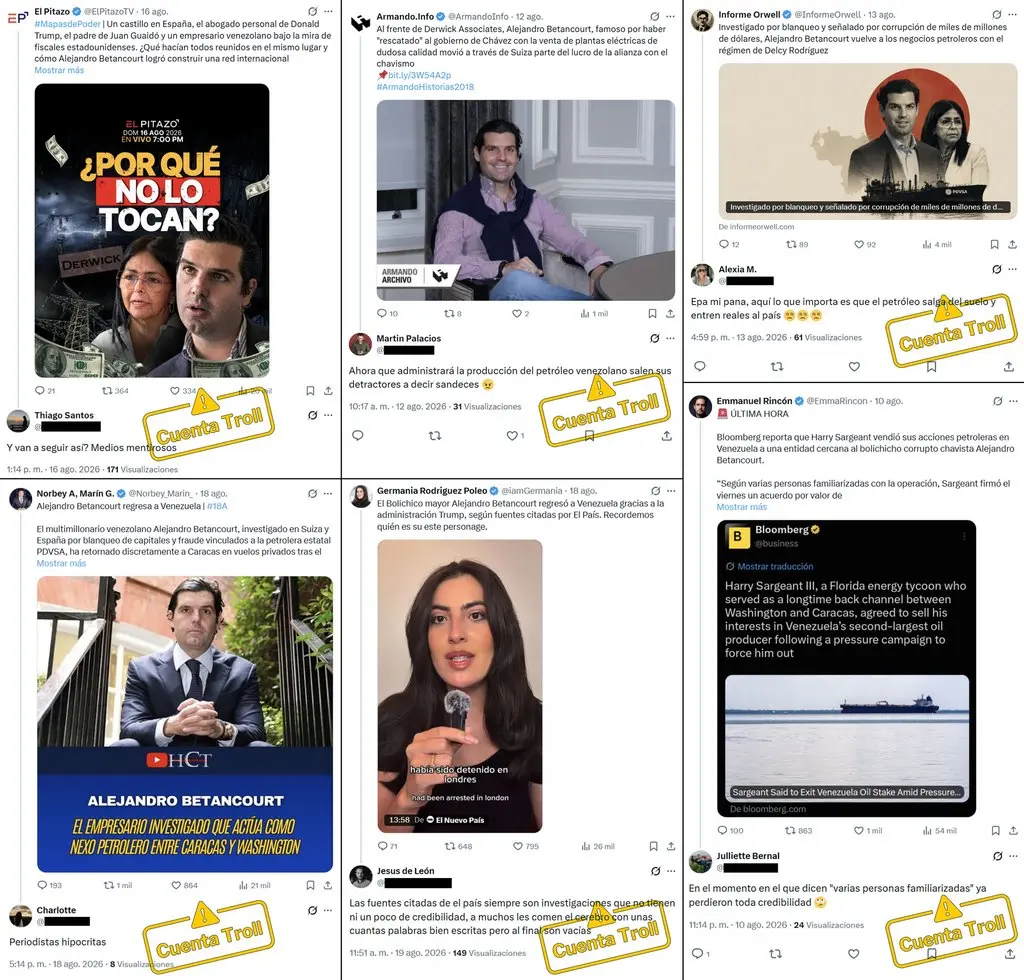
The network’s messages revolve around three main narratives. The first promotes and defends Betancourt and NABEP, the private oil company he leads and which operates Venezuelan fields under new concessions granted by the Rodríguez administration. The accounts portray the company’s activities as an opportunity for Venezuela’s economic development.
The second expresses optimism about Venezuela’s economy and, while celebrating Nicolás Maduro’s capture, simultaneously supports Rodríguez’s performance as acting president. The third, promoted less frequently, rejects Machado’s leadership of the Venezuelan opposition.
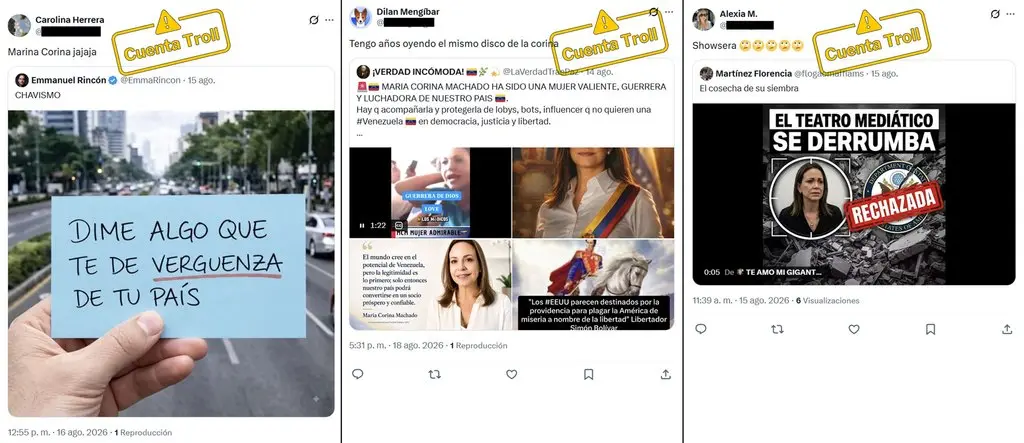
The 75 accounts fall into two groups: 62 that appear to be real people, with names, profile pictures, and short biographies, and 13 posing as news outlets.
The apparent personal accounts share a striking pattern: 61 were created between 2011 and 2015, with more than half created in 2013 or 2014.
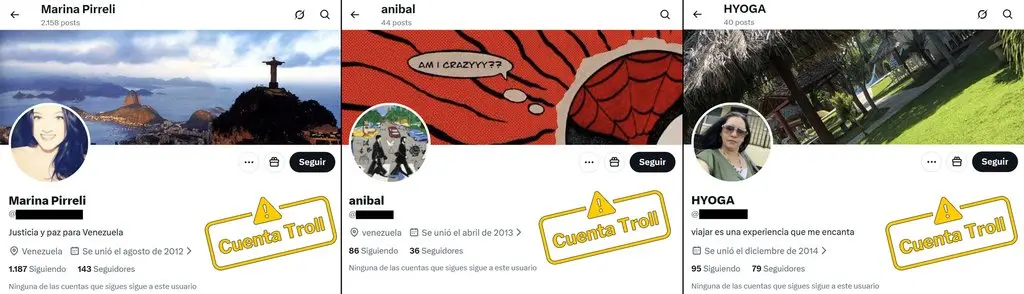
Most follow between 90 and 200 accounts, have 80 to 120 followers, and have fewer than 300 posts. Some have no posts predating August 2026, despite having been created more than a decade ago. Cazadores de Fake News considers it likely that the accounts were purchased in bulk, a common practice for giving inauthentic networks an appearance of age and avoiding newly created profiles that are more vulnerable to suspension under X’s platform-manipulation policies.
The other X accounts do not present themselves as individual users. Instead, they pose as Venezuelan news outlets with generic names. As of August 19, 13 such accounts had been identified.
Several accounts posing as individuals have posted favorable comments beneath the fake outlets’ posts, creating the appearance of organic approval. Legitimate X users could interpret these exchanges as genuine conversations, even though both sides belong to the same network.
Twelve of the fake news profiles were created between January 2024 and July 2026 and have already accumulated between 5,681 and 18,900 followers. Yet none has published more than 157 posts. Their coverage repeatedly advances the same narratives as the accounts posing as individuals: favorable coverage of Betancourt and NABEP, support for Rodríguez, and attacks on Machado.
The operation extends beyond X. Almost all of the fake outlets link to websites using the same name as their X profiles. The sites are designed to resemble legitimate Venezuelan digital media, with sections for politics, crime, business, sports, and regional news.
Under Maduro, Cazadores documented similar campaigns favoring other Venezuelan oligarchs and their businesses, such as Alex Saab (2020) and José Simón Elarba (2026), the owner of waste-management company Fospuca.
The 13 domains were registered between July 26 and 27 using the same hosting provider, about a week before the coordinated X activity began. All operate on WordPress, and none has a contact page, editorial team, legal notice, advertising, or audience-measurement tools. In several cases, the same image appears on four or five different sites.
One of the clearest examples was the coordinated amplification of a Bloomberg article about Betancourt published August 17. The fake outlets reproduced, under different headlines, only the favorable portions of the article that portrayed him as an intermediary for Washington. They omitted other details mentioned by Bloomberg, including financial sanctions imposed in the United States on one of his partners and allegations involving the supply of power-generation equipment in Venezuela.
Content supporting the same narratives was also published by five fake news accounts and one influential account belonging to La Fábrica de Desinformación, a network of anonymous Instagram news accounts aimed at opposition audiences that Cazadores de Fake News has documented since 2020 as a recurring source of disinformation and pro-government propaganda.
Digital reputation operations benefiting businessmen linked to political power were a recurring feature under Nicolás Maduro. Cazadores de Fake News documented one deployed in favor of Alex Saab beginning in 2020, and in May 2026 identified a network of inauthentic accounts that attacked media outlets investigating José Simón Elarba while praising Fospuca, his company.
The evidence documented here indicates that such operations continue under Rodríguez’s administration.
Who commissioned the operation and how it was financed remain unanswered questions. What is documented is that, in four weeks, someone purchased dozens of old accounts, registered 13 domains, and activated six profiles from a previously exposed network—all serving the same purpose.
Caracas Chronicles is 100% reader-supported.
We’ve been able to hang on for 22 years in one of the craziest media landscapes in the world. We’ve seen different media outlets in Venezuela (and abroad) closing shop, something we’re looking to avoid at all costs. Your collaboration goes a long way in helping us weather the storm.
Donate