
Changing the Government Won't Be Enough in Venezuela
The transition’s stakeholders won’t secure democracy by simply replacing the people in power
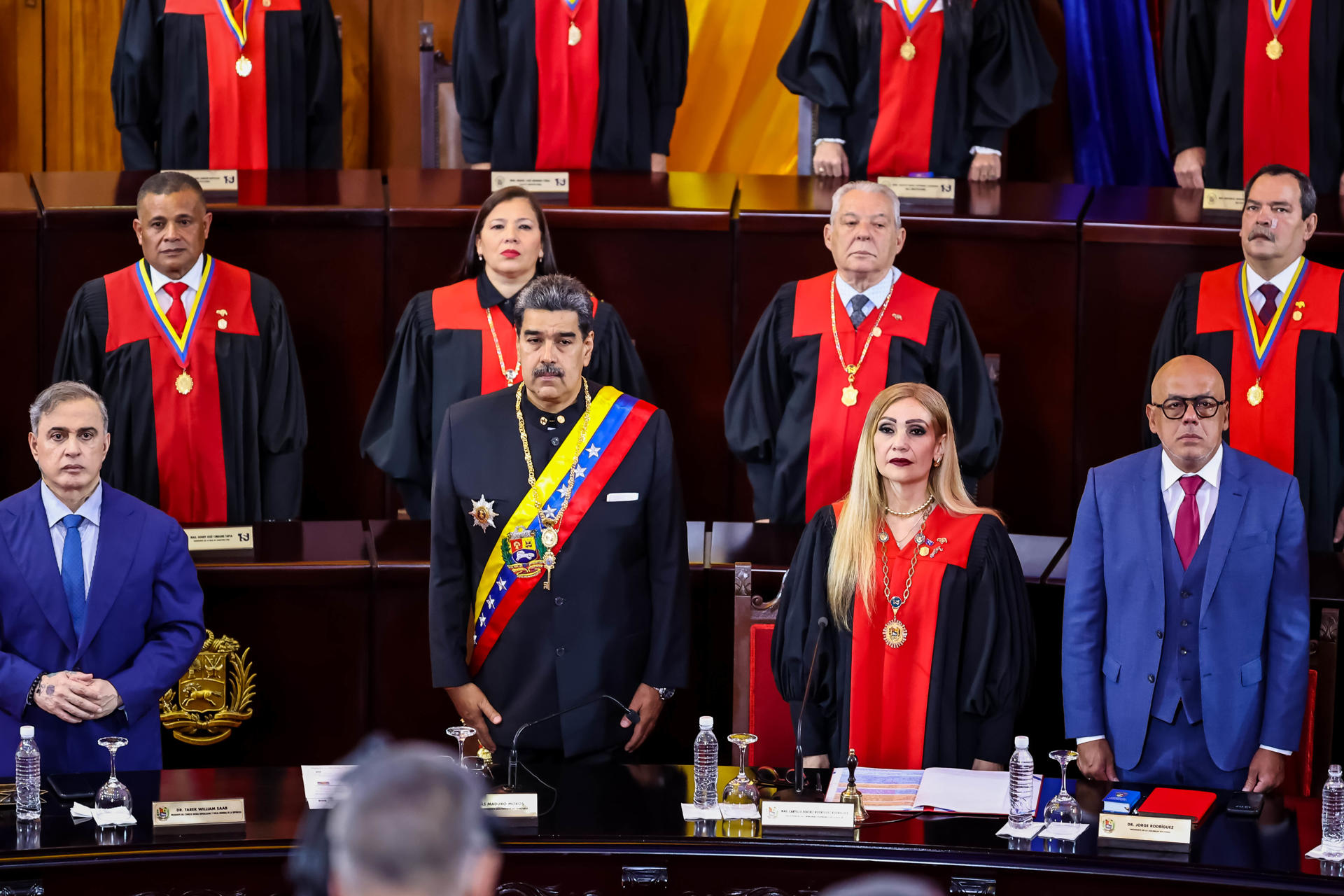
Fotografía de archivo del presidente de Venezuela, Nicolas Maduro, la presidenta del tribunal supremo de justicia Caryslia Rodriguez y el presidente de la asamblea nacional, Jorge Rodriguez (d). EFE/ Miguel Gutiérrez
For the first time in years, Venezuela is discussing institutional change as something more concrete than an opposition demand. The talks between the two National Assemblies have embraced the problem of the Supreme Tribunal of Justice (TSJ), with the electoral authority next in line. New magistrates, new CNE rectors, new elections: after decades of institutional capture, replacing the people who run these bodies is obviously necessary.
The danger is believing it will be enough.
Venezuela has spent the last quarter of century demonstrating that its democratic decline cannot be reduced to bad people occupying important offices. Chavismo did not merely place loyalists inside the State. It gradually transformed the relationships between institutions so that political power could survive electoral setbacks.
The clearest example came after 2015. When the opposition won a two-thirds majority in the National Assembly, chavismo did not accept that voters had changed the institutional balance of the country. The TSJ then progressively neutralized the newly elected Assembly. When that was no longer enough, the government created a Constituent Assembly capable of bypassing it altogether.
This adaptability matters for the transition now being negotiated.
Chavismo’s institutional principle has never really been presidentialism. It has been simpler: power should remain wherever chavismo remains.
Venezuela is extraordinarily centralized, and there is good reason to believe that no political project can govern effectively without controlling the presidency. But it would be a mistake to assume that the presidency will remain as powerful after chavismo loses it as it was while chavismo controlled the rest of the State.
A democratic president facing a chavista supermajority in the National Assembly and a hostile Supreme Court could discover rather quickly that Venezuela’s supposedly omnipotent presidency is considerably less omnipotent than advertised.
Chavismo’s institutional principle has never really been presidentialism. It has been simpler: power should remain wherever chavismo remains. That is why replacing the people at the top of Venezuela’s institutions is only the beginning of reinstitutionalization.
We have tried this before
The CNE should make us particularly cautious.
In 2021, Roberto Picón and Enrique Márquez joined an electoral board that was widely regarded as the most balanced Venezuela had seen in years. Both pushed for meaningful improvements, and international observers recognized that the new composition produced a better electoral environment than the one that preceded it. The Carter Center described the board as “less unbalanced,” while still documenting structural problems surrounding electoral competition.
The episode demonstrated the limits of solving institutional problems through personnel alone. An election is not defined solely by what five CNE rectors do on election night. It also depends on who can register to vote, which candidates can run, whether parties can organize, how public resources are used, what media can report, what security forces do, and which court ultimately resolves a dispute.
Barinas provided the almost perfect illustration. After the 2021 gubernatorial election, the TSJ intervened while the vote was still being resolved, invoked a political disqualification against the opposition candidate and ordered the election repeated. Picón and Márquez publicly dissented. The independent rectors were there. The larger machinery around them remained capable of overruling the political meaning of the vote.
A good rector can behave honorably inside a bad system. The same is true of judges.
“Non-repetition” cannot mean guaranteeing that chavismo disappears from Venezuelan politics.
Replacing the current Supreme Court with independent jurists would be an enormous democratic achievement. Even so, courts lack enforcement mechanisms for a reason, meaning that the armed forces or the police could ignore their rulings, or that, as chavismo has already done, the president du jour could resort to the military court system. But Venezuela should also be asking whether a future court should retain all the powers that chavismo accumulated and exploited through it.
Otherwise, the transition risks producing institutions that are safe only for as long as good people control them.
That is not institutional reform. It is institutional trust.
And democracies are supposed to require less of it.
Political scientist Guillermo O’Donnell made this distinction precisely when he wrote about the weakness of “horizontal accountability” in Latin American democracies. Elections determine who governs, but democracy also requires institutions capable of restraining those winners once they do. A president who receives millions of votes is still bound by courts, legislatures, and rules that do not derive their legitimacy from his personal mandate.
Venezuela inverted that principle. Institutions increasingly became instruments for preserving whoever already controlled them. Changing their occupants without changing that logic would leave the central vulnerability untouched.
What non-repetition actually means
This is where the transition needs a more demanding definition of success. “Non-repetition” cannot mean guaranteeing that chavismo disappears from Venezuelan politics.
A democratic Venezuela should permit a chavista party to reorganize, contest elections and, if voters choose it again someday, return to government. Democracy cannot mean competitive elections until the people we dislike win one.
Nor does democratic consolidation require Venezuela to eliminate every trace of authoritarian nostalgia. Spain still contains defenders of Franco. Chile still contains defenders of Pinochet. Their democratic success is not that those political traditions vanished, but that political competition became overwhelmingly organized around institutions that survived changes of government.
Nicaragua, on the other hand, demonstrates what happens when that consolidation remains incomplete.
The Sandinistas lost the 1990 election and surrendered the presidency. Daniel Ortega remained in politics, competed repeatedly, and eventually returned through elections in 2006. This democratic failure was certainly exacerbated when Nicaragua’s institutions proved unable to stop Ortega from progressively dismantling the democratic constraints that had made his return possible in the first place. Research on Nicaragua’s backsliding traces how electoral rules, courts and other institutions were gradually eroded on the road back to authoritarianism.
If judicial independence depends on always selecting virtuous magistrates, the judiciary has not been fixed.
That is the warning Venezuela should take seriously.
Non-repetition does not mean ensuring that Venezuelans never again elect someone with authoritarian instincts. It means building institutions capable of surviving when they do. And that standard has an uncomfortable implication for whoever eventually replaces chavismo.
The next democratic government should not ask only which powers it needs in order to govern. It should ask whether it would be comfortable leaving those same powers to its worst political adversary. That is the test that should apply to the new TSJ, the new CNE and eventually every institution rebuilt during the transition.
If electoral integrity depends on always appointing five excellent rectors, the electoral system has not been fixed. If judicial independence depends on always selecting virtuous magistrates, the judiciary has not been fixed. If the survival of democracy depends on trusting whoever occupies Miraflores, Venezuela has learned very little from the last twenty-five years.
The current negotiations can replace officials. They can make credible elections possible again. They can remove some of the people who converted public institutions into instruments of political control. All of that is necessary. But Venezuela’s democratic challenge will not be solved by transferring those instruments to new hands.
The institutions being negotiated today should be designed not merely to produce the next democratic government, but to survive the next authoritarian one. Otherwise, Venezuela may succeed in changing who holds power without changing what power allows them to do.
Caracas Chronicles is 100% reader-supported.
We’ve been able to hang on for 22 years in one of the craziest media landscapes in the world. We’ve seen different media outlets in Venezuela (and abroad) closing shop, something we’re looking to avoid at all costs. Your collaboration goes a long way in helping us weather the storm.
Donate