How US–Venezuela Military Cooperation Looks Like
Security analyst Daniel Blanco discusses the US role in reshaping the FANB, strikes against the ELN, and the covert mechanics behind Machado’s return
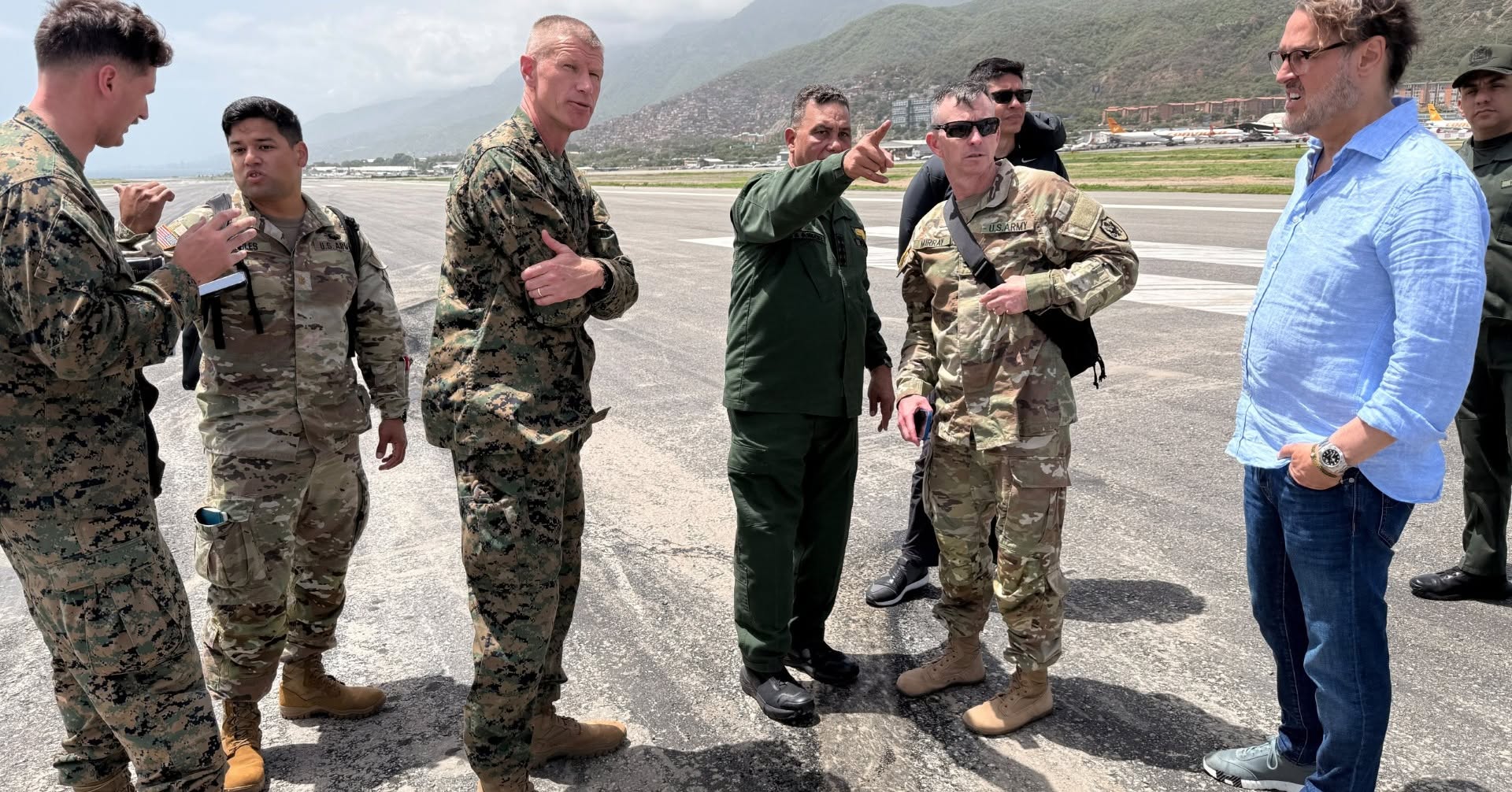
After the earthquakes, Defence Minister Gustavo González López and former Foreign Minister Félix Plasencia stand alongside Maj. Gen. Kevin Jarrard and other US military officers. US personnel then gained access to Maiquetía’s control tower and operations. Source: US Southern Command.
How are the National Bolivarian Armed Forces (FANB) and the rest of the security apparatus actually changing? Both publicly and behind closed doors, a military institution forged in Hugo Chávez’s operational doctrine and hardened under Nicolás Maduro’s governance of patronage, corruption and systemic repression is now actively coordinating with the foreign force that entered national territory on January 3, inflicted heavy casualties across the FANB (predominantly among young service members) and captured the man they answered to as Commander-in-Chief.
The recent news cycle offers hints of how this military cooperation is taking shape in the bilateral Caracas–Washington relationship. On Tuesday, November 3, The New York Times reported that the Trump administration is seeking to lay the groundwork for US military forces to operate and establish a footprint inside Venezuela. Days earlier, local human rights group FundaRedes reported a lethal FANB offensive against the National Liberation Army (ELN) in Apure state, which was reportedly mirrored shortly after in a mining zone in western Bolívar state. Sources cited by the Times noted that the Apure operation was conducted with direct US intelligence and drone assets.
Daniel Blanco, until recently an intelligence analyst at the UK-based risk consultancy Grey Dynamics, has published extensive assessments on military operations, armed groups, and geopolitical dynamics across Latin America, Africa, Ukraine, and the Middle East. He was on the ground in Venezuela earlier this year, observing firsthand the progress made in the post-Maduro phase and the significant operational friction that lies ahead. We sat down with him to discuss whether the nation’s political shifts are penetrating the least visible layer of power: the interior of the barracks, the orders currently being issued, and the practices that have quietly ceased.
At an operational level, where do you see the actual footprint and decision-making power of the United States within Venezuelan security agencies, the Armed Forces, and territorial control?
Ever since the capture and extraction of Nicolás Maduro in early January, we have seen consistent operational indicators suggesting that US tutelage over the Venezuelan Armed Forces is being channeled through a Train, Advise, and Assist (TAA) framework. This model of military cooperation can span everything from instructional training and doctrinal advising to joint operational planning, tactical intelligence sharing, logistics, and inter-unit synchronization, without necessarily requiring US forces to assume direct command of field operations.
A clear precedent was seen in the deployments following this year’s Vargas earthquake, when US Special Forces operated alongside the Venezuelan Military Police and maintained a temporary operational presence at Maiquetía International Airport.
Is the FANB genuinely falling in line under the command of Gustavo González López? From your perspective, what has structurally changed—and what hasn’t—since January 3 and the departure of Vladimir Padrino López?
Armed forces and intelligence apparatuses anywhere in the world can be compared to massive cargo ships: changing their heading takes considerable time, regardless of the immediate intentions of those at the helm. That said, just because broad strategic reorganizations or wide-scale shifts are not immediately visible in public discourse does not mean that tactical-level refinements are not already underway. These improvements have already yielded concrete results, such as the tactical neutralization of Niño Guerrero.
President Trump announced that alleged elimination of Niño Guerrero, which many presume was directly carried out by US assets. Yet irregular groups still exert tight control over Venezuelan gold. What is your read on Washington’s posture toward southern Venezuela, given its strategic interest in Bolívar’s mineral reserves?
The United States has an undeniable strategic interest in stabilizing the Orinoco Mining Arc. Establishing security across the region not only cuts down overarching security expenditures, but also clears the path to scale up industrial mining operations on the ground. You cannot train, employ, and professionalize a local workforce if civilians wake up every morning having to navigate extortion payments to sindicatos (local criminal networks) or dodge anti-personnel landmines planted along transit routes by guerrilla fronts from Colombia.
What can we expect from joint or coordinated FANB operations against the ELN and FARC dissident factions in conjunction with the US and Colombia?
We will likely continue to observe the “Hunter-Killer” framework previously deployed in Bolívar. In this operational model, specialized intelligence units from the Venezuelan Ministry of Defense supply actionable, real-time target data to the US, which then carries out precision kinetic strikes using unmanned aerial platforms, such as Reaper or Predator drones. It is a structure designed to cleanly target acquisition and tracking from the physical execution of the strike.
Reports indicate that military forces struck an ELN encampment with drones along the Apure–Colombia border on Friday, October 31, leaving about 20 dead and numerous wounded. The following day, FundaRedes reported another offensive in the Los Pijiguaos mining area in Bolívar state, near bauxite storage hubs—reportedly also involving loitering munitions or explosive drones. Do these maneuvers signal an institutional break in how the FANB approaches what was historically a local partner? Could the kinetic phase have been physically executed by the US?
If these events were indeed kinetic strikes carried out by unmanned aerial platforms, we have to assume the strikes were physically executed by Washington. Caracas currently lacks long-range, armed unmanned combat aerial systems. However, we cannot entirely rule out that the Venezuelan Air Force deployed conventional airframes delivering standard air-to-ground ordnance in Apure.
Why do you think there has been almost total official radio silence around these recent border maneuvers, while the operation against Niño Guerrero was an immediate media event championed by both Delcy Rodríguez and Donald Trump? Does that discrepancy surprise you?
Because they represent completely different operational tiers and tactical doctrines. The strike in Bolívar was a localized tactical engagement designed to win an immediate firefight; it did not require strict Operational Security (OPSEC). Apure, by contrast, points to a broader operational deployment aimed at sustaining a prolonged counter-insurgency campaign. That distinction explains the current silence: forces on the ground intend to sustain their pressure and cannot afford leaks that compromise intelligence sources, operational methodologies, or airborne assets.
Furthermore, this information blackout is actually an encouraging metric of the professionalization the Armed Forces could eventually achieve. In terms of maintaining OPSEC, moving away from theatrical parade formations and staged photo-ops of military brass is a positive step.
Weeks ago, there was heavy debate surrounding the return of María Corina Machado: whether it had US backing, and how much assistance came from the Colombian state. Venezuela’s borders remain notoriously porous, but Machado is one of the most recognizable figures in the country. To move her securely from Panama to Colombia and finally across the border into Venezuela, what role could the United States have realistically played?
There was unequivocally some degree of operational coordination, logistical assistance, and strategic communication between the US and Colombia during María Corina’s reentry into Venezuela. Without access to classified operational logs, I wouldn’t speculate on whether this was handled through intelligence liaison officers or via direct executive-level channels. What is indisputable is that the maneuver fits the definition of a Covert Action: a scenario where external state participation is inferred, but where the participating actors retain plausible deniability on the public stage.
How complex is it from a security standpoint to extract and insert a high-profile political leader into Venezuelan territory?
Very complex given the severe breakdown of law and order along the Colombian border. Throughout her transit, María Corina was directly exposed to multiple irregular armed groups controlling movement in that corridor. The operational footprint almost certainly incorporated passive surveillance or low-profile close protection details tasked with safeguarding her physical integrity and ensuring freedom of movement.
What practical security precautions would you recommend to journalists and civillians traveling to Venezuela under current conditions?
Security protocols depend heavily on the specific risk profile of the individual and the organization they represent. At a bare minimum, travelers should carry a dedicated burner work phone equipped with a local physical SIM card, scrubbed clean of personal social media accounts or banking access, and kept entirely isolated from their everyday personal devices to mitigate exposure to growing local cybercrime. Beyond that, individuals must maintain a low digital footprint—what we term personal OPSEC—to minimize trackable data traces that hostile actors, both inside and outside Venezuela, can harvest and weaponize.
Caracas Chronicles is 100% reader-supported.
We’ve been able to hang on for 22 years in one of the craziest media landscapes in the world. We’ve seen different media outlets in Venezuela (and abroad) closing shop, something we’re looking to avoid at all costs. Your collaboration goes a long way in helping us weather the storm.
Donate