


Javier Téllez: “We Must Learn from Madness”
The Venezuelan artist, recently awarded the Pérez Museum Miami’s annual prize, reflects in this conversation on categories of insanity and the richness of marginalized voices, shaped by their distinct ways of seeing reality

Almost 30 years have passed, and I remember it as if it happened yesterday; such was the impact it had on me. In a large space at the Museum of Fine Arts in Caracas, in 1996, the artist Javier Téllez (Valencia, Venezuela, 1969) recreated a ward from the Bárbula psychiatric hospital, which operated near the main campus of the University of Carabobo. There were cots, electroshock machines, diagrams, and the floor was littered with confetti as if a carnival party had just ended. It was his exhibition “The Extraction of the Stone of Madness”, a monumental reflection on the problems of the concept of insanity, and Téllez was invoking his experiences as the son of psychiatrists who witnessed patients and doctors exchanging roles in Bárbula, during the carnivals.
Since then, Téllez has continued to build a body of work across various media, primarily film, revolving around the mysteries, politics, and complexity of the many ways we perceive reality. His work abounds with the voices of those we don’t want to hear, such as the mentally ill and the immigrants. This is why the director of the Pérez Art Museum Miami (PAMM), Franklin Sirmans, celebrated his practice, which “expands the possibilities of empathy, dignity, and community,” when that city’s largest art museum awarded Téllez the 2025 Pérez Prize, an unrestricted $50,000 grant, on November 15.
In his 2007 film Letter on the Blind for the Use of Those Who See, Téllez revives the Indian fable of the blind men and the elephant, a powerful metaphor these times in which we insist on seeing as wholes what are merely fragments of our surroundings. In Caligari and the Sleepwalker, he sought out a classic of German Expressionism to explore perceptions in the present. In Amerika, made last year, eight Venezuelan migrants watched a series of Chaplin films and identified with the Tramp to recreate that aesthetic in a collective representation of migration. All of them had crossed the Darién Gap. “This carnivalesque element allows people to talk about their situation without directly confronting the trauma,” says Téllez.
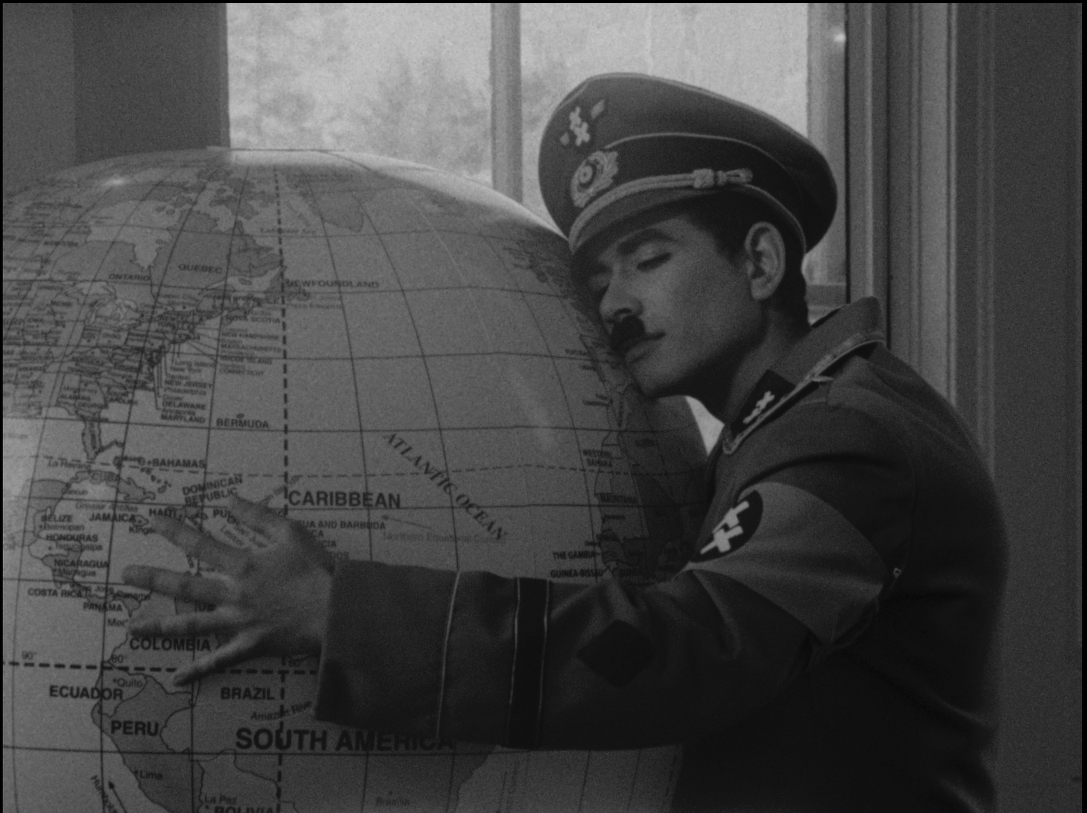
Single-channel video installation, 16mm transferred to 4K video, color and black-and-white, 5.1 surround sound.
Carpet, theater seating. 23:46 minutes. Variable dimensions.
Produced by the Center for Artistic Alliances (CARA), 2024. Installation view. Photo: Kris Graves.
Courtesy of the artist.
Téllez has participated in numerous artist residencies and has exhibited in many countries since the early 1990s. Besides film, he uses photography, artist’s books, installation, and sculpture. He has built aviaries and giant birds for his exhibitions that play with the anti-psychiatric novel One Flew Over the Cuckoo’s Nest, and in One Flew Over the Void (2005) he had the human cannonball David Smith fly from the US to Mexico over the border line, while patients at a psychiatric hospital in Mexicali played a march.
From New York City, Téllez talked to Caracas Chronicles about the purpose of his work.
How did your childhood and adolescence lead you to study art, to understand that you were an artist?
I was very fortunate to be born into a home with intellectual parents from very different cultural backgrounds. My parents, Teresa Pacheco Lugo and Pedro Téllez Carrasco, were psychiatrists. Our house contained the largest private library in the city, and there were books in every room. My father conducted his psychiatric consultations there. We grew up surrounded by patients, as we also visited the Bárbula Psychiatric Hospital, where he worked. This world was further enriched by our frequent visits to Turmero, where my aunts ran the Capitol Cinema, one of the first movie theaters in the country. I also saw films on the big screen before I learned to read. I think it was natural that, having been born into that environment, I decided from a very young age to dedicate my life to art, and especially to moving images and video installations.
For everyone else, “madness” is a category that associates danger, absurdity, and total marginalization with that “otherness” incarnated by psychiatric patients. But you were taught to see them differently.
Absolutely. The stigmatization of difference begins in childhood, and my siblings and I were immune to it from a young age, due to the liberal upbringing we received from our parents. The proximity, the familiarity we had with those considered “crazy” by society normalized mental illness and relativized the stability of the “normal” world. Our annual visits to the carnival held in Bárbula, where some patients and psychiatrists exchanged uniforms, were fundamental to this perception. The inversion of values that those carnivals represented is a memory that still stimulates my work as an artist. It’s no surprise, then, that today my older brother is a psychiatrist and that I work with psychiatric patients to pursue my artistic work.
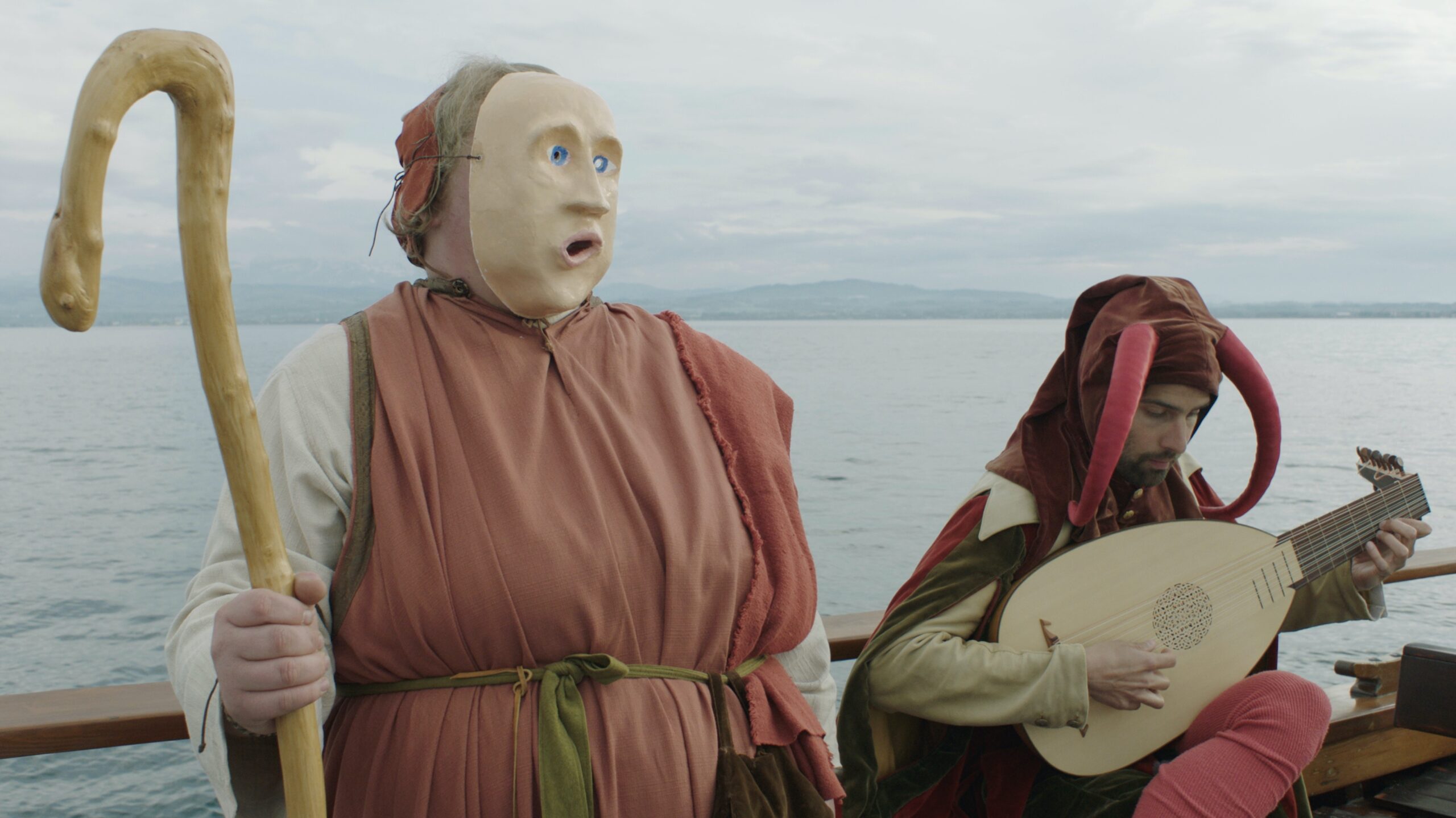
Single-channel video installation, 4K video, color, 5.1 surround sound. Variable dimensions.
Produced by Kunstmuseum Thurgau, Ittingen. Still image.
Courtesy of the artist.
In that small-town movie theater you had access to what ordinary moviegoers didn’t, to another kind of “otherness”: the machine behind the miracle. Am I to assume that this understanding of cinema as something that not only happens, but can be made, began there?
My passion for cinema began at the Capitol Cinema in Turmero. Having constant access to a cinema from the spectator’s point of view, but also being able to witness the spectacle behind the scenes and see the films projected from the projectionist’s booth, allowed me, from childhood, to dissect the components of the “cinematic apparatus” and understand cinema from its materiality. I remember the fascination I felt watching the stillness of the film frames, how they were “devoured” by the gigantic projector and activated by a blinding light capable of creating impossible universes. When I was nine or ten, my father gave me an 8mm camera, with which I made my first films. A little later, when I was barely 13, I bought a Super 8 camera, with which I made several surrealist films with my friends, which I edited on a small Moviola. I began studying the early 20th-century avant-garde movements and saw the films of Buñuel, Eisenstein, Vertov, Dreyer, Murnau, Vigo, and others for the first time. My first works at that time were drawings, collages, assemblages, and films.
In “The Extraction of the Stone of Madness” you offered a confluence of your explorations on media and on mental health. Which of those questions, issues, or themes continued in your later work?
The theme of mental illness is essential in my work; it is the thread that guides me through the labyrinth. The otherness inherent in madness permeates all my work. With “The Extraction of the Stone of Madness,” I began working with psychiatric institutions and discovered the importance of working in collaboration with people who had been diagnosed. I realized that it was impossible for me, who had never been diagnosed as mentally ill nor had I suffered institutionalization, to articulate a discourse on mental illness without the help of others who had experienced it. Since then, I have carried out more than twenty projects on mental illness in collaboration with patients in Asia, Europe, Australia, and the Americas. The questions are specific to each project, as they respond to unique situations defined by the individuals and their circumstances, but a group of questions emerges in almost every project: How is “normal” defined, and what is considered “pathological” or “abnormal,” and how do these definitions affect individuals? What does it mean to live with the stigma of mental illness or disability? Can society learn to exist inclusively, including those who have been marginalized for being different? These questions remain constant because they are fundamental to our society.
Every day we wake up to find a new incarnation of Ubu, that grotesque authoritarian king imagined by Alfred Jarry, be it Trump, Milei, Putin, or Maduro. We mustn’t confuse the paranoid madness of these individuals and the masses who follow them with the madness of the average citizen.
How has this work you describe, which explores and exposes the voices of psychiatric patients and questions the idea of normality and the representation of reality, helped you understand this golden age for those who create prefabricated realities and claim that everyone else is crazy?
In my video installations, I include the diverse voices of the participants, attempting to generate a collective voice that identifies those marginalized by their circumstances. I work with my collaborators—whether they are psychiatric patients, people with disabilities, or migrants seeking asylum—to develop fictional narratives akin to fables or myths, creating short films where they are also actors and can articulate a collective discourse that resists the hegemonic concepts with which some social groups try to mask reality. Undoubtedly, the 21st century presents us, as Guy Debord already warned, with a reality impossible to separate from the notion of spectacle. Every day we wake up to find a new incarnation of Ubu, that grotesque authoritarian king imagined by Alfred Jarry, be it Trump, Milei, Putin, or Maduro. We mustn’t confuse the paranoid madness of these individuals and the masses who follow them with the madness of the average citizen. It is from the latter that society can learn, for we must learn from madness.
To what extent can your work, or that of other artists with whom you identify, help to make sense of a reality that we feel we don’t understand… or at least make visible the meaninglessness, the nonsense of what they want to impose on us as meaning?
I have taken as my motto the definition of art given to us by Paul Klee: “art makes visible.” As visual artists we have an inescapable commitment to our reality, to the historical moment we are living through. I fervently believe that art has the power to change how we perceive reality and, therefore, can lead to its transformation. My generation, that emerged in the 1990s, has a critical view of the dominant power structures but also toward artistic discourses, and constantly questions the language of art. I view with dismay the output of many contemporary Venezuelan artists intent on resurrecting obsolete models. It is regrettable that the country’s meager art market continues to encourage geometric abstraction and landscape painting as defining genres of our visual identity. But fortunately, there is also the valuable work of some artists who have explored, through their art, the political and cultural context of our tragic reality after more than twenty-five years of chavismo. I hope that in the very near future these works will become better known outside the country.
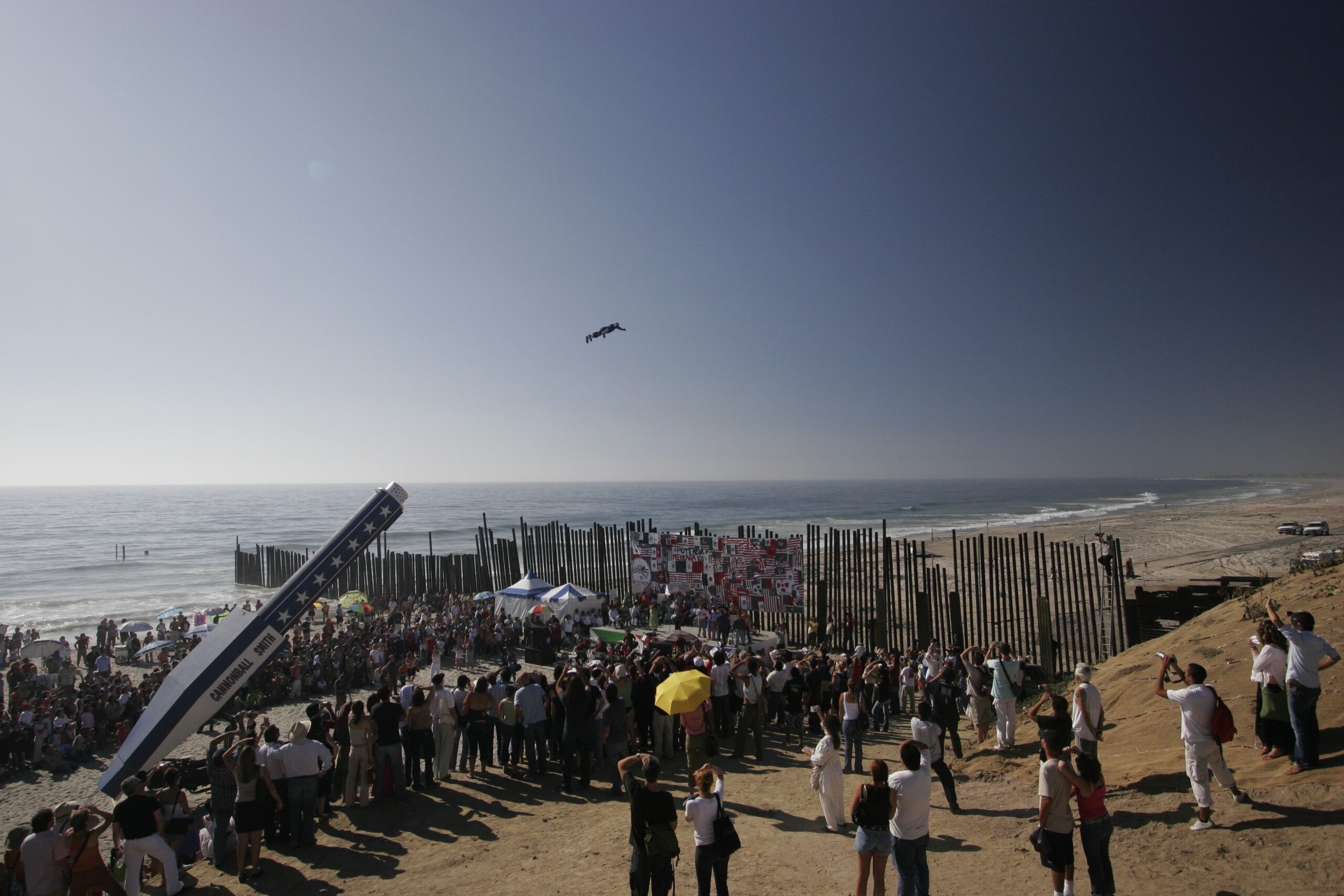
Single-channel video installation, HD video, 11 minutes. Variable dimensions.
Produced by INSITE 05, 2005. Still image.
Courtesy of the artist.
The US government, headed by a guy who came from reality TV, is threatening a dictatorship that invented a grand false narrative—the redemption of the poor—with its propaganda machine. Do you think it will become anything more than “good TV” featuring only extras dying at sea and being kidnapped in Venezuela?
This relationship between war, technology, and spectacle that you mention isn’t new; just remember the first Gulf War, the search for nonexistent “weapons of mass destruction” in Iraq, or the capture of Bin Laden. Our experience of armed conflict is increasingly affected by the media and technology, which irreversibly shape our vision and understanding of geopolitical conflicts. We are rapidly heading towards a new era that produces toxic wars as a spectacle, characterized by a sinister cocktail of paranoia, inequality, and authoritarianism, all seasoned by rampant technological development. It is true that the wars waged by empires resemble video games, but the dead in these conflicts are always real. In this case, the victims are Venezuelan, which should be even more unacceptable to us.
I believe it is regrettable that only chavismo and a minority of the opposition have denounced the deaths of the people aboard those boats, who were executed by the US military in a completely illegal manner without any proof of their guilt. The deaths of these people, like those who have died at the hands of the Maduro regime, should be outrageous regardless of one’s political stance. The right to life is the most fundamental and inherent right of all human beings. It’s disheartening to think of Venezuelans who dream of a US military intervention in Venezuela, because if this were to happen, it would be a profoundly tragic event for our country and the continent. It seems we haven’t learned anything from modern history and how lethal all US military interventions have been, from Vietnam to Iraq and Afghanistan. I firmly believe that the self-determination of peoples is essential. The worst thing that could happen to us is war.
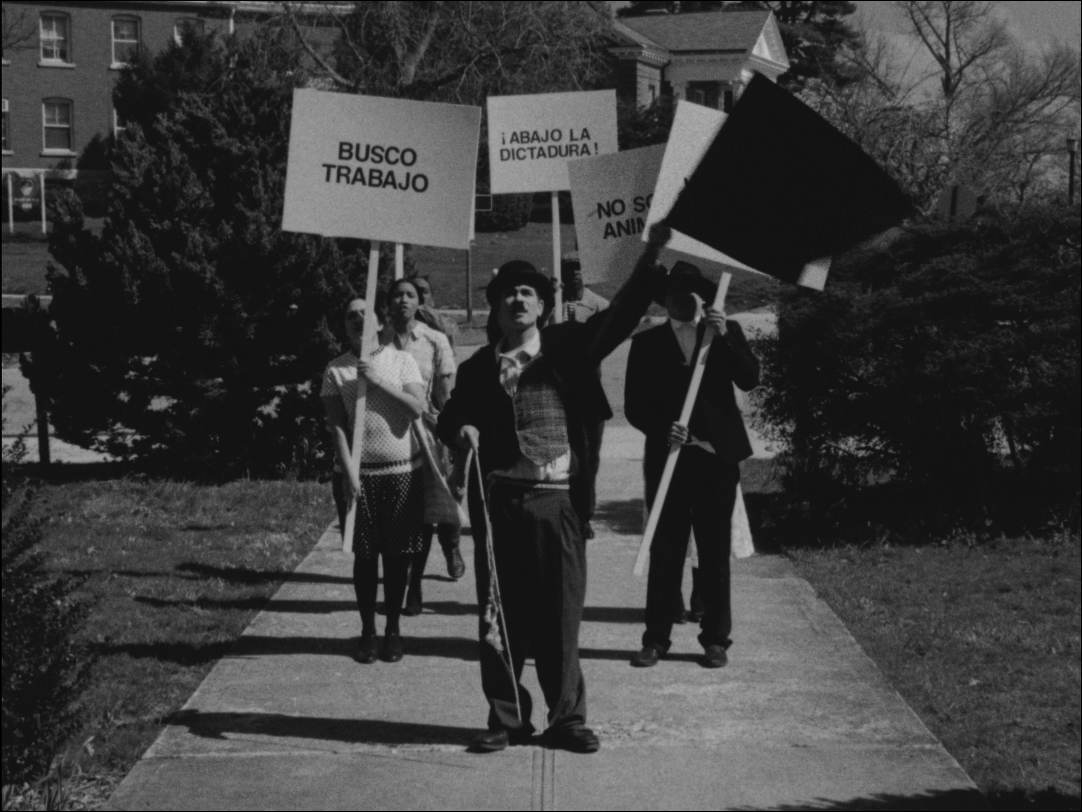
Single-channel video installation, 16mm transferred to 4K video, color and black-and-white, 5.1 surround sound.
Carpet, theater seating. 23:46 minutes. Variable dimensions.
Produced by the Center for Artistic Alliances (CARA), 2024. Installation view. Photo: Kris Graves.
Courtesy of the artist.
Caracas Chronicles is 100% reader-supported.
We’ve been able to hang on for 22 years in one of the craziest media landscapes in the world. We’ve seen different media outlets in Venezuela (and abroad) closing shop, something we’re looking to avoid at all costs. Your collaboration goes a long way in helping us weather the storm.
Donate

