
After the Venezuela Earthquakes, People Fight for Their Dead
Chaos, corruption and criminal negligence re-victimize the relatives of the thousands of victims
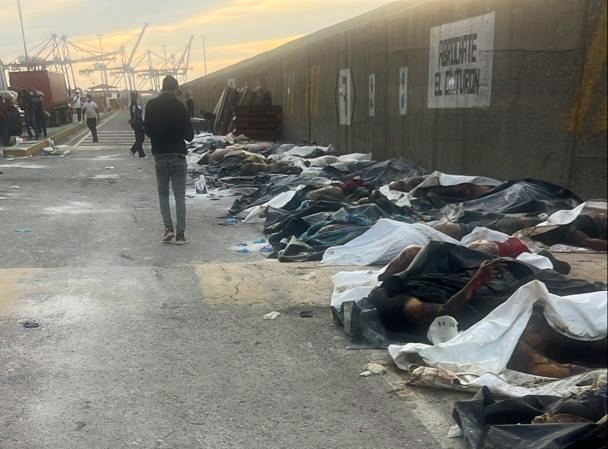
Photo: Efecto Cocuyo
(Photo by Efecto Cocuyo)
A pier in Venezuela’s main port, La Guaira, became an open-air morgue. They call it Los Silos because it holds some old silos, once painted by the famous Venezuelan artist Carlos Cruz Diez. In front of it is Casa Guipuzcoana, one of the most valuable vestiges of colonial architecture.
On June 29, five days after the twin earthquakes that toppled hundreds of buildings in this densely populated region of the Venezuelan coast, Los Silos is making another entry in the country’s history as a nightmare come true.
By the afternoon of June 29, about 150 bodies had accumulated in Los Silos, brought from places like Hospital Dr. José María Vargas, also known as Seguro Social de La Guaira, where images from the previous days had shown a backyard lined with corpses, some of them naked and mutilated.
There is more order in Los Silos, but it wasn’t a fully managed disaster theatre where each corpse was safely guarded in a black body bag or treated with dignity. There were just a few tents and tables for the pathologists. The soldiers, police agents, or firemen who brought the bodies had to leave them on the ground. Four mobile fridges were doing their best, but so many bodies, from people who in many cases perished five days ago, are decomposing fast in a region as hot as Florida.
In this video made by journalist Maryorin Mendez (the same one that few weeks ago covered the entire story of Victor Quero’s mother), we can see how the sea breeze ripples over the plastic bags or sheets covering the bodies, while by the national forensic service and the police process them, and the relatives wait to confirm the identity of the loved ones who didn’t survive the earthquakes.
Since then, more private help has come, and the State has deployed more resources to streamline the bureaucracy, which is already a heavy weight in normal circumstances when someone dies in Venezuela. But in La Guaira, the situation is just too difficult.
Los Silos is far from being the only site where one can assess the height to which the human cost of the earthquakes is rising.
It’s just the tip of an iceberg from hell: the violence of the seismic events plus the absence of the State combined to increase the difficulties of rescuing survivors and recovering bodies in the hours and days that have passed since San Juan’s unforgettable day.
The stench of decomposing bodies is flooding entire areas like Caraballeda, a nice neighborhood that was also severely hit in the 1999 landslides. This is because bodies are everywhere, rotting on the sidewalks, but especially amid the rubble of the houses and buildings that died with them.
Neither the Caribbean breeze nor the wind stirred by the US helicopters can dissipate the overwhelming odor rising from the thousands of victims. Nature, expressed in the form of two mighty earthquakes shaking the alluvial soil of Caracas and La Guaira, is innocent. The one culprit here is the regime that deliberately, criminally emptied the State of its capabilities.
Bodies as characters in a propaganda story
However, even in these conditions, the third chavista regime is repeating the same behavior of the first one with Hugo Chávez and the second with Nicolás Maduro: hiding what they can, lying about what they can’t hide, and deflecting toward others all the blame they deserve.
On June 27, Jorge Rodríguez said there were 1,430 dead and 3,238 injured. The following day, despite the images spreading worldwide of the extent of the devastation and the assessments from organizations like NASA, Delcy’s brother said that the dead were just 1,450… and the injured were less than the previous day: 3,150.
Those announcements came after the regime blocked access to La Guaira, enforced the use of access credentials for everyone trying to enter that state to help or to search for their relatives, and corralled foreign rescuers and correspondents into militarized incursions to certain zones. The propaganda operation to hide the magnitude of the disaster and distort the narrative into one where the regime that noticeably abandoned the population had begun.
On Monday, Rodriguez said that the death toll had risen to 1,719 and that the region’s health centers were attending to 5,034 injured at that moment. Even so, it was obvious how he was trying to downgrade the human cost. Just after the earthquakes, the US Geological Survey estimated that such a seismic event in such a densely populated area might kill between 10,000 and 100,000 people. Other estimations, based on an educated guess on what seems to be the survival rate in La Guaira versus the population density, are pointing to around 8,000 dead. The online resources trying to concentrate information are estimating that around 50,000 people are missing.
On Monday night, once videos and articles appeared in the global press where the foreign correspondents and Venezuelan journalists working for international media talked about the organizational chaos and the ire of the relatives against the authorities, the regime cancelled for 48 hours all access to La Guaira to the press, alleging “sanitary risk” and the need to reduce the noise to find survivors.
Those who remain in the ruins
As it happened with the dead from the 1999 landslides, it’s likely that we’ll never have a precise, reliable figure of how many people were killed by the earthquakes of June 2026 in Venezuela. It’s impossible to think that a government unable or unwilling to coordinate anything other than the arrival of foreign help could manage to record, cross-check, and audit hundreds of lists of victims, is going to produce a total this time. Especially when it’s a regime whose main features include the manipulation of reality.
Just as with the 1999 tragedy, we’ll have to complete the picture with oral history and art: novels, films, visual arts, songs.
Social media and reporting from the field are already feeding this new corpus of stories and images of a society that, once again, is grieving another mass loss in this chavista era that never ends.
Dozens of reels on Instagram show civilians unearthing the bodies of their loved ones, just in a few cases with the help of soldiers, police or professional rescuers. They are raging when the soldiers came only to take cars or TVs, and leave without helping them to recover corpses.
While foreign teams focus on salvaging the few survivors that might be trapped six days after the earthquakes, we are seeing more and more testimonials of people telling how the military and the police are there just to loot, or even block the attempt of people to dig for their dead. People say that soldiers and police are charging bribes of 450 dollars to deliver a body, or 2,000 dollars to allow the passage of heavy machinery to a site where rubble must be removed to uncover the dead.
There’s a story of a man who only found the severed arm of his daughter and went to bury it. Other people had to carry the corpses on bikes and cars to transport them to morgues or funeral homes. Volunteers abroad are posting instructions on how to purchase body bags and safety masks on Amazon.
As the last faint voices of the survivors grow scarce or cease under the rubble, the bad news spreads on social media and WhatsApp. You recognize the faces of people missing who are now reported dead. You start to hear from people you know who lost someone. One friend of mine living in Buenos Aires knew that her missing cousin was found alive in La Guaira, but his wife lost her legs and is in a critical condition, and their two children passed away. My sister-in-law in Caracas told my wife that a woman she knew from a yoga class died in Los Palos Grandes with her daughter. One friend asked for help to distribute the call for help for her two missing aunts and the day after they were found dead. Entire families have been erased. Dozens of children orphaned, or killed along with their parents.
We fear that many of the dead will be buried in mass graves or drowned forever under a sea of concrete, once the destroyed buildings are razed by bulldozers, and that their names, their fates, will stay as an unanswered question in the hearts of everyone who loved them. They might be swallowed by the sea, like some in 1999. They might disappear with no trace, like some that drowned in the Caribbean or were lost in the Darien Gap fleeing from the humanitarian emergency created by Maduro.
Once again, a tragedy increases the death toll for a nation forced to grieve year after year.
And the regime responsible is still there.
Caracas Chronicles is 100% reader-supported.
We’ve been able to hang on for 22 years in one of the craziest media landscapes in the world. We’ve seen different media outlets in Venezuela (and abroad) closing shop, something we’re looking to avoid at all costs. Your collaboration goes a long way in helping us weather the storm.
Donate