
Pragmatic Bipartisanship? The Two Faces of US Policy Toward Venezuela
The White House negotiates without Machado. Congress shields her legitimacy. What’s the strategy?
Washington does not have a single policy toward Venezuela. On the contrary, since January 3, it has shown two distinct tracks that, for now, avoid colliding. The first is executed by the White House—a pragmatic, gradual strategy willing to bring opposition figures beyond María Corina Machado and Edmundo González to the negotiating table. The second has been maintained by Congress since the removal of Nicolás Maduro, most recently taking the form of a bipartisan Senate resolution that insists both remain the legitimate leaders of the opposition. The real question here is not which of these two faces will prevail, but why it serves US interests for both to exist simultaneously.
The past week showed how the board is functioning. On August 1, Jorge Rodríguez and Dinorah Figuera initiated dialogue over the phone between Delcy Rodríguez’s “government” and the remnants of the 2015 National Assembly, with the Trump administration acting as sponsor. Four days later, the Senate resolution reaffirmed González as president-elect, aligned with the administration’s stated goal of free elections while recognizing the electoral illegitimacy of Delcy Rodríguez. Caught between these two approaches, Marco Rubio asked Venezuelans for patience (“months, not years”) regarding elections, while Democratic Representative Jonathan Jackson (who had traveled to Caracas in July with the House delegation) revealed that even within Congress, there is no single consensus on what the US should be doing in Venezuela. Still, the simple fact that a Democrat secured permission to travel with the delegation speaks volumes.
Two paths, one destination?
For the White House, Venezuela has ceased to be—if it ever fully was—a matter of democratic principles, morphing instead into an equation of stabilization: energy, migration, and hemispheric security. Secretary Rubio’s three phases lay this out frankly: economic stabilization, recovery and reconciliation, and transition. This sequence shifts US priorities from democratic ideals to transactional metrics.
The IMF mission making headway in Caracas, Energy Secretary Chris Wright’s focus on the oil sector, and Rubio’s comparisons to transitions that took “nearly three and a half years” in countries like Paraguay and Spain confirm that the White House is prepared to manage Venezuela’s political timeline in a gradual, controlled manner, avoiding disruptions that could impact oil prices. Congress, on the other hand, bears no such executive burden. It can afford to speak the language of principles because it doesn’t have to sit down and negotiate barrels or deadlines.
Shielding that stance in a bipartisan manner is, at its core, a way to ensure US tutelage over Venezuela survives beyond Trump.
The Trump administration excluded Machado and Edmundo González from the process launched on August 1, a fact both publicly confirmed while clarifying that they would not stand in its way. Their seats at the table were filled by Dinorah Figuera and a delegation from the 2015 National Assembly. While this group does not answer directly to Machado’s party, it comprises members of Primero Justicia and Voluntad Popular, two parties that have consistently backed Machado and González throughout.
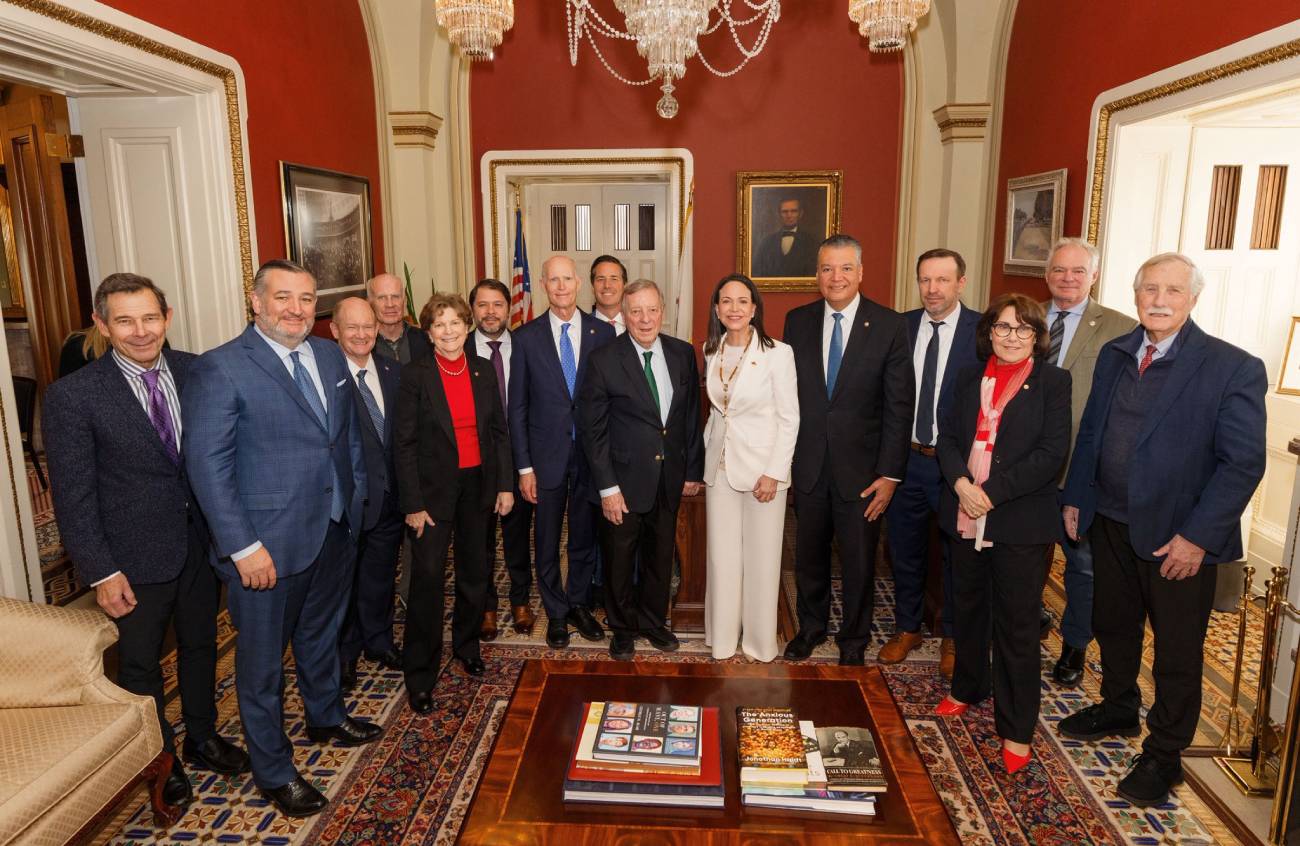
Meanwhile, the Senate resolution does the exact opposite: it explicitly names Machado and González as the legitimate leaders, describing Delcy Rodríguez as someone lacking an electoral mandate who would be unlikely to win a free election. It is a text that leaves no room for the ambiguity the White House grants itself.
Why this shift in signal? My first response would be that Congress—and particularly the Foreign Affairs committees in both chambers—operates under an institutional incentive distinct from Trump’s: surviving electoral cycles and administrative turnover. A resolution that anchors the recognition of legitimacy to Machado and González does not depend on who occupies the White House in 2029. Shielding that stance in a bipartisan manner is, at its core, a way to ensure US tutelage over Venezuela survives beyond Trump, even if the next occupant of the Oval Office chooses to change course.
Who are the players and what are their interests?
On the congressional chessboard, it is worth examining who the key players are—a crucial detail with the November midterm elections fast approaching.
In the Senate, the Foreign Relations Committee is chaired by Jim Risch (R), with Jeanne Shaheen (D) as ranking member. The Western Hemisphere Subcommittee is chaired by John Curtis (R) alongside Tim Kaine (D). Here lies the first key detail: Shaheen, the prominent Democratic voice who co-led the August 4 resolution with Ted Cruz (R), announced she will not seek reelection in 2026. She is retiring from Congress, but leaving this text as a legacy, which deprives Trump of a critical Democratic counterpart willing to apply public pressure.
Committee Chair Risch is on the ballot this November, while John Cornyn (a Republican who has been critical of Trump) is retiring, allowing him to adopt a harder line on foreign policy even when it diverges from the administration’s stance. Cruz, by contrast, does not face voters again until 2030, insulating him from immediate electoral pressures—making it no coincidence that he is leading the toughest resolution against the Delcy regime.
In the House, the Foreign Affairs Committee consists of over fifty members. It is chaired by Brian Mast (R), who led the July delegation to Caracas, with Gregory Meeks (D) as ranking member. The Western Hemisphere Subcommittee (which has served as the key House venue shaping the tone toward Venezuela) is chaired by María Elvira Salazar (R) with Joaquín Castro (D) as ranking member, alongside 13 other members (six Republicans and five Democrats).
A Congress with more elected Democrats, or with Republicans who survived tough races where voters demanded tangible results, will push harder to ensure the process unfolding in Venezuela moves beyond rhetoric.
All thirteen members are seeking reelection in 2026, meaning their moves leading up to November could either preserve Republican control of the committee or shift its leadership to the Democrats. Another detail worth noting is that Michael Lawler (R)—representing one of three Republican districts won by Kamala Harris in 2024—flirted for months with a run for New York governor before deciding in July to stay in his House seat to avoid risking the Republican majority. It is the same logic that kept Castro from running for the Senate in Texas. In a Congress where every seat matters, even figures with national ambitions end up staying put.
Another factor connecting the midterms directly to the Venezuelan community—particularly those in South Florida—is the special election in November to fill the remainder of the Senate term left vacant by Marco Rubio when he became Secretary of State. Given Florida’s demographic makeup, that seat cannot afford to be detached from US policy toward Venezuela. Furthermore, the seat will be up for election again in 2028, requiring anyone competing for it to keep their stance on Venezuela front and center.
Analyzing these congressional actors reveals that the pursuit of bipartisanship on Venezuela—a staple of foreign policy since 2014—appears to be a mechanism for institutionalizing US tutelage, regardless of who occupies the Oval Office. What could change (and likely will after November) is the execution. A Congress with more elected Democrats, or with Republicans who survived tough races where voters demanded tangible results, will push harder to ensure the process unfolding in Venezuela moves beyond rhetoric into a concrete transition.
What this means for Venezuelans
Amid all these tensions are the Venezuelan people, and this is where the gap between Washington and Caracas becomes most uncomfortable. The August 1 dialogue addresses earthquake relief, democratic strengthening, and political guarantees: a modest agenda compared to the demands set by the Senate. Meanwhile, real money is flowing into Venezuela through the IMF mission, energy cooperation, and the capital accompanying the “economic stabilization” phase Rubio outlined. Here, despite its strong resolutions, Congress exercises little actual oversight over how negotiations are conducted or where that money goes, as foreign policy decisions and economic licenses ultimately rest with the Executive branch.
Rather than leaving all these levers to executive discretion, Congress could take a far more active role.
This is why symbolic resolutions fall short. If Congress wants its recognition of Machado and González to be more than a gesture, it possesses concrete tools it has yet to fully deploy, such as: (i) conditioning any sanction relief or oil license on mandatory reporting regarding the destination of funds entering Venezuela; (ii) requiring the State Department to brief Congress periodically on the status of the August 1 dialogue; and (iii) tying the approval of new economic licenses to verifiable negotiation milestones, such as the release of political prisoners, the appointment of Supreme Court (TSJ) magistrates or new National Electoral Council (CNE) rectors, and ultimately the publication of an electoral timetable.
Rather than leaving all these levers to executive discretion, Congress could take a far more active role. None of this requires Congress to act as a negotiator—only to stop being a passive spectator in a process funded partly through money within its jurisdiction. For Venezuelans who have waited more than two decades for a genuine transition, the question is not just whether Machado and González remain recognized by the United States, but whether anyone in Washington will be held accountable for what is being negotiated in their name.
Both sides of this coin prompt us to ask: To what extent is the “transition” an act in which Venezuelans actually hold decision-making power? How far do US interests truly align with improvements for the Venezuelan people? Are we willing to prioritize institutional strength over the leadership of the moment? There will be as many answers as there are Venezuelans. What we can say for certain is that in this process, the United States is playing a role far beyond that of a mere “watchdog.” It is actively building an “institutional” tutelage.
Caracas Chronicles is 100% reader-supported.
We’ve been able to hang on for 22 years in one of the craziest media landscapes in the world. We’ve seen different media outlets in Venezuela (and abroad) closing shop, something we’re looking to avoid at all costs. Your collaboration goes a long way in helping us weather the storm.
Donate