
Good Friday in Petare: The Via Crucis That Takes Over El Nazareno
In the heart of the slum, a crowd accompanied the living via crucis that remains a symbol of Holy Week in Caracas
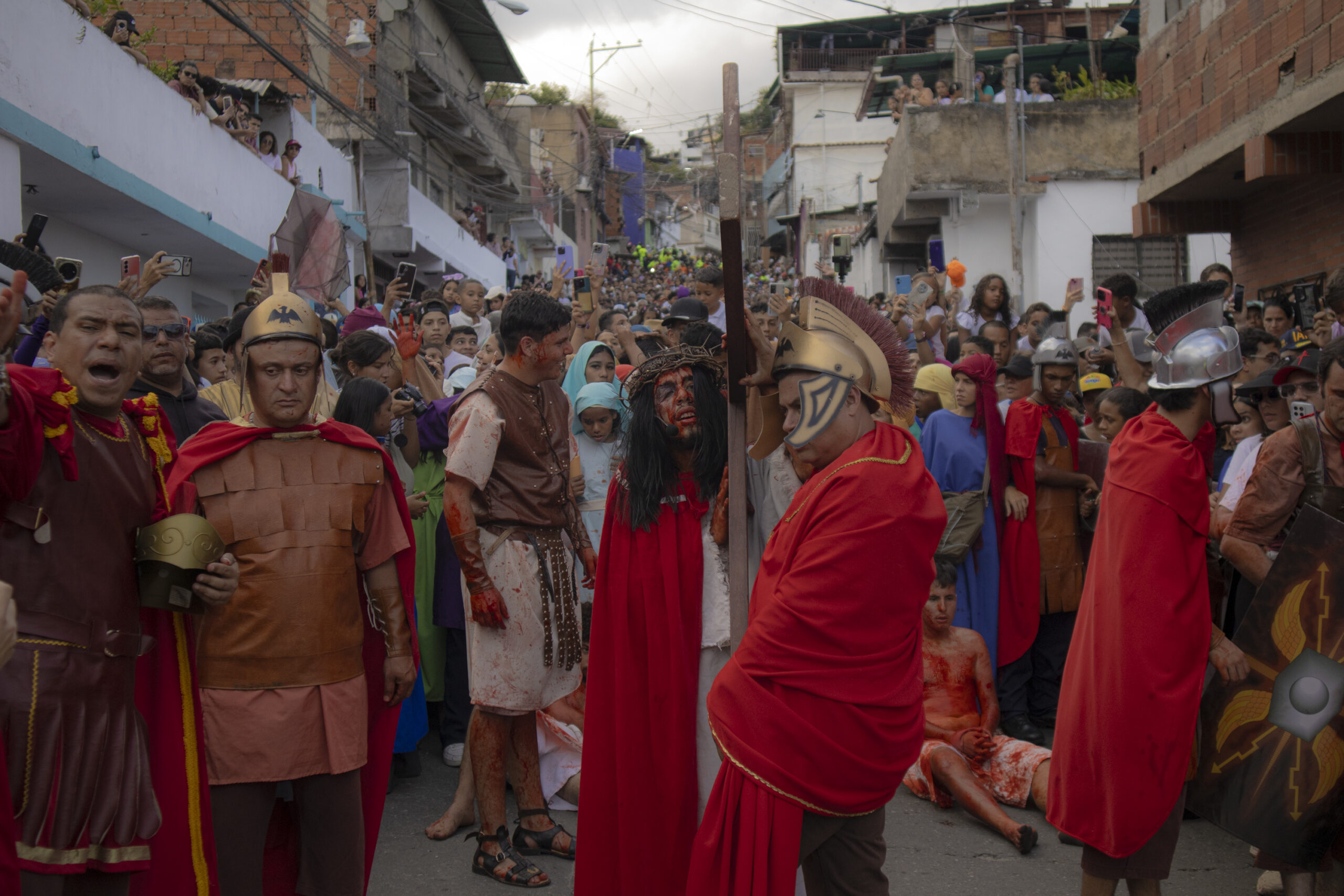
It is Good Friday, and the community of El Nazareno knows it. For the past three months, they have been preparing to stage the 40th edition of Petare’s live Via Crucis, which winds through the entire neighborhood all the way up to the lookout at El Morro.
The barrio has never been so full. “There’s a bululú, this is the Via Crucis with the biggest crowd,” someone says from within the mass of people packed onto the sidewalks outside Nuestra Señora de Fátima Church.
For people in Petare, this is not just a typical Holy Week festivity. It is tradition and promise, passed down to new generations. Taking part in the reenactment demands commitment. “From the moment rehearsals begin, we have to go to Mass every Sunday, go to confession, and attend retreats. The preparation is spiritual, too,” says Kristman Gómez, who leads the parish youth group and the staging of the performance.
“I’m 35, and I’ve been climbing up to El Morro for 30 years,” says Kimberly, a local resident who has taken part since she was five and now helps organize the theater group. This year, she performs alongside her nine-year-old daughter, Euliev.
The influx of people is noticeable miles before reaching the parish. Motorcycles defy gravity on the steep streets, and contingents from different security forces begin to gather along the roads. Residents, actors, and visitors from all over Caracas wait expectantly while the Good Friday liturgy is still underway. The trial of Jesus Christ begins at 3:00 pm.

In the middle of the street, between neighbors’ homes, stands a stage meant to evoke Pontius Pilate’s fortress. The Roman guards are played by young police cadets, their uniforms show beneath their costumes. No one breaks character, and in the front row, the press waits for Jesus Christ to arrive.
Parish priest Alexis Montesinos says a few words, and the performance begins. The windows of nearby houses are filled with spectators, and even a balcony serves as the jail where Barabbas is being held. A silence of concentration and admiration settles over the streets.
“There are 40 lashes,” two women whisper, waiting for the Passion to begin. At the first lash, a horrified cry is heard in the distance. By the second, the audience is being splattered with Christ’s blood. “It’s fake,” a child says, trying to calm his little sister. “It’s Fructus,” another woman assures her.
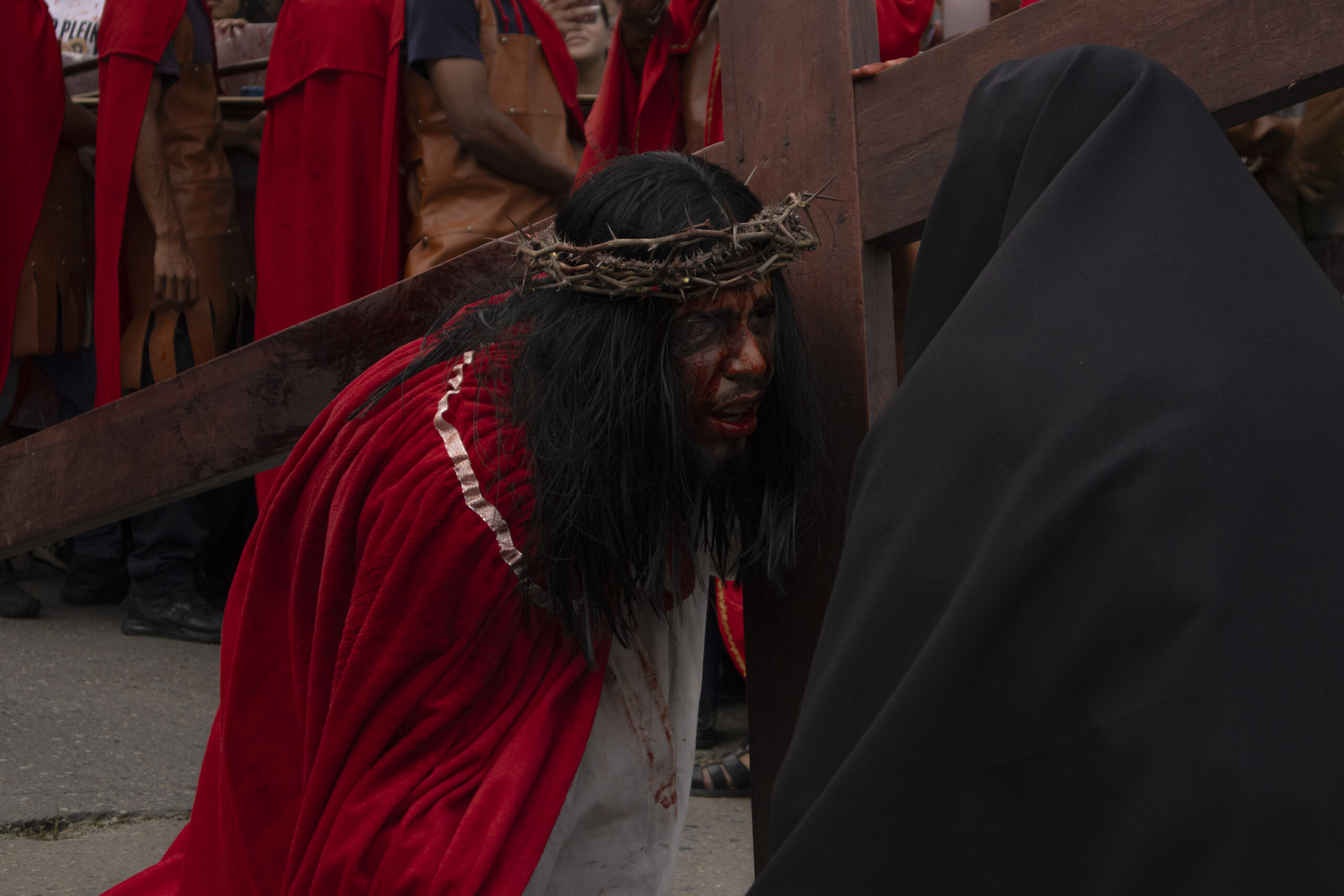
“To make the blood, we boil water with flaxseed the day before, then add food coloring. The flaxseed gives it the thickness that makes it look real,” Kimberly explains.
Kristman has played Jesus four times. He alludes to the story of David and Goliath, saying he never thought he would be chosen because of his height. He migrated to Colombia in 2017, pushed out by the country’s socioeconomic crisis, and returned in 2021. Since then, he has become one of the community’s recognized leaders. Alongside the parish priest, he organizes and mobilizes.
“We make a huge effort, but God is great and keeps opening doors and opportunities for us to put on the Via Crucis. I carry Him as an example in my life, at work, and in my family.”
For a few hours, those in attendance seem able to detach themselves from politics, from their personal and collective crosses, and accompany Christ in his suffering downhill through the barrio. The walls are painted purple, with images recalling past Via Crucis reenactments. The lashes keep splattering, and the wooden cross falls several times against the sloped pavement.
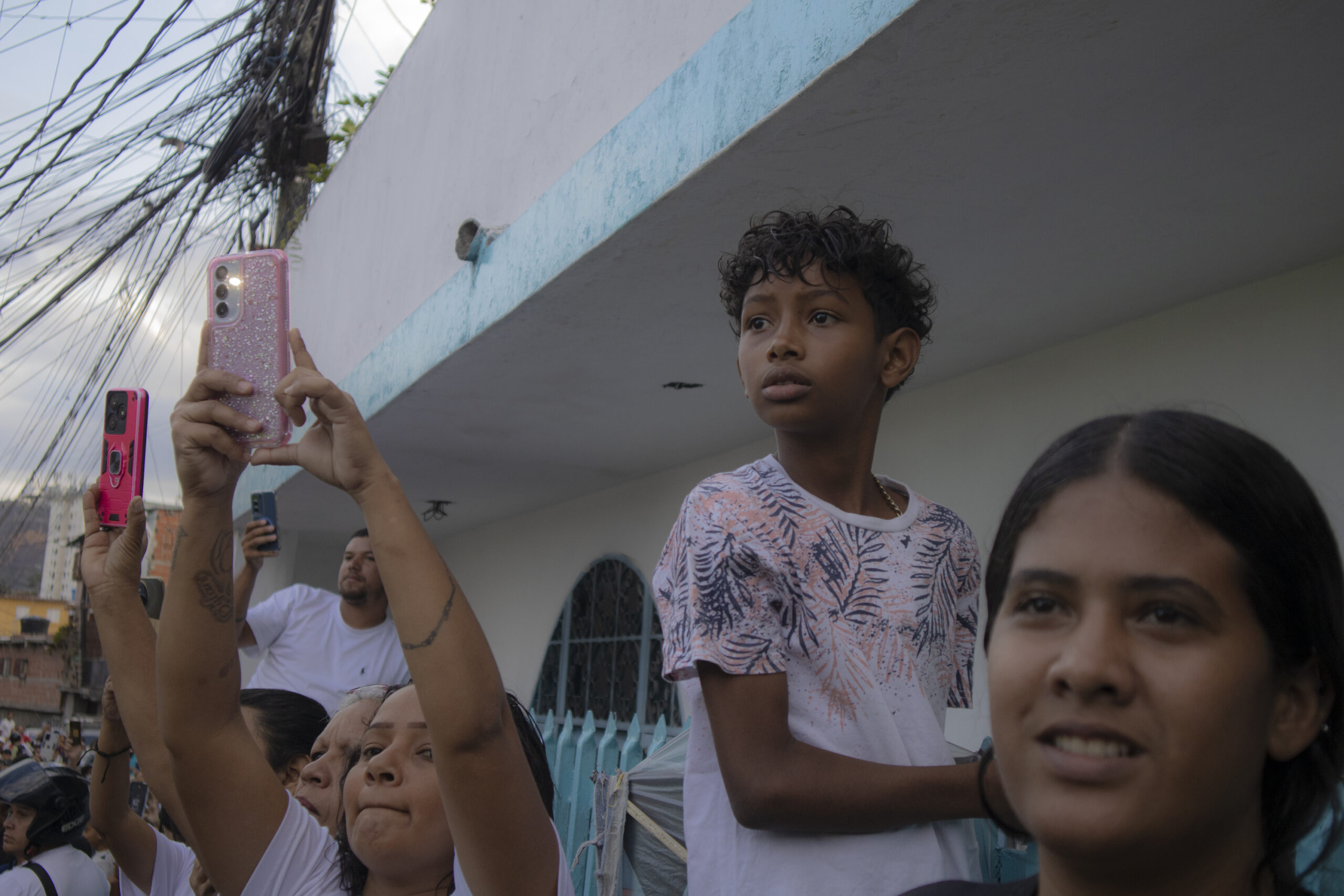
The procession continues. Children perched on their parents’ shoulders record the event on their phones. On the sidewalks, the profane persists in anachronistic fashion: beer is sold alongside the festivity. Many people move ahead and head straight for El Morro, where this year the lookout was prepared to receive visitors attending the Via Crucis.
At the top, commerce is moving too. “Chupis, tetas, soda and water,” reads a sign taped to a cava de anime. Farther ahead, on an embankment, a seven-meter papagayo rises directly in front of the cross at El Morro. Joel, who built the giant kite, says he does not want to fly it today.

“Today, Christ is the protagonist.” The sky looks like a sea full of jellyfish. Six in the evening is papagayo-flying time, and so the divine and the everyday inhabit the same landscape.
The crucifixion is the hardest moment. The actors playing John, Mary, and Mary Magdalene weep, and their tears seem to set off a collective crying spell in the audience. Christ is bound to the cross, and Moisés, the actor portraying him, lifts his gaze toward the sky.
“I hope to take part in this until the last days of my life. This goes beyond theater: you feel it in the spirit. It is our way of honoring the Gospel and bringing it to others,” Kimberly says.

Caracas Chronicles is 100% reader-supported.
We’ve been able to hang on for 22 years in one of the craziest media landscapes in the world. We’ve seen different media outlets in Venezuela (and abroad) closing shop, something we’re looking to avoid at all costs. Your collaboration goes a long way in helping us weather the storm.
Donate