
The Concorde Landed in Venezuela 50 Years Ago
A visit to a Paris museum offers a close encounter with this elegant airplane that embodied the fallen dream of first-world-level consumption
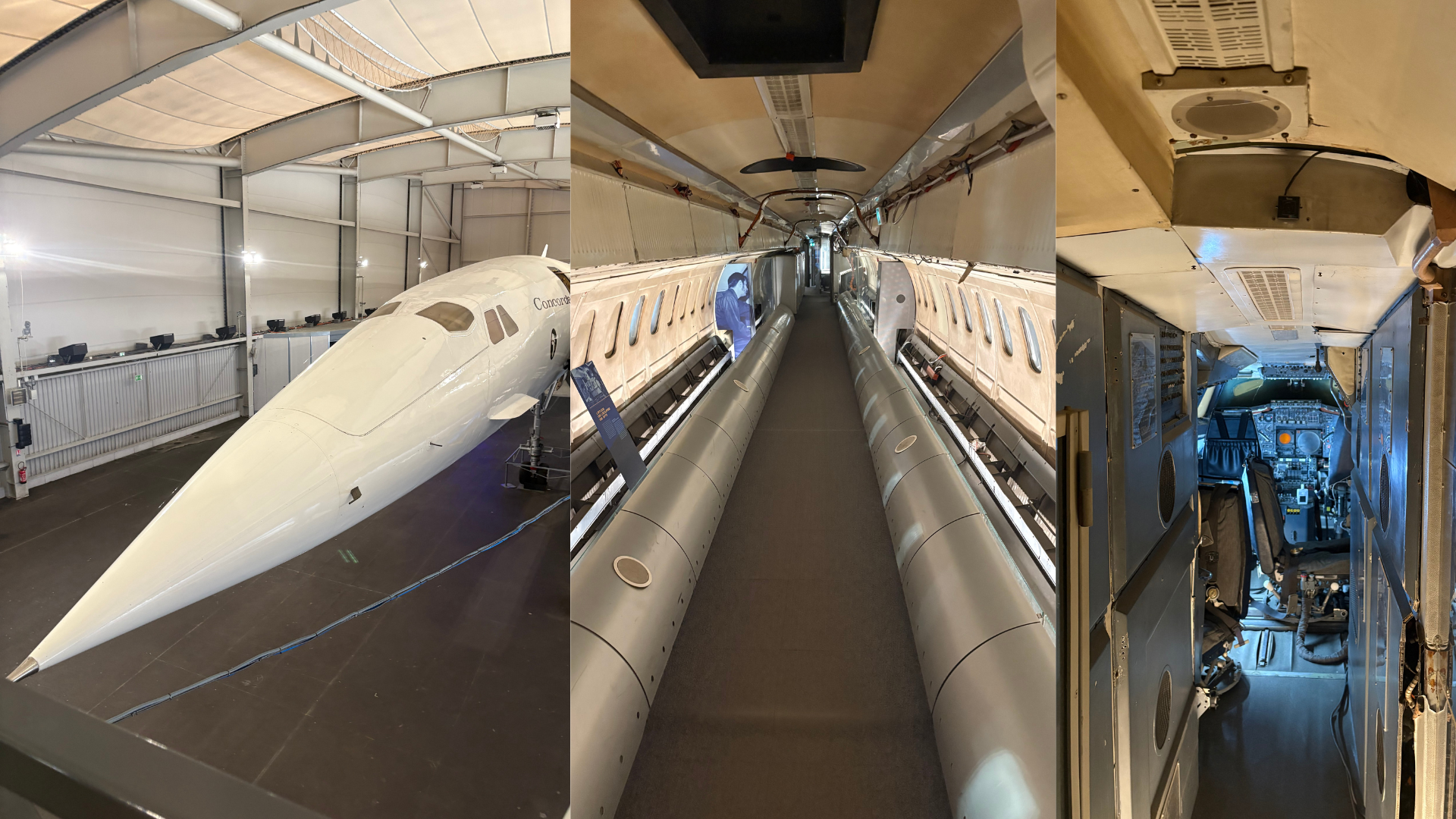
Arriving at the Concorde Hall at the Paris Air and Space Museum is a rather unique experience. The hall is functionally a hangar, with reverberant acoustics, curved metallic ceilings, and strong fluorescent lights. It doesn’t feel like part of a museum, but that’s part of the charm of the large compound that houses both Le Bourget Airport and the museum. As soon as you walk in, you are welcomed by the view of the Concorde Sierra Delta, one of the famous supersonic luxury jetliners, and, next to it, the Concorde F-WTSS prototype, a model used for scientific experiments. Under both planes, there’s a brief exhibit on the history of the model, its significance for French aviation, and memorabilia like the cutlery that passengers would use during the glamorous flying experience.
I went to visit it yesterday with friends, as a bit of a field trip. For me, it was particularly important given that, all my life, I’ve been a fan of the Concorde. Ever since I was a little kid, I would ask my dad to print photos of the plane, and I would spend entire afternoons marveling at the curved shape of its wings and the signature pointy nose. However, as I’ve grown older, I’ve come to appreciate the plane not only for its design, but also for what it represented as a landmark of mid-century collaboration, engineering ambition, and human progress, and, more importantly, for what it represented for Venezuela and its place in the world.
European luxury
On April 9 1976, at the height of the country’s oil boom, Air France inaugurated regular Concorde service between Paris and Caracas, placing Venezuela among the privileged group of cities connected by supersonic travel. The following day, the inaugural Caracas-Paris supersonic flight took off. This week marks the 50th anniversary of those flights, so visiting this museum in the French capital feels less like a coincidence and more like a reminder of a moment when Venezuela saw itself at the center of global modernity.
One of the interesting aspects of the museum is that it allows you to enter both planes and to experience something that few people have: what it was like to be inside the Concorde. The entry point is through the back of the F-WTSS. Upon entering, the biggest surprise is how short the plane is. I could easily touch the ceiling with my head, and the windows were surprisingly small. The lighting was relatively dim, and the first plane was mostly empty, save for a few cards explaining some of the experiments conducted on it, like the interception of the path of a total solar eclipse in 1973. As you approach the nose of the plane, you can see the cockpit and the large number of dials, indicators, and other control mechanisms that are crammed into the tiny space. There, a bridge would take you to the Sierra Delta. While crossing, you get an eye-level view of the delta wing that, as you continue walking, quickly becomes the inside of the commercial plane.
Capacity was limited to around 100 passengers, and tickets were expensive, which positioned the Concorde as an exclusive, luxury experience. Yet, to fly on the Concorde was to participate in an innovative vision of the future, where speed, technology, and refinement came together in a plane with delta-shaped wings and an instantly recognizable pointy nose. In the aftermath of World War II, this had huge political and symbolic implications. Concorde’s development occurred through cooperation between France and the United Kingdom, solidifying the idea that humanity was moving towards an era when technological advancement could help bridge centuries-old rivalries and give tangible evidence of the optimism of this time.
The first prototype took flight in 1969 and broke the sound barrier in October of that year. By early 1976, Air France had begun its first commercial flight connecting Paris with Rio de Janeiro. British Airways covered the London-Bahrain route. Later routes, however, included London-Washington, Paris-Washington, London-New York, Paris-New York, and Paris-Mexico City via Washington or New York. Because of the loudness of its Rolls-Royce Olympus engines, most of the flights were limited to transatlantic crossings.
Tropical mirage
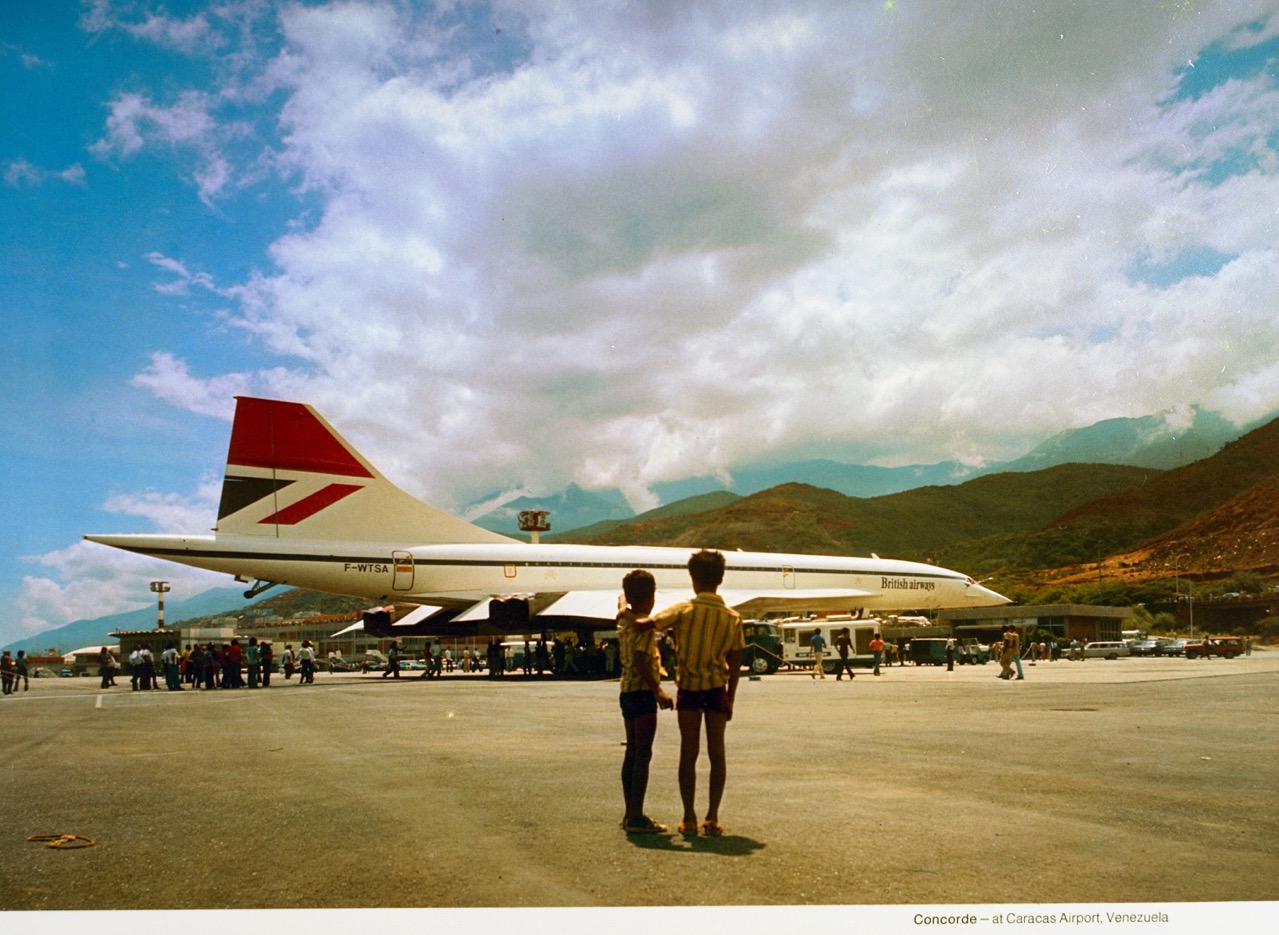
Caracas was the second route to the Americas that Air France would do with the Concorde. In fact, it was advertised to Venezuelan travelers as “Ruta 2 a Mach 2.” For Venezuela in the 1970s, characterized by an oil-fueled boom, mass government spending, and economic expansion, there were growing aspirations of leadership on the global stage, and this event meant an important landmark. The arrival of the Concorde as one of the first destinations for its transatlantic flight represented the inclusion of Venezuela in this vision of the future. Initial flights into Caracas started in 1973, when Concorde 102, a prototype that sported both the Air France and British Airways livery, visited Maiquetía on a sales tour.
It was during this trip that the iconic anonymous photo of the plane being observed by two children was taken. The image summarizes the entire sentiment of the plane’s arrival: a young nation observed, with amazement, that the future was knocking on its door and was inviting it to join. Caracas was being positioned as one of the great cities of the world, and the feeling of progress would ultimately usher in an era of development. Interestingly, this image would later be used by artist Tony Vázquez Figueroa to critique Venezuela’s oil dependency.
On April 9 1976, at the height of the country’s oil boom, Air France inaugurated regular Concorde service between Paris and Caracas, placing Venezuela among the privileged group of cities connected by supersonic travel. The following day, the initial Caracas-Paris supersonic flight took off.
An additional test flight was conducted in February of 1976, just a few months before the launching of the commercial route between Paris and Maiquetía, which, as previously stated, began operating on April 10 of that year. It landed in Maiquetía after having covered the 4,453 miles of the route in 6 hours, with a layover in the Azores Islands to refuel. The service started with a single flight leaving Paris on Fridays at 7 PM and arriving in Maiquetía at 7 PM local time, 6 hours, as opposed to the usual 10 to 11-hour flights. The first flights were received by curious onlookers. The plane stayed overnight in the country, then left for Europe on Saturday at 9 AM, and by 1977 it was extended to two weekly flights on Tuesdays and Saturdays.
A particular perk of the route was that travelers were able to experience “two sunrises.” An account of Jean-Michel Rougier, a maintenance mechanic on the Concorde, explained this phenomenon: “The sun had disappeared on the horizon, and the night settled on the island [Azores]… sitting on the ‘Observateur’ seat behind the Captain; then, by the combined effect of the altitude and speed of Concorde to Mach 2, I was able to witness a second sunrise in the same day, but this time, in the West!”
Despite the wonder, the flight was not without risk, particularly because the Concorde’s fuel consumption was complex, burning a large amount early in the flight and becoming more efficient later, forcing pilots to plan around expected efficiency gains. On top of that, the aircraft’s balance had to be carefully managed by moving fuel between tanks, since passengers couldn’t be repositioned, and any miscalculation could affect stability. This was even harder considering that it was breaking the sound barrier.
The service started with a single flight leaving Paris on Fridays at 7 PM and arriving in Maiquetía at 7 PM local time, 6 hours, as opposed to the usual 10 to 11-hour flights.
Ultimately, these risks, plus the increasingly complex economic situation of Venezuela in the 1980s, made the Concorde flights to Caracas no longer profitable. The operational costs were just too high, and Air France decided to use different aircraft to cover the route. This did not mean the complete disappearance of the Concorde in Venezuela. French President François Mitterrand arrived in one during his visit to Caracas in 1989.

Profitability issues plagued the Concorde towards the end of the 20th century. This, in addition to rising maintenance costs and increasing safety concerns after a crash in Paris in 2000, led to it being discontinued in 2003.
Yet, I can’t help but still marvel at the Concorde. The reverence placed on the exhibit, along with the careful details like the cutlery, the seats, and the view of the delta wings from the bridges connecting the plane, made the grandiosity of the Concorde palpable. It reminded me that optimism and collaborative development once achieved feats of engineering that seemed almost impossible. While it’s challenging to find sources of optimism today, it’s imperative to remember that it is possible and, as Venezuela finds itself once again at a crossroads of uncertain futures, maybe it’s also time to imagine a future that feels just as ambitious as the one that once landed in Maiquetía.
Caracas Chronicles is 100% reader-supported.
We’ve been able to hang on for 22 years in one of the craziest media landscapes in the world. We’ve seen different media outlets in Venezuela (and abroad) closing shop, something we’re looking to avoid at all costs. Your collaboration goes a long way in helping us weather the storm.
Donate