
The Chain of Command That Concealed Víctor Hugo Quero's Death
Those responsible for protecting his life failed completely and maintained, for months, a silence that defies explanation. Here they are fully identified
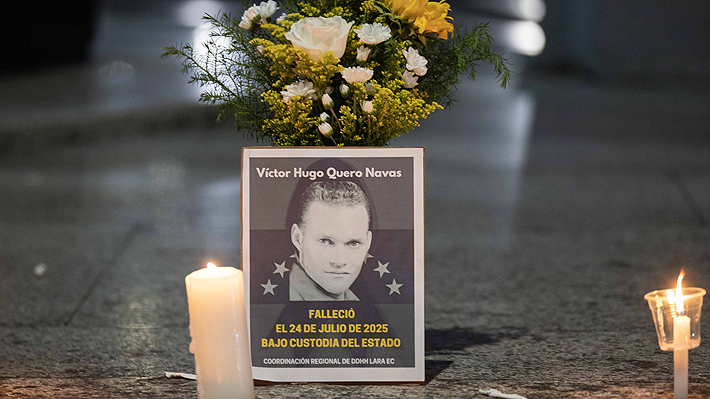
There is not just one person responsible for covering up and silencing the death of political prisoner Víctor Hugo Quero for nine months. There are many. A chain of responsibilities and silences runs through the institutions and officials who were obligated to protect his fundamental rights, and chose not to.
But where does that responsibility begin? Who was actually in charge? Runrunes traced the chain of command that, as a state detainee, held authority over his health and his life. Here, with full names, are the highest-ranking officials and their teams: the people who kept Carmen Teresa Navas, 81 years old, from knowing that her son had died in July 2025, according to the official record.
The highest link in this chain belongs to the Ministry of Penitentiary Services, represented by its head, Julio García Zerpa, a close ally of Diosdado Cabello. The institution he leads must maintain complete information on all detainees (such as their whereabouts and their procedural status) and yet denied that information to Víctor’s mother on repeated occasions.
Decree 8.266, which established the Ministry in July 2011, states in Article 2, paragraph 3, that the minister must regulate the organization and functioning of the prison system (including each individual facility) as well as “issue, formulate, supervise, and evaluate policies that guarantee the security and custody of detainees… with strict adherence to Human Rights,” as paragraph 7 reads.
Under the Ministry’s authority sits El Rodeo I Capital Judicial Detention Center, a maximum-security facility in Guatire, Miranda state, where Quero was imprisoned before his death. National Guard Colonel Alexander José Martínez Endeiza directs the facility. Other political prisoner cases have already named this man for blocking the release of detainees who hold valid release orders. In an earlier posting, he presided over Misión Negra Hipólita, a program dedicated to sheltering homeless individuals.
According to fellow inmates who knew him at El Rodeo I, Quero required a special diet that prison forced him to abandon. Every time he complained about the food, the facility’s custodians (also among those responsible) tortured him. Poor nutrition weakened and sickened him to the point that, during the first half of July, staff transferred him to the Carlos Arvelo Military Hospital in Caracas with an “upper gastrointestinal hemorrhage.” He died there.
The Organic Penitentiary Code states in Article 122 that when staff transfer a detainee for medical reasons, the supervising judge “must be notified immediately… so that the appropriate jurisdictional decisions can be made.” Since a court had not yet sentenced Quero, that notification should have gone to the control court judge handling his case. But that judge also stayed silent. His name is Carlos Liendo, and he presides over the 2nd Control Court for Terrorism. Liendo is one of the judges who has sent hundreds of political prisoners, adults and adolescents alike, behind bars since the disputed presidential elections of July 2024.
Liendo charged Quero Navas with terrorism, financing of terrorism, criminal association, treason, and conspiracy. From that point forward, Quero remained imprisoned on Liendo’s order. This made Liendo personally responsible for guaranteeing “fundamental rights and the legality” of the criminal process during both the preparatory and intermediate phases, as the Organic Code of Criminal Procedure establishes
The accusers
The Prosecutor General’s Office bears responsibility for Quero Navas’s life as well. It directs criminal investigations, orders the collection of evidence, and files charges. Prosecutor No. 67 for the Caracas Metropolitan Area, Luis Felipe Cádiz Valdez, handled Quero’s case and secured his indictment before the courts.
But the Prosecutor General’s Office’s obligations do not end there. It must also guarantee “legality, constitutional rights, and the exercise of public criminal action.” For that reason, former Prosecutor General Tarek William Saab also bears responsibility for Quero’s physical integrity and for providing truthful information about his situation and whereabouts.
A source with ties to the Prosecutor General’s Office told Runrunes that when Carmen Navas came to their offices to request information, officials should have triggered a protocol to investigate the forced disappearance. This probe would have been handled by the human rights protection division that operates within the Prosecutor’s Office. Instead, they simply ignored her.
According to the source, the Metropolitan Caracas Coordination of the Attorney General’s Office should have received her request and redirected it to the Human Rights Directorate, then headed by Karin García. From there, the Directorate of Human Rights Investigations—whose director at the time was Nicola Stanley Coppolone—should have assigned a prosecutor to investigate Quero’s forced disappearance. The Director of Sentence Enforcement, Enrique Arrieta, should also have acted: even though a court had not sentenced Quero, officials still had to verify his detention conditions at El Rodeo I. The case received widespread media coverage. None of them lifted a finger.
The paper trail
The Ministry of Penitentiary Services claims that Quero Navas never provided “information about family ties and that no family member presented themselves to formally request a visit.” But officials recorded that information not once but repeatedly, across every institution that processed his detention.
“Any law enforcement body that detains a person, in this case the DGCIM, must bring them to the CICPC, where the Records Division has to complete the Unified Detention Form, known as the PD-1,” the source with ties to the Prosecutor General’s Office explains. That document captures photographs of the detainee along with personal and family information: name, age, address, the names of both parents and whether they are living or deceased, siblings, children, and their contact phone numbers. Officials then enter most of this data, including the family details, into the official police report as well.
Quero would have provided his personal information on additional occasions. At his initial appearance hearing, court clerks had to collect that data for the record. The public defender assigned to his case did the same, filling out a form with this information in order to communicate with his family about the proceedings.
The defenders who didn’t defend
The Autonomous Public Defense Service, directed by Public Defender General Daniel Ramírez Herrera, also did nothing to provide information about Quero Navas’s situation. His mandate is to direct, supervise, and guarantee the right to free legal defense and access to justice for citizens—especially vulnerable ones—which places him directly above the public defender assigned to Quero’s case.
Article 14, paragraph 8, of the Organic Law of Public Defense grants the Public Defender General the authority to “request collaboration and coordinate with the various authorities of the Republic for the better fulfillment of its functions.” Where were those officials when Carmen Navas was going to the press, demanding to know what had happened to her imprisoned son?
The Public Defender’s Office also failed. Dionita Coronado, Defender III of the Investigation, Mediation and Conciliation Unit of the Delegated Public Defender’s Office for the Caracas Metropolitan Area, signed a notice of appearance for Carmen Navas when she came in October 2025 to demand due process for her son.
At that point, the Public Defender’s Office had supposedly confirmed that Quero — already dead by then—had recently been transferred to Prosecutor No. 67. In keeping with the institution’s own principles, Coronado should have launched and pursued, on her own authority, “the verifications and investigations necessary to clarify the facts,” going to whichever institutions could confirm the detainee’s whereabouts. Instead, she accepted the word of a single prosecutor’s office official and stopped there.
The Public Defender’s Office website states that the institution “is responsible for the promotion, defense, and oversight of the rights and guarantees established in the Constitution of the Bolivarian Republic of Venezuela and in international human rights instruments.” The Organic Law of the Public Defender’s Office, in Article 15, paragraph 2, empowers it to intervene in habeas corpus actions, habeas data actions, precautionary measures, and other judicial remedies “when it deems it justified”—actions that neither former Public Defender Alfredo Luis Angulo nor his successor, Tarek William Saab, ever took.
Paragraph 5 of the same law requires the Public Defender to “safeguard the rights and guarantees of persons who, for any reason, have been deprived of liberty, confined, interned, detained, or whose freedom has in any way been restricted.” Every official who held that position while Carmen Navas searched for her son ignored that obligation entirely.
Collateral responsibility
The chain of responsibility does not end with these institutions. Others also held information about Quero Navas’s whereabouts and said nothing. Vice Admiral Luis Montaño Hernández, director of the Dr. Carlos Arvelo University Military Hospital, and the medical and nursing staff who treated Quero all stayed silent. He spent at least nine days in that facility before his death—long enough for staff to have recorded his personal information and notified his family.
Carmen Teresa Navas told media outlets that she visited morgues herself to make sure her son had not died. Why did Lissett Moreno, director of the National Forensic Medicine and Sciences Service (Senamecf), say nothing about his death?
The officials of that institution—including the forensic physician who signed the death certificate—performed the autopsy, registered his death, and kept quiet. They also ignored the Minnesota Protocol, which sets out the international guidelines the United Nations adopted for investigating potentially unlawful deaths or suspected cases of forced disappearance — which is precisely what Quero Navas’s case was.
The CICPC opened an official investigation into Quero’s death on March 10, 2026. But why did the Ministry of Penitentiary Services break the news rather than the criminal investigation police and their director, Douglas Rico? And why did the CICPC take nearly two months to find answers about a person who died in state custody?
Those failures at the Senamecf and the CICPC fall directly under the Ministry of Interior, Justice and Peace—the ministry Diosdado Cabello commands. One more link in a chain of silences that finally broke on May 7 with the noise of a tragedy.
Caracas Chronicles is 100% reader-supported.
We’ve been able to hang on for 22 years in one of the craziest media landscapes in the world. We’ve seen different media outlets in Venezuela (and abroad) closing shop, something we’re looking to avoid at all costs. Your collaboration goes a long way in helping us weather the storm.
Donate