
In Madrid, María Corina Claimed the Great Return Has Begun
Machado said she will go back for a new election. Will Venezuelans in Spain follow?
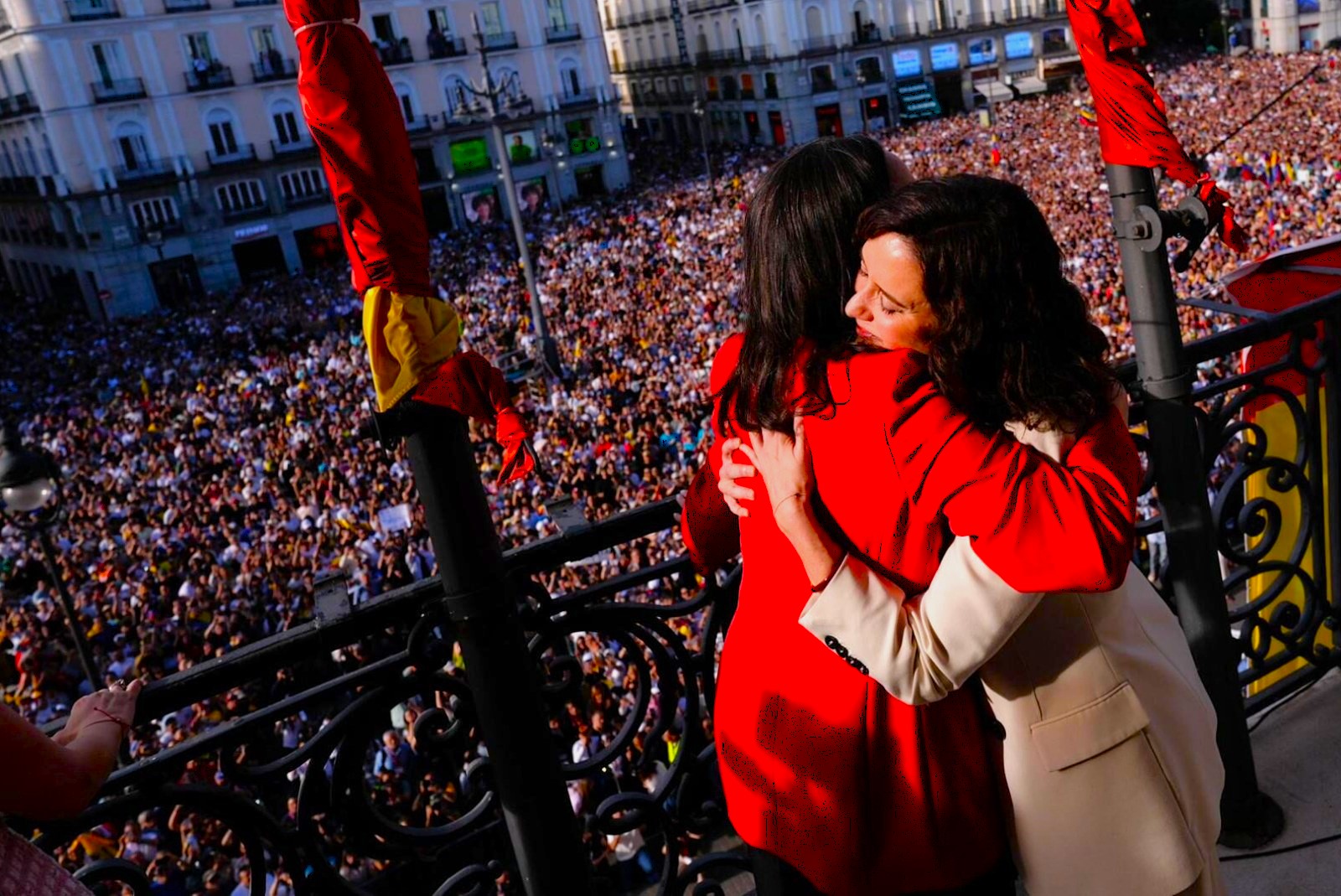
At Puerta del Sol, in what has been the largest gathering of the Venezuelan diaspora in several years, María Corina Machado sought to deliver two clear messages: Venezuelans are united and eager for a new election where she can stand, and the diaspora must return to the country to take part in its reconstruction.
After meeting with Emmanuel Macron, Rob Jetten, and Giorgia Meloni, Machado closed her European tour in a capital that is now home to more than 200,000 Venezuelans—a figure that nearly matches the total number of local migrants from Romania and Morocco, according to El Confidencial. Across Spain, there are nearly 700,000 people born in Venezuela. The Objective has reported that in 2025, 99.4% of residence permits granted on humanitarian grounds (a status similar to the US TPS) went to Venezuelans.
The government of Pedro Sánchez announced the end of this policy starting in June, although Spain will continue processing asylum and international protection requests from Venezuelans.
“Madrid is the heart in Europe for Venezuelans who have had to leave. This city has not only welcomed them. It has also integrated them, embraced them,” Machado said. Before stepping onto the main stage, she had appeared on the balcony of the Real Casa de Correos alongside Isabel Díaz Ayuso, president of the Community of Madrid, who greeted Venezuelans who have found a home there. Madrid’s mayor José Luis Martínez-Almeida had presented Machado with the Keys to the City, a recognition typically granted to heads of state.
“María is going to arrive unstoppable,” Ayuso said. “María Corina will be the president of Venezuela.”
Statements in recent days have fueled expectations of new presidential elections.
At a press conference earlier in the day, a journalist asked Machado about the role of Sánchez and the Spanish government in Venezuela’s situation. She sidestepped the question by expressing gratitude for the reception and integration of her compatriots in Spain.
Her weekend was marked by her new campaign slogan, a la venezolana, a cheeky catchphrase that seeks to contrast Machado’s leadership with the nature of a regime led by Delcy Rodríguez and currently backed by Donald Trump. Her Spain visit was also defined by her refusal to meet with Socialist leader Pedro Sánchez (a controversial decision for some) and by her clear affinity with rivals of the ruling PSOE party like Ayuso, Almeida, Santiago Abascal, and Cayetana Álvarez de Toledo.
“Today, the whole world has its eyes on this Puerta del Sol, because it knows that today we are beginning the return home.”
Elections, now closer?
Several statements in recent days have fueled expectations of new presidential elections. Without referring to Machado, Jorge Rodríguez told El País that opposition figures must “self-include” in the new national political landscape in order to return to the country and even negotiate an electoral timetable. Meanwhile, his sister Delcy has already hired an American lobbyist to manage her potential candidacy before the White House.
Lula da Silva said that if he were Delcy, he would call for general elections after taking power. Petro suggested a co-government between chavistas and opposition figures to prepare the ground for an election. And Michael Kozak, a senior State Department official, stated that Machado and other opposition leaders will be able to return and compete in elections. In a congressional hearing, Ambassador Kozak explicitly referred to Delcy’s pending tasks on electoral matters.
“The Constitution is very clear: there should already have been an election in Venezuela and a defined electoral calendar,” Machado said on Saturday morning. “We know that from a technical standpoint there are a number of elements that must be put in place to ensure a flawless election, and that is why we must begin now, with the first step being the appointment of a new electoral authority.”
Some openly expressed optimism about a new country under Machado’s leadership. Others were less certain about leaving their lives in Spain.
Machado paired this demand with what she expects from her supporters in order to build what she calls a Venezuela of reunion (la Venezuela del reencuentro), a central theme of her 2024 campaign. At Sol, she told her followers must not only organize and continue exposing the reality in the country, but also begin making plans.
“Raise your voices and pack your bags, because we are going back,” said the Nobel Peace Prize laureate at the close of her speech.
Caracas Chronicles spoke with several Venezuelans attending the event about their expectations for change and the possibility of returning home. All spoke positively about their experience migrating to Spain, and the safety and wellbeing this country offers.
Reflections on returning to Venezuela in the event of political change were varied. Some did not hide their optimism about a new country under Machado’s leadership. Others were less certain about leaving their lives in Spain given the still uncertain national outlook.
Hopes of returning
“I want to go back to Venezuela. I know it will become a prosperous country again,” said Rodolfo, a 52-year-old from Caracas. He is a communications technician, a profession he has been able to continue practicing in Madrid after arriving with his wife and two children seven years ago.
“Everything I’m learning here, I’ll take back there. We want technology. Everything they have here either doesn’t exist in Venezuela or doesn’t work. Things are slow right now, stalled, but we will rebuild with what we bring.”
Alejandro, 34, sounded less certain. From Mérida, he arrived in Madrid at 27. He ws unable to validate his business administration degree, and began working in a call center. He eventually grew within his company and became a data analyst.
“I can’t complain. Spain has welcomed me very well,” he said. On the possibility of returning, he added: “I would have to think about it, because professionally it’s a complex decision. I’m essentially building my career here, but I would also consider becoming an entrepreneur in Venezuela.”
Mileibis, 31, from San Felipe, believes there will be change and that María Corina will go “all the way” (hasta el final), but for now she is focused on regularizing her status after receiving humanitarian residency two years ago. She doesn’t know when she might return.
“I don’t know about the future. I prefer to live in the present and let the future surprise me,” she said. “But yes, nothing compares to the warmth of home. This is a borrowed country, something temporary. We came here only to do what we couldn’t do in Venezuela.”
“I don’t know if I will return soon, but I wouldn’t want to grow old as a migrant. I would like to end up there.”
“A lot has happened since January 3. That gave me a push. Now I’m focused on establishing myself in Spain, because I don’t know when I might have to leave. Always thinking about starting a business, but in my country,” said Luis, 31, from Calabozo. He is an industrial machinery mechanic. He says Spain has allowed him to work, support his family, and fulfill dreams. He is one of many who still believe in Machado’s leadership.
“As an example of resilience and conviction, she has always been there giving it her all, never giving up. We will be forever grateful because she has achieved what many could not.”
Jason, 28, also from Calabozo, spent four years in Chile before returning to Venezuela. At the end of 2024, he gathered enough money to travel to Spain with his partner, where he applied for asylum. He is not authorized to work while his application is pending.
“I’m going to do everything possible to stay in Spain until I obtain citizenship,” Jason said. “Soon, I will withdraw my asylum application and opt for residency regularization after four years. That’s the path I’m on, through lawyers. My goal is to obtain citizenship and see what my options are.”
A transition that excludes
Daniela, 30, from Barcelona (Anzoátegui state), also lived in Chile between 2018 and 2025. She left due to worsening insecurity. She later returned to Venezuela, but says the country she knew no longer existed, so she left again.
“I don’t know if I will return soon, but I wouldn’t want to grow old as a migrant. I would like to end up there,” she said. “Little by little I’m building a small house in Anzoátegui, which has been difficult to finish. I have faith that things will improve.”
Among our interviewees, there is a degree of optimism about the steps Venezuela has taken since the US captured Maduro, although progress is seen as slow.
Ronald, 34, from Caripe del Guácharo, says there are certainly positive signs. He was forced into exile for political reasons he preferred not to detail.
“Letting us vote is one of the many things they owe us.”
“I cannot be in Venezuela while this regime exists,” he said, his voice breaking. “This amnesty law that was passed is a sham. It’s not for everyone. We still have more than 500 political prisoners.”
“As Diosdado Cabello himself said: people like me cannot set foot in Venezuela again.”
A potential election in Venezuela will also depend on the existence of an electoral registry that includes the diaspora. In 2024, when Edmundo González beat Maduro by at least four million votes, the regime blocked Venezuelans abroad from registering. Of a diaspora exceeding six million people, only about 69,000 citizens (roughly 1.7%) were eligible to vote outside the country.
“Letting us vote is one of the many things they owe us,” said Rodolfo, the communications technician. “Between my family and my wife’s, there are eight of us here. None of us could vote at that time.”
“Anyone can win like that, man. In the end, we all want change. But real change.”
Caracas Chronicles is 100% reader-supported.
We’ve been able to hang on for 22 years in one of the craziest media landscapes in the world. We’ve seen different media outlets in Venezuela (and abroad) closing shop, something we’re looking to avoid at all costs. Your collaboration goes a long way in helping us weather the storm.
Donate