
Can Venezuela Become an “Oil-Rich Hungary” in the Caribbean?
After two decades of a hyper-ideological anti-West agenda, can Caracas start pursuing a more pragmatic foreign policy?
Walking through Budapest, it is impossible not to notice the contradictions. Hungary is a member of NATO, a member of the European Union, and a beneficiary of decades of Western integration. At the same time, Chinese companies are building multibillion-dollar factories, Russian energy remains essential, and Viktor Orbán spent years cultivating close ties with both Moscow and Beijing.
From Caracas, many would interpret this reality as an anomaly. Perhaps for a country so accustomed to contradictions, it is a window into the world that is coming. Or into the world that already arrived.
For decades, international politics was dominated by a relatively straightforward question: whose side are you on? The Cold War forced countries to choose between Washington and Moscow, although Venezuela took a novel approach in the second half of its democratic period. Even after the collapse of the Soviet Union, the American unipolar moment sustained the assumption that development, prosperity, and international integration were ultimately synonymous with Westernization.
The twenty-first century has proven more complicated. Turkey purchases Russian weapons while hosting American bases as a NATO member. India participates in strategic partnerships with the United States while maintaining longstanding military and energy ties with Moscow. The United Arab Emirates hosts capital, companies, and citizens from virtually every geopolitical camp. Hungary, home to CPAC Europe and a destination for both Chinese investment and Western conservative movements, has perhaps turned this logic into a national strategy more successfully than any other European country.
These countries are not neutral. Nor are they non-aligned in the classical Cold War sense. They are states that have learned to maximize their options in a multipolar world.
Time to embrace multipolarity?
For years, discussions about Venezuela’s future have been framed as a choice between opposing models. Would the country resemble Cuba or Colombia? Nicaragua or Costa Rica? Would a transition imply a return to the Western consensus that shaped much of Latin America after the Cold War?
Five months after January 3 and the beginning of a period of unprecedented American tutelage, those questions appear increasingly outdated.
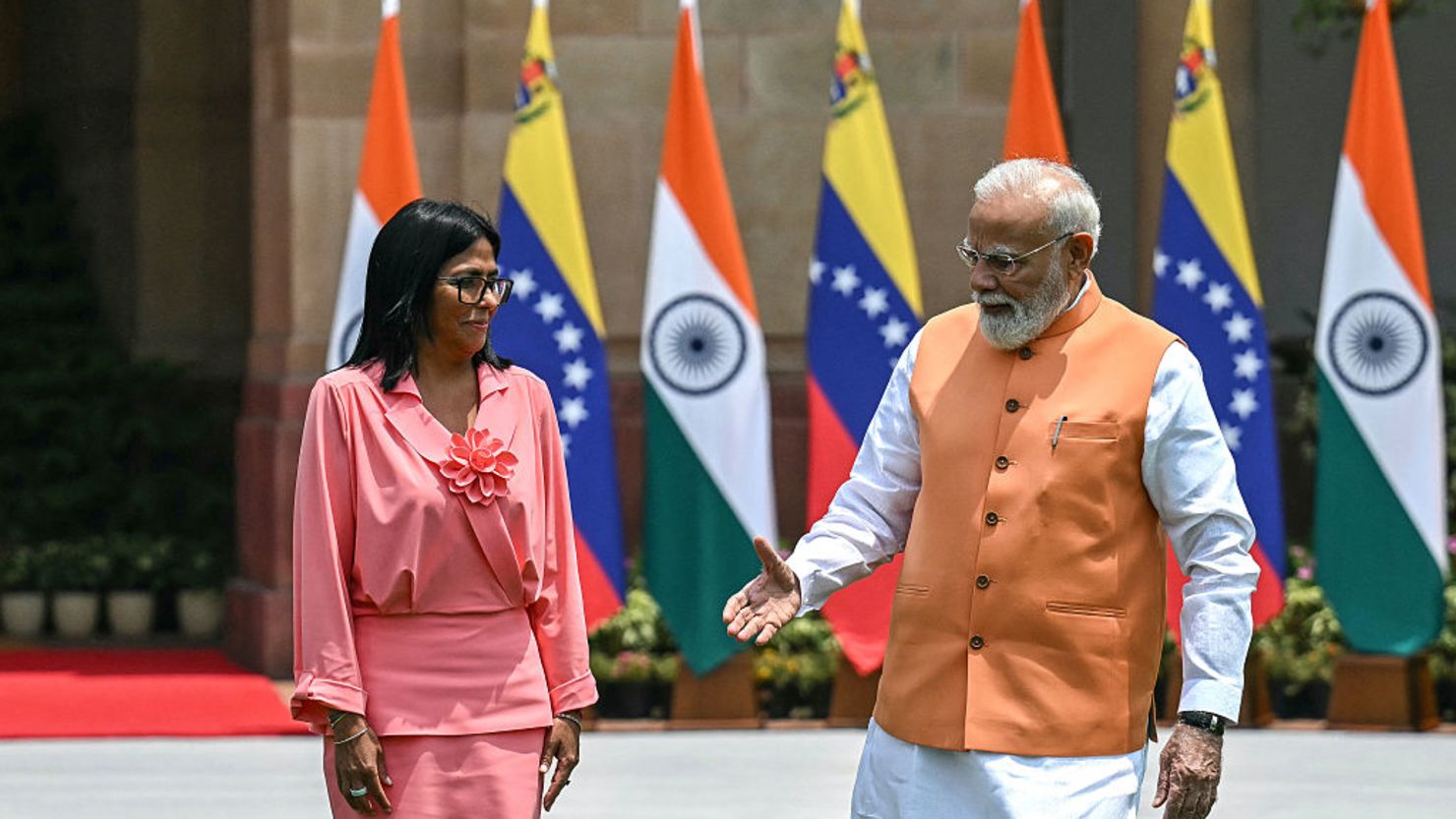
The symbolism of recent weeks is difficult to ignore. While Delcy Rodríguez was in India seeking to deepen energy ties with one of the world’s fastest-growing economies, General Dan Caine was simultaneously in Caracas discussing security cooperation with Venezuelan authorities. In the traditional chavista worldview, these developments would have belonged to rival geopolitical universes. In today’s Venezuela, they increasingly appear as part of the same strategy.
Venezuela arrives at this reality from a different place. Questions of external influence, compromised sovereignty, competing centers of power, and tutelage have played a far larger role here than among our neighbors.
The concept of regime learning refers to the ways political systems adapt in order to survive. In Venezuela, that process has already transformed the country’s economic model. Price controls have largely been abandoned. The private sector is in a slow process of rehabilitation. In short, revolutionary orthodoxy has repeatedly yielded to political necessity.
Regime learning does not only change how states govern. It changes how they understand the world.
What is becoming apparent in 2026 is that the same process may be transforming Venezuela’s geopolitical posture.
The Bolivarian Revolution was founded on a particular assumption. Venezuela would help construct an alternative pole of power, aligned with actors such as Cuba, Russia, Iran, and eventually China. The goal was not merely to diversify partnerships. It was to build a geopolitical project capable of challenging American influence in the hemisphere.
Twenty-five years later, the lesson learned appears remarkably different.
Arriving late to the game
Russia became absorbed by its invasion of Ukraine. China proved willing to defend its own interests, but not necessarily those of its partners. Iran remained geographically distant and economically constrained. Cuba, despite years of leeching off the Venezuelan state, proved largely incapable of defending the revolution against genuine external pressures. The experience of governing under sanctions, isolation, economic collapse, and great-power competition appears to have produced a different conclusion: dependence on any single external patron creates vulnerabilities.
The logical response is not non-alignment, but rather hedging.
Instead of anchoring Venezuela to a single geopolitical camp, the emerging strategy appears designed to maintain productive relations with several simultaneously. Security cooperation with Washington. Oil exports to India. Commercial ties with China. Investment from the Gulf. Access to Western financial markets. None of these relationships are mutually exclusive. In fact, they reinforce one another.
To some extent, there is nothing uniquely Venezuelan about this. Much of Latin America already operates in a multipolar environment. Governments across the ideological spectrum maintain economic ties with China while preserving political, commercial, and security relationships with the United States. Yet Venezuela arrives at this reality from a very different place. Questions of external influence, compromised sovereignty, competing centers of power, and political tutelage have played a far larger role in Venezuelan politics than in most neighboring countries.
The lesson Venezuela appears to be learning is neither socialist nor liberal, neither anti-Western nor fully Western.
In some respects, the country’s experience over the last quarter century has more in common with the dilemmas faced by some post-communist European states (like Ukraine) than with those of Colombia, Peru, or Ecuador. Venezuela is never going to become Switzerland, nor is it going to become India. It lacks the geography, the institutions, and the scale required for either role. Yet it may be discovering a different path, one better suited to its circumstances: not a great power, not a neutral sanctuary, but a medium-sized energy producer whose strategic value derives from its ability to remain relevant to multiple centers of power simultaneously.
This is what makes Hungary such a useful comparison. Not because Hungary represents a political model for Venezuela, nor because Viktor Orbán and Nicolás Maduro are comparable figures. If anything, a Venezuelan transition led by María Corina Machado would likely have more in common ideologically with a post-Orbán government than with Orbán himself. Yet that is precisely the point. Even a post-Orbán Hungary would remain a member of NATO and the European Union, continue attracting Chinese investment, and remain constrained by the economic and energy relationships accumulated over decades. Hungary is useful because it illustrates a broader phenomenon: the emergence of states whose prosperity depends less on belonging to a bloc than on remaining useful to several at once.
Viewed from this perspective, Venezuela’s current trajectory increasingly resembles neither Cuba nor the Colombia of the early 2000s. It is not moving toward the permanent isolation of the former, nor toward the straightforward Western alignment of the latter under Álvaro Uribe. Instead, it is beginning to occupy an intermediate position, one that may become increasingly common in a multipolar world.
The Bolivarian Revolution aspired to create a twenty-first-century Cuba. Five months after January 3, its most enduring geopolitical legacy may be the emergence of an oil-rich Hungary in the Caribbean.
Regime learning does not only change how states govern. It changes how they understand the world. After 25 years of revolution, sanctions, collapse, and adaptation, the lesson Venezuela appears to be learning is neither socialist nor liberal, neither anti-Western nor fully Western. It is something more pragmatic: in a multipolar world, survival belongs to those who can make themselves useful to everyone.
Caracas Chronicles is 100% reader-supported.
We’ve been able to hang on for 22 years in one of the craziest media landscapes in the world. We’ve seen different media outlets in Venezuela (and abroad) closing shop, something we’re looking to avoid at all costs. Your collaboration goes a long way in helping us weather the storm.
Donate