
How Technology Is Helping Venezuelans To Deal with the Disaster
Many people knew about the earthquakes thanks to their cellphones and now the Internet is spreading information to assist those in need
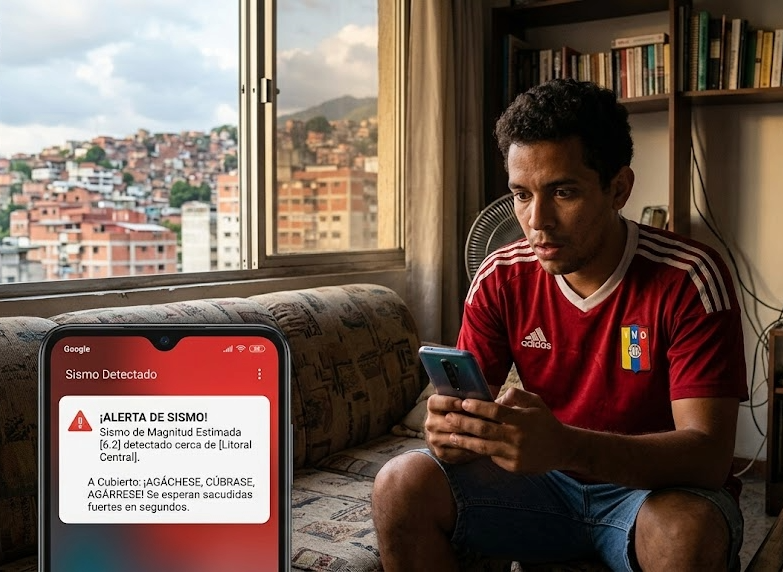
Around 6 p.m. on June 24th (a public holiday in Venezuela), the quietness of the day was unexpectedly interrupted by an unknown alarm sound coming from the cellphone. The screens indicated an earthquake was about to happen. Just then, things started to shake.
Many people in the country like me became aware of the biggest seismic event in more than a century thanks to this message from Google’s Android Earthquake Alert System. And that has become a remarkable story in itself.
Those few seconds between the message’s arrival and the earthquakes were key for those who read it and react: leaving their premises, taking cover or staying away from windows.
Pericles Sanchez, a 39-year old writer in Caracas, told AP that he got an alert through his Android telephone sent by Google. “It gave us time to get out, it wasn’t until we were outside when we felt it”.”
This message also reached Diógenes López, a 36-year old Venezuelan migrant living in Bogota, and allowed him to find out that the epicenter of the earthquake was close to his hometown. At first he feared the worst, but his sister contacted him and told him the entire family was saved.
How did this work? Marc Stogaitis, Principal Software Engineer at Google explained it last year:
“The accelerometer in an Android phone, the same sensor that flips the screen when it’s turned sideways, can also detect the ground shaking from an earthquake. If a stationary phone detects the initial, faster-moving P-wave of an earthquake, it sends a signal to our earthquake detection server, along with a coarse location of where the shaking occurred. The system then quickly analyzes data from many phones to confirm that an earthquake is happening and estimate its location and magnitude. The goal is to warn as many people as possible before the slower, more damaging S-wave of an earthquake reaches them…”
Other countries have developed similar alert systems to inform citizens of earthquakes or other types of natural or man-made disasters. For example, Mexico has the Mexican Seismic Alert System (SASMEX) which provides an early warning to those living in high-risk seismic areas.
But Venezuela does not have one. As Lopez told the AP: “We don’t have a seismic culture like other countries like Chile or Japan.” And this highlights the bigger issue of how the country was mostly unprepared for this kind of emergency.
Paraphrasing what Juan Carlos Gabaldon recently wrote here in CC, the private sector alone (either domestic and/or foreign) cannot provide all what is required to respond to extraordinary circumstances like the one we are currently going through.
In the meantime, this terrible disaster was also a major test for our digital and telecom infrastructure, likely the biggest one it has faced since the 2019 nationwide blackout.
The overall Internet connectivity in Venezuela suffered “a significant decline” in the aftermath of the earthquakes, according to watchdog organization Netblocks, pointing at “power cuts and infrastructure damage.” 24 hours after the seismic event they reported that “the situation has improved with some partial restoration observed” but still remaining below ordinary levels.
In comparison with how we were back in 2019, the internet in Venezuela has come a long way and things have improved quite a bit. However, there are still plenty of challenges ahead as the strength of the earthquakes and the dire state of our infrastructure at large has taken a serious toll, especially in heavily affected areas like Caracas and La Guaira.
In the wake of the emergency, major phone carriers made phone calls and text messages free of charge for the next few days to assist with rescue and recovery efforts, but the biggest news has been the apparent lift of the blocking against the social media platform X (formerly known as Twitter), as some media outlets reported that users could access it without a VPN.
There was no formal confirmation from the communications authority CONATEL or any indication whether this is either a temporary measure or the actual end of the blocking, which began back in August 2024, right after the presidential election of July 28th and the wave of street protests that followed. Several NGOs like Provea, VeSinFiltro and Espacio Publico publicly called for the lifting of the blocking affecting not only this social media platform, but many local media outlets.
The Internet and social media are now being used not only to provide necessary information but also to actively help in the search for the whereabouts of many people still unaccounted for. Several online initiatives like Desaparecidos Terremoto Venezuela or Venezuela te Busca have been quickly set up to assist people looking for their missing loved ones. Other platforms like Hazlo Hoy are helping out with broader relief efforts and allowing our large diaspora to collaborate.
The immediate shock that came into us after the ground beneath us moved has quickly been replaced with an outpour of solidarity, as we witness how people are giving what they can offer to help those in desperate need, who have lost everything and now ponder an uncertain future.
The Internet has been a useful tool in such an effort and honestly, it’s good for a change that instead of being used to mostly spread hate and fear, it can provide hope and solace as well.
Caracas Chronicles is 100% reader-supported.
We’ve been able to hang on for 22 years in one of the craziest media landscapes in the world. We’ve seen different media outlets in Venezuela (and abroad) closing shop, something we’re looking to avoid at all costs. Your collaboration goes a long way in helping us weather the storm.
Donate