
Has Venezuela Formally Entered a Transition?
Very likely, yes
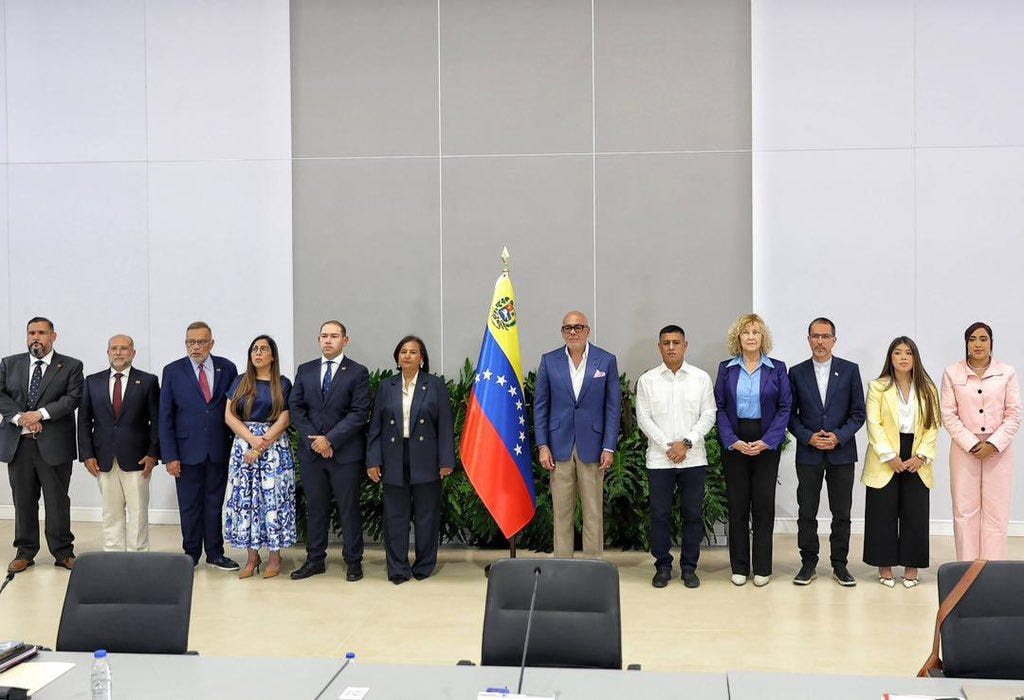
Since chavismo completed the takeover of all the branches of government and the electoral and judicial systems, the regime has never made institutional concessions like the ones announced today. At the end of a day filled with rumors, a communiqué signed by Jorge Rodríguez and Dinorah Figuera said that, besides joining efforts to recover the Venezuelan gold frozen in the United Kingdom, in order to fund the post-earthquake reconstruction efforts, promised to start this very August a timeline to reform the Organic Law of the Supreme Tribunal and the process to postulate and appoint all the magistrates:
It’s true that the regime has deceived the opposition in every negotiation process.
But this time it looks different.
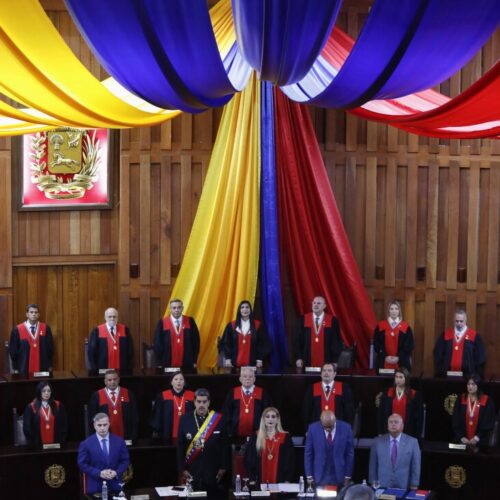
One of the defining characteristics of the Venezuelan regime since 2004 has been the use of the Supreme Court of Justice (TSJ), and later other lower courts, to isolate political leaders and parties and to manipulate political crises to its advantage. The TSJ served as the final institutional word to avert all the political crises in which both Hugo Chávez and Nicolás Maduro have been embroiled. In the most critical moments, such as the 2004 recall referendum, the 2013 presidential elections, the opposition’s electoral victory in the National Assembly in 2015, Hugo Chávez’s absence from the presidency, and the 2024 elections, the regime has turned to the TSJ for protection and has invariably succeeded. Without the TSJ, it is quite possible that it would not have politically survived some of those crises.
Therefore, if, under this negotiation process with the United States as mediator, the interim authorities allow the election of an independent Supreme Court, as announced today, it can be concluded that the Venezuelan political transition likely began on August 12, 2026.
If we add to this other points of the agreements between the 2015 National Assembly and the interim authorities, such as the revision of provisions in the Organic Law of the Supreme Court of Justice, or the appointment of other key authorities in the judicial system, the probability increases that we are indeed witnessing a historic event.
Today’s announcements appear to be a significant turning point in contemporary political history. And, as so often happens in history, this turning point would have the 2015 National Assembly as one of its foundations. A scenario we had suggested in this article, but which at the time seemed more like speculation. Here in another piece, we suggested a path that could very well work, and which seems aligned with today’s announcements.
Political transitions often begin like this.
In places no one expected.
Caracas Chronicles is 100% reader-supported.
We’ve been able to hang on for 22 years in one of the craziest media landscapes in the world. We’ve seen different media outlets in Venezuela (and abroad) closing shop, something we’re looking to avoid at all costs. Your collaboration goes a long way in helping us weather the storm.
Donate