
Every Political Transition Is Wickedly Tortuous
Much like Spain’s transition half a century ago, every reform reveals its true purpose only with time
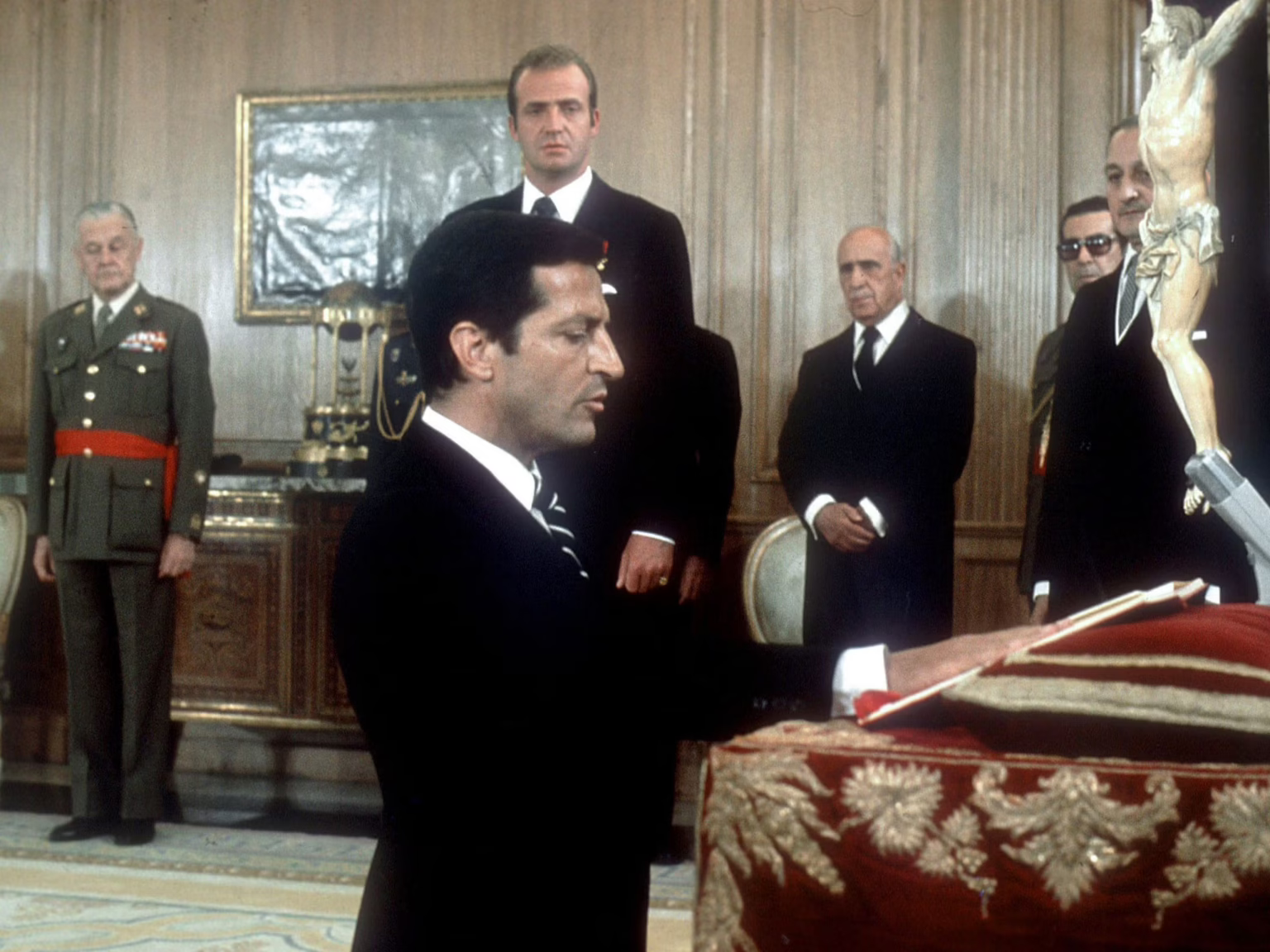
Under the eye of King Juan Carlos and surrounded by men of the ancien regime, Adolfo Suárez kneeled before Christ to open the path to democracy
Successful political transitions are like those movies with an unexpected ending that explains the entire course of history: they are only understood some time after they have been completed.
Only then, the reasons why the regime fractured become clear, the motivations of those who held power for gradually handing it over to certain successors, or the personality traits of each of the previously opposing actors that allowed them to understand each other despite their differences. Thanks to these ex post facto discoveries, the outcome can be understood, and it can be said that the success of that transition was due to the fact that it was those particular people who “negotiated” a path to reach a transitional process. Calmness is necessary to analyze the process if one wants to understand why the actors made decisions that could be considered unconstitutional or illegal, or risky or clumsy from a political point of view.
The Spanish example: the Law for Political Reform
Fifty years ago, when the young King Juan Carlos I appointed Adolfo Suárez as Prime Minister of Spain, the virtually unanimous conclusion was that he had made a serious political error. History later proved that the king had the information and political acumen to know that this was the right person, as indeed he was.
Juan Carlos I had assumed the head of state position upon the death, in 1975, of Francisco Franco, as the dictator himself had stipulated. The head of government remained in the hands of Carlos Arias Navarro. The king’s political decision was that the regime itself should dismantle the regime. To this end, he relied on Torcuato Fernández-Miranda, who had been his professor of Political Law, and whom he appointed as President of the Cortes (the national Parliament), of the Council of the Realm, and of the Regency Council. And in Adolfo Suárez, a young politician who, with the support of the king and Fernández-Miranda, quickly rose through the ranks of the regime to become the first head of government after the resignation (subtly encouraged by the king) of Arias Navarro.
Fernández-Miranda’s appointment was met with frustration in some sectors, as he was seen as a faithful continuator of the regime, even though he was convinced that a political transition was necessary. But his personal conviction was not enough to win the trust of the regime’s more conservative sectors.
The king’s initial decision to keep him as president of the government was based on a practical view of the process: although the king knew that Arias Navarro was not in a position to lead the transition, it was preferable to keep him at the head of the government after Franco’s death to guarantee political and military stability in that initial stage.
Adolfo Suárez’s Law for Political Reform repealed the seven fundamental laws that institutionally sustained Francoism and opened the door to a new legal framework for the transitional process.
King Juan Carlos I’s decision to appoint the relatively unknown Adolfo Suárez as PM caused genuine astonishment within the Franco regime, due to the perplexing nature of the selection. Only years later could its true significance be appreciated: a pertinent and crucial measure that ensured the transition process’s success.
A common element among the three figures is that, in their own way, they belonged to the Franco regime. But, although they couldn’t openly acknowledge it, they believed that the transition had to begin within the regime itself, through a series of institutional acts that would dismantle the “Francoist institutions.” The intention of the King and the President of the Cortes (Congress) was to achieve political transformation through the reform of existing laws. In other words, to use the legal framework of the Franco regime to institutionally dismantle Francoism.
In this case, the Law for Political Reform of December 17, 1976, drafted by Torcuato Fernández-Miranda at the request of the King and Suárez, was decisive. In short, the Law repealed the seven fundamental laws that institutionally sustained Francoism and opened the door to a new legal framework for the transitional process. It was based on the 1947 Law of Succession, enacted during the height of the Franco regime.
At the time, naturally, there was distrust in the process, because some sectors questioned whether it could end in a form of reinstitutionalization of Francoism.
In any case, it is worth clarifying that the Spanish case may have some similarities, but also significant differences, with what the transition in Venezuela might entail.
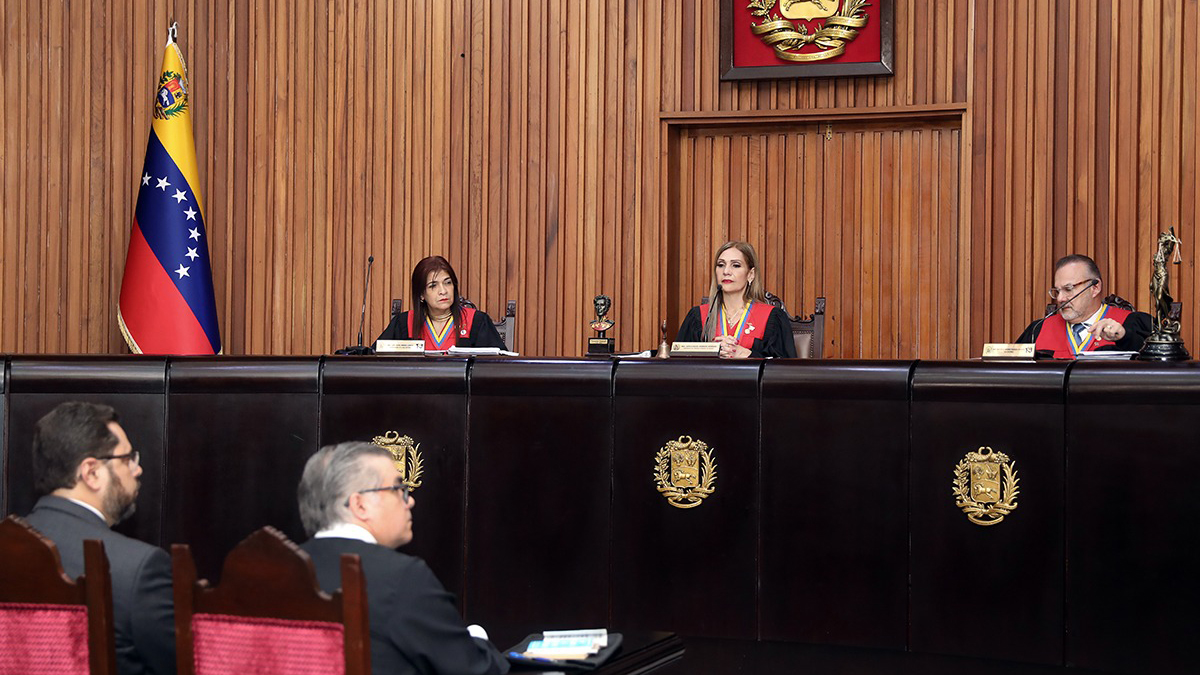
The reform of Article 65 of the Organic Law of the TSJ
Yesterday, September 1, the National Assembly approved the specific reform of Article 65 of the Organic Law of the Supreme Court of Justice. As we pointed out in this other article, the reform includes the number of members of the Nominations Committee The number of judicial nominations would increase from 21 to 23, but the most significant aspect is that these two additional members would come from civil society.
The project was challenged by the Academy of Political and Social Sciences, which rightly pointed out that the reform is unconstitutional because, according to Article 270 of the Constitution, the Judicial Nominations Committee must be “composed of representatives from different sectors of society, in accordance with the provisions of the law.” The correct interpretation of the Constitution is that, certainly, the Committee should not be composed of members of parliament.
But this specific reform is what was agreed upon. It seems small, and the questioning of the reform’s constitutionality is evident, but as I also argue in this article, it could be the first institutional and legal step taken by the interim authorities toward a genuine transitional process.
We cannot know that today. What we do know today is that the reform may seem specific and its validity questionable. Only if the transition actually occurs will we be able to gauge the importance of this first small step.
When the process is fraught with such decisions and concessions, it is difficult to understand how these decisions can ultimately benefit the transition.
As announced, the second round of in-person negotiations will take place between September 15 and 20, and will focus on the restoration of political, civil, and electoral guarantees.
In short, complex political transitions, like ours, are arduous paths. It requires working with political actors from the outgoing regime, making unpleasant concessions, and working with the regime’s legislation and institutions to dismantle it.
At the initial stage of the transition, when the process is fraught with such decisions and concessions, it is difficult to understand how these decisions can ultimately benefit the transition.
But when transitions are successful, time reveals the wisdom of many of those decisions.
Caracas Chronicles is 100% reader-supported.
We’ve been able to hang on for 22 years in one of the craziest media landscapes in the world. We’ve seen different media outlets in Venezuela (and abroad) closing shop, something we’re looking to avoid at all costs. Your collaboration goes a long way in helping us weather the storm.
Donate