
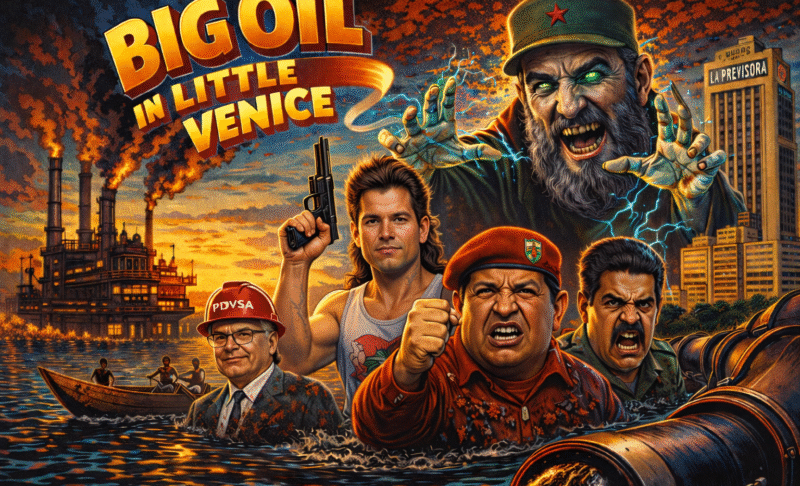
Big Oil in Little Venice
Big Oil's history in Venezuela has been quite the adventure. A big adventure
Most people live many lives. This is specially true for us Venezuelans, many who’ve had to reinvent themselves several times along the past couple of decades. Doesn’t matter if they live in Venezuela or abroad, we’ve had to remain… “fluid,” the word of the moment. Like water.
In one such life, I did a whole bunch of lawyer work in oil industry related stuff. That was back when the PDVSA work was distributed between Venezuelan law firms, before chavismo syphoned all those cases to conveniently concentrate them in just a couple. That’s a huge story, but not the point of this post.
During those years, the Chávez doctrine was to take over or renationalize everything no matter what it took. In fact, while everybody used the term “expropriation,” there weren’t many technical (or legal) expropriations—although there’s a legal argument to say that any government action with the same effect of an expropriation is one. As you’d remember a famous reply to Chávez in the Venezuelan legislature many years ago: expropriating without paying is stealing. The Chávez government employed different strategies to apply this policy.
That’s why I thought it was funny that former Venezuelan oil tsar and destroyer of worlds Rafael Ramírez, a few days ago, in an interview, said that the Conoco and Exxon problems with Venezuela, the cause of their reluctancy to invest, were because they simply didn’t accept the new contractual terms offered to them at the time, back when he was President of PDVSA.
But first, let’s go back a few years. The Venezuelan oil industry was nationalized many years ago (1976) during the government of Carlos Andrés Pérez. As a consequence, all foreign oil companies established in Venezuela were acquired by state owned oil companies putting an end to all existing concessions. In April 1982, Petróleos de Venezuela, SA (PDVSA) executes several agreements which gave way to its evolution into a transnational company.
Then, in 1996, the Caldera administration launched the Apertura Petrolera initiative to ramp up production and opening the long secluded oil market to international and domestic companies with some favorable conditions to those looking to develop heavy crude projects in the Orinoco basin. Strategic associations were formed and profit sharing agreements were signed with PDVSA. The association agreements implied that the operating companies would assume all the risk and costs, which was very high in some cases, and they would sell production to PDVSA for a fee—they would not be taxed as oil companies since they’d be considered independent contractors.
Ten years later a new Hydrocarbons Law was sanctioned. Ramírez, then Minister of Oil, enforcing a Hugo Chávez presidential decree, announced the termination of all strategic associations and operating agreements because they violated the new law, even when in Venezuela it should not have been applied retroactively, and forced them to migrate to the much more less favorable mixed company format established in the law—according to which it was necessary for the Venezuelan state to hold a majority stake.
The conditions changed significantly. Not only would these companies have to deal with the oversight of a now incompetent PDVSA, but they had to pay a 30% royalty too and had to face a massive tax increase.
Some companies agreed to migrate to the new format, others didn’t. ExxonMobil was amongst the ones that refused.
Mobil Cerro Negro, LTD., a subsidiary of ExxonMobil, filed two international arbitration actions, suing PDVSA Cerro Negro, C.A. for contractual damages. Mobil CN stated that when the Venezuelan Government decided to terminate the agreement which created Strategic Association Cerro Negro, the government actually intended the direct expropriation of MOBIL CN’s interests and rights over the agreement.
ExxonMobil has been awarded around $1.6 billion for these claims, which is nothing compared to what ConocoPhillips is pursuing for similar claims (which approach or exceed $10 billion).
I had forgotten all about this. Insane, because back then these cases impacted every lawyer working the industry. What is even worse, a couple years later I wrote a paper about it for my master’s degree:
International Project Finance for Venezuelan oil investments: Expropriation risk and limits to foreign remedies.
I wrote a whole freakin’ paper based on the ExxonMobil case, and it was completely wiped from my memory and probably replaced with memes.
And then, Exxon CEO Darren Woods enumerated the minimum requirements to consider a Venezuela investment. The two loose cables in my brain made contact and everything came back like a Johnny Mnemonic upload.
Darren Woods said:
“If we look at the legal and commercial constructs—frameworks—in place today in Venezuela, today it’s uninvestable. And so significant changes have to be made to those commercial frameworks, the legal system, there has to be durable investment protections, and there has to be a change to the hydrocarbon laws in the country.”
Broadly, he was speaking of the exact same things that affected them back then. Not only that, but those pretty much speak to the conclusions of my 2008 paper on what would be required to safely invest in Venezuela: develop a structure including a jurisdiction with investment protection treaties, international arbitration and legal jurisdiction clauses, legal stability contracts, and targeting assets abroad for guarantees.
Anyone looking at Venezuela now (and then) would ask for similar conditions.
Conditions that not only the US, but also China, Russia and Iran have been asking of Venezuela for a decade. We’ve been hearing of a reform to the Hydrocarbons Law stuck in the legislature for years. And, in part, it never moved forward because Diosdado Cabello constantly blocked those initiates to have leverage over Maduro and the Rodríguez siblings. Eventually, chavismo had to use the antiblockade law, an illegal mechanism that was created to circumvent US sanctions by “protecting” Venezuela prospective partners, to go around the hydrocarbon legislation to be able to give their partners a better cut of the business via a parallel contractual framework (Contratos de Participación Productiva or CPPs). That block by Cabello survived the blackout, the Guaidó caretakership, and the sanctions…
Well, you know how the old adage goes: why use sanctions when you have hellfire?
A week after Woods made his very public request before Trump, Delcy Rodríguez said there would be a reform to the oil industry legal framework. One week later, the legislature that her brother runs approved a first draft of the law in first discussion. Another week goes by, and the law was fully sanctioned in the National Assembly. Boom.
The modified Hydrocarbon Law reads like an email that answers Woods conditions almost point by point. In article 1 language was added to reassure that this law was created under the principles of “…progressive maximization of rent, legal certainty, and contractual transparency.” Hilarious.
During his Venezuela assessment before the US Senate, Rubio said that the new legislation “basically eliminates many of the restrictions on foreign investment in the oil industry. It doesn’t go far enough to attract more investment, but it’s a big step compared to where things were three weeks ago.”
After all the chaos it caused, Chávez’s oil legacy was wiped clean as if it was a bug on a windshield.
On good authority we heard that Rubio was expecting to have the law approved on Tuesday to be able to announce it on Wednesday, the day of the assessment. The folks at The Branch missed the deadline by a couple of days. Rubio just spoke about it with full confidence, knowing what it would be approved the day after.
Here’s some of the stuff that was changed:
- First and foremost: Arbitration. The original law said that disputes could only be solved in Bolivarian Republic of Venezuela courts and it explicitly prohibited the use of foreign jurisdictions. In the reformed law they added the possibility to solve disputes via arbitration and removed the jurisdiction limitation.
- The big one: Now state companies and JVs can engage private companies domiciled in Venezuela to perform oil industry “primary activities” (exploration, extraction, and production). Also they can assign to them any rights over assets and real estate. These operating agreements would be similar to the CPPs, and remove the need to participate in a JV.
- Operating companies have the right to commercialize production directly.
- Royalties are capped at 30%, and amplifies the right to negotiate a lower royalty.
- Simplified taxes and widened exemptions regime.
- The shady one: Operating companies are exempted from having to apply the Public Contracting Law. It’s not very transparent, but it will make life easier for foreign companies.
Right after Jorge Rodríguez said that the law had been approved, OFAC dropped the newly minted General License 46. Which still has to be read carefully, but it does partially lift sanctions over the oil industry with some limitations: lets U.S. companies handle Venezuelan oil again, butthere’s tight control over payments and sales to third countries + an explicit restriction over transactions with the axis (Russia, Iran, North Korea, aaand China).
Section 1 double downs on the mantra “never trust chavista courts.”
“Any contract for such transactions with the Government of Venezuela, PdVSA, or PdVSA Entities specify that the laws of the United States or any jurisdiction within the United States govern the contract and that any dispute resolution under the contract occur in the United States…”
So long, Revolution. A new meaning to rodilla en tierra.
Big Oil doesn’t trust Venezuela, can’t blame them. But I’ve got a feeling they really want to. They just have to bring the big guns to the negotiating table.
Caracas Chronicles is 100% reader-supported.
We’ve been able to hang on for 22 years in one of the craziest media landscapes in the world. We’ve seen different media outlets in Venezuela (and abroad) closing shop, something we’re looking to avoid at all costs. Your collaboration goes a long way in helping us weather the storm.
Donate