
Fact-Check: How Machado & Rodríguez Talk About Racism
Delcy deploys racism as a political accusation with shifting targets, while María Corina frames it as a strategy to divide
For years, María Corina Machado has returned to a consistent argument when addressing racism: that chavismo has instrumentalized it to divide Venezuelan society along lines of class, race, and political identity. Delcy Rodríguez, by contrast, has mostly invoked racism as a political accusation aimed at the regime’s adversaries, particularly the United States, Donald Trump, neighboring governments, and the Venezuelan opposition.
These conclusions come from an investigation by Cazadores de Fake News, which analyzed 971 YouTube videos published between 2012 and 2026, covering more than 304 hours of public appearances by both leaders. References to racism, race, or classism appear in just 45 of those videos—17 in Machado’s case (1.7%) and 28 in Rodríguez’s (2.9%) and usually occupy only brief moments within longer interventions.
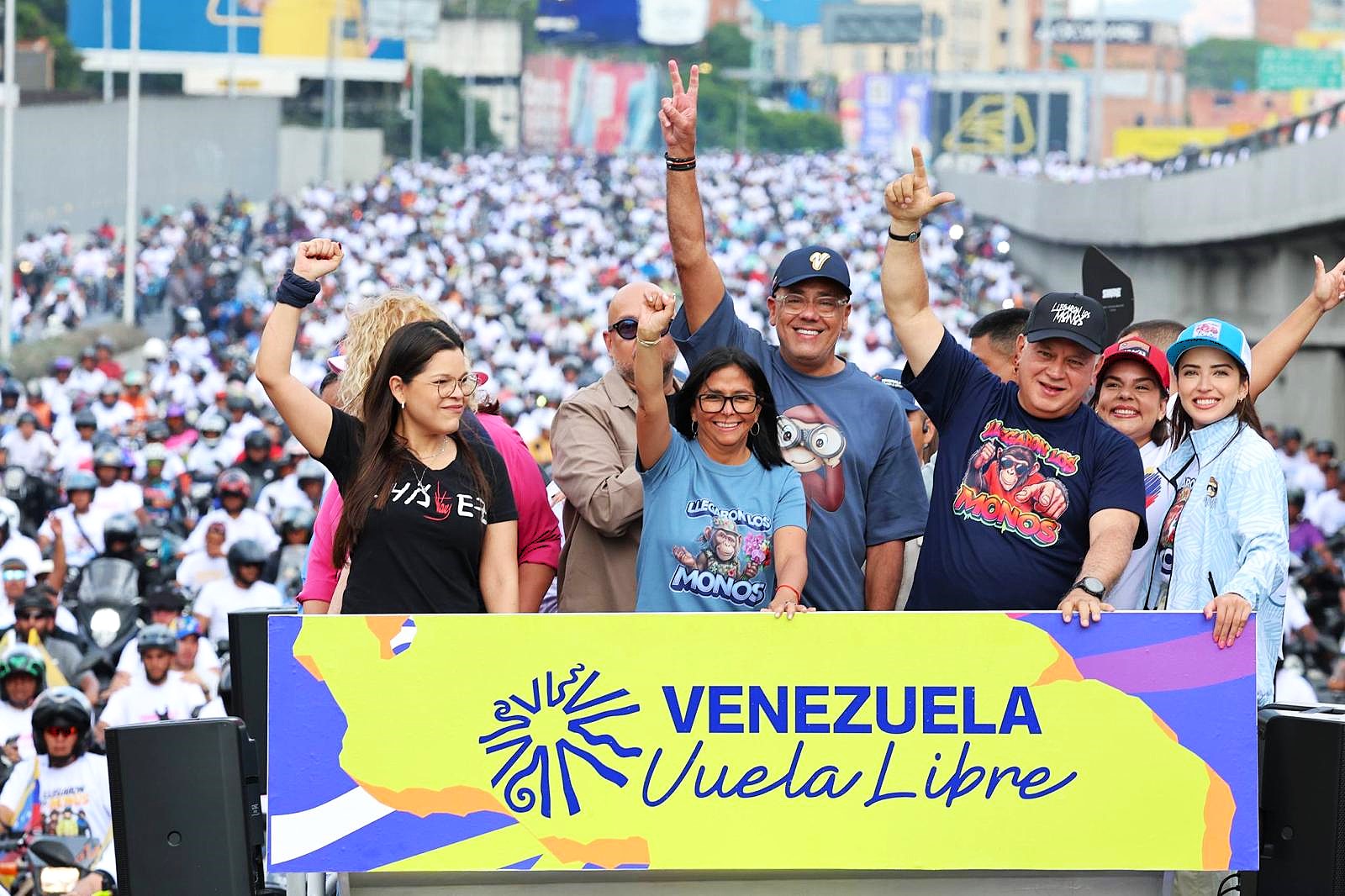
The findings stand in contrast to one of the central narratives promoted by the Rodríguez government in its “Great National Pilgrimage Against Sanctions,” launched on April 19, 2026, which we treat as an unofficial pre-electoral tour. Chavismo’s stated goal on the road was to call for an end to US sanctions. However, the campaign also framed the Venezuelan opposition as racist and classist. Especially Machado.
That narrative emerged in response to an event Machado had recently held in Madrid’s Puerta del Sol. During the rally, some attendees chanted a racist insult directed at Rodríguez, fuera la mona. Singer Carlos Baute, who was part of the event, amplified the chant before Machado took the stage. The chants resumed during her speech, but Machado did not engage with them. The following day, in an interview with Spanish news agency EFE, she rejected the insults and called for focusing on substantive criticism instead. In the days that followed, pro-regime media and officials appropriated the chant, turning it into a central element of their messaging against her.
Machado has denounced chavismo’s use of class and race to deliberately fragment Venezuelan society.
Cazadores de Fake News examined how Machado and Rodríguez have addressed racism, Afro-Venezuelan identity, and classism across public appearances available on YouTube. The analysis focused on videos containing keywords such as “racism,” “race,” “Black,” and “classism,” within a dataset of 971 videos totaling more than 304 hours.
The material comes from two major archives: 359 videos from Machado’s party channel, Vente Venezuela (covering appearances since 2012), and 612 videos from an archive of pro-government content maintained by chavista curator Luigino Bracci Roa (since 2015).
Mentions of these topics are relatively rare. Even within the videos where they appear, references are brief, suggesting that racism and classism have not been central themes in either leader’s discourse. At least until April 19, 2026, when the Baute incident unravelled. We excluded mentions after that date to avoid distorting the analysis with the Venezuelan State’s reaction to the episode in Madrid.
Exposing her opponent’s narrative
Across her appearances, Machado’s references to racism consistently point to a single idea: that chavismo has used it deliberately to fragment Venezuelan society, pitting “rich against poor,” “Black against white,” and “insiders against outsiders.” This argument appears in most of the identified interventions and remains remarkably stable over time.
She deploys it in two ways. First, Machado tends to denounce it as a political strategy designed to maintain power through division. Second, more recently, as evidence that this strategy has begun to fail. She has wielded this conclusion in the aftermath of the 2023 primaries and the 2024 presidential campaign, arguing that the opposition managed to unify voters across those divides.
After January 3rd, references to racism directed at the US and Trump disappeared almost entirely from Delcy’s rhetoric.
The earliest instance dates back to January 2015, when Machado described Venezuela’s economic crisis and foot shortages as a phenomena that cut across class and race, affecting “rich and poor, Black and white, civilians and military alike.” That same framing reappeared throughout subsequent campaigns and political moments, emphasizing unity in the face of systemic collapse.
On February 1, 2024, at one of her campaign events, Machado summed up this argument by stating that chavismo had used “three tools” against the country: lies, fear, and discouragement. She maintained that, on the basis of lies, the regime had tried to divide Venezuelans between “Blacks and whites, rich and poor, left, right, those outside, those inside.”
Her most explicit statement on the issue came in September 2023. She was asked about combating abuse against members of the LGBTI community.
At that point, she rejected all forms of discrimination, namely sexual preference, ethnicity, race, religion and gender. Machado pledged to promote tolerance as public policy. We found no evidence of Machado using racist or classist language. Her references consistently frame the issue in terms of inclusion and non-discrimination.
Delcy accuses everyone
In the case of the interim leader, references to racism and classism function primarily as political accusations. The dataset shows how their targets have shifted over time.
Until 2025, most of these accusations were directed outward, particularly at the US, Donald Trump, and what she describes as Western imperialism. In several cases, Delcy framed racism within a broader anti-imperialist and anti-colonial narrative. For example, in 2019, responding to the sanctions, she linked a wave of mass shootings in the US to what she described as “racist and supremacist hatred” promoted by Trump. At other times, Rodríguez applied similar labels to Zionism and to the Monroe Doctrine, portraying it as a symbol of US interventionism in Latin America.
This pattern extended, to a lesser degree, to other governments in the region, including Colombia and Ecuador, particularly in disputes over the treatment of Venezuelan migrants.
A second line of argument targeted domestic opponents. In roughly a third of the identified interventions, Rodríguez accused the Venezuelan opposition of racism, classism, or fascism, often in the context of defending government actions or discrediting political challengers.
What stands out, however, is how abruptly this discourse changed after Nicolás Maduro’s capture on January 3, 2026. References to racism directed at the US and Trump disappeared almost entirely from Rodríguez’s rhetoric, coinciding with the start of formal engagement with Washington. A decade of anti-US discourse was effectively muted within days.
By 2026, two contrasting patterns emerge.
Machado’s framing of racism remains consistent over time: she presents it as a tool of division and emphasizes inclusion as a political response. Rodríguez’s use of the issue, by contrast, shifts depending on the political context, moving from external enemies to domestic opponents as circumstances change.
The narrative from ruling chavismo in April 2026 once again placed accusations of racism at the center of its attacks on the opposition. In doing so, it echoed the very dynamic Machado has long denounced: the instrumentalization of race and class as tools of political conflict.
Caracas Chronicles is 100% reader-supported.
We’ve been able to hang on for 22 years in one of the craziest media landscapes in the world. We’ve seen different media outlets in Venezuela (and abroad) closing shop, something we’re looking to avoid at all costs. Your collaboration goes a long way in helping us weather the storm.
Donate