
Diplomatic Defeat for Delcy: The UN Will Keep Probing Chavismo
Distancing from old allies made the regime look lonelier than ever in the Human Rights Council
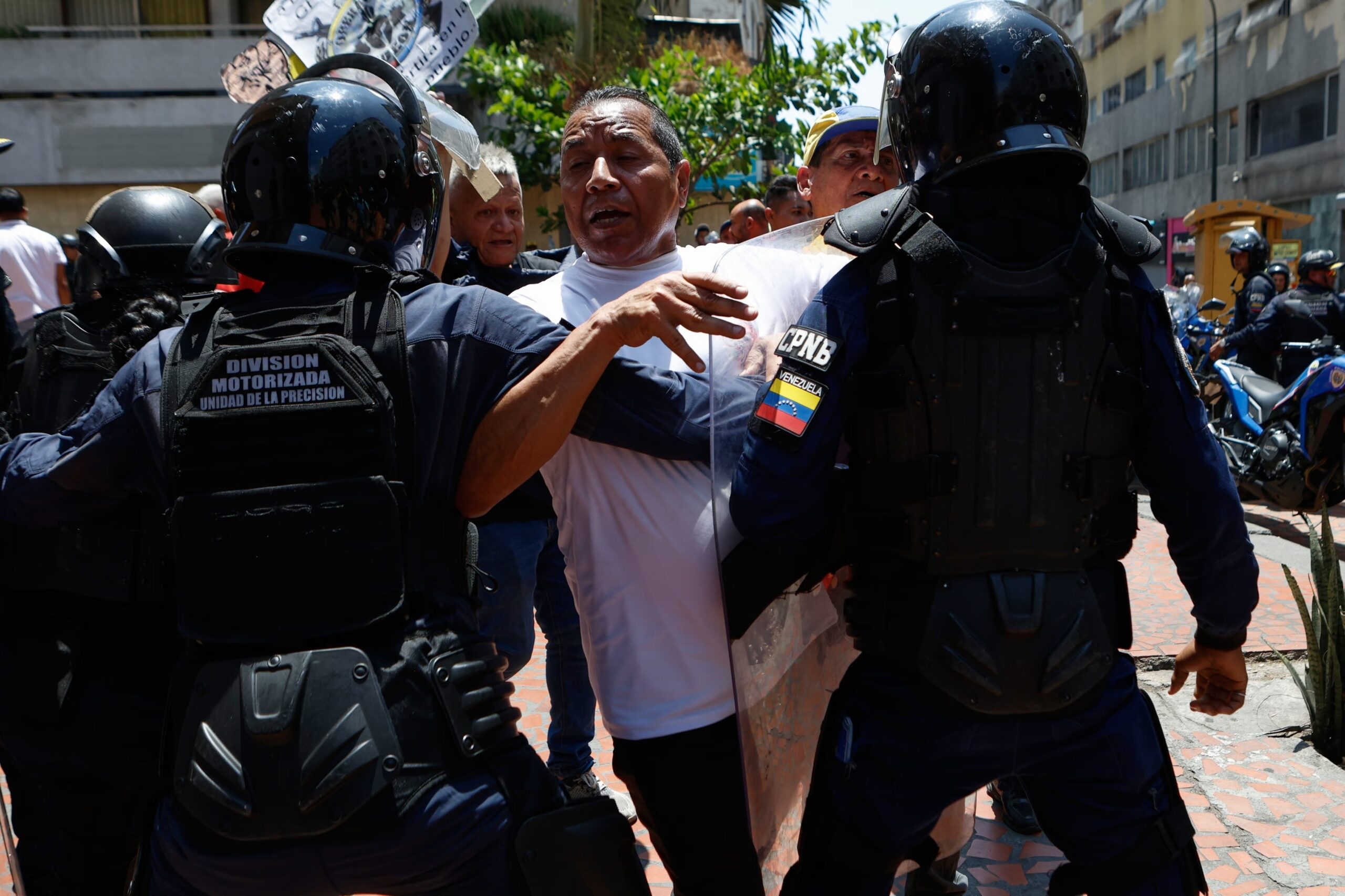
Police officers block a protest demanding decent wages as public workers, students and pensioners try to reach the presidential palace. Photo by Associated Press, April 2026.
On October 6, the UN Human Rights Council voted to renew the mandate of its Independent International Fact-Finding Mission on Venezuela for two additional years. For victims, their families, and society at large, it means an independent investigation must continue as long as the machinery of repression remains operational, and through any transition that finally allows more of the truth to emerge.
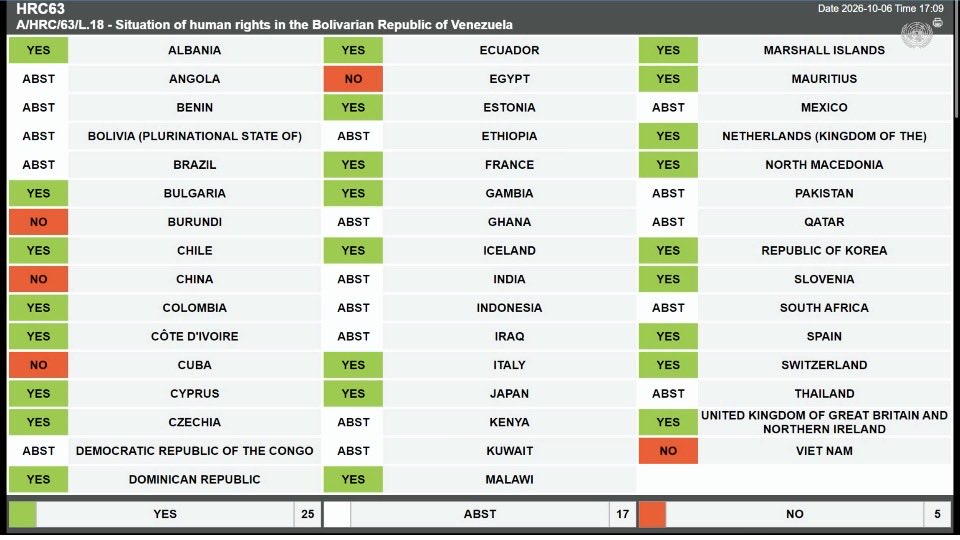
The vote must be read alongside the negotiation that made it possible. A striking 25 of the Council’s 47 members voted in favour, 5 against and 17 abstained. The result sends a clear signal, but must be read carefully: governments can allow an investigation to continue while disagreeing over findings or the way forward because of considerations beyond the Council room.
The diplomacy behind
This renewal reflected some of those wider considerations. It also deserves recognition as the outcome of sustained diplomatic work by the Core Group: Argentina, Canada, Chile, Ecuador, Guatemala, Paraguay and Uruguay. As one diplomat told me, this included outreach to Washington DC through privileged diplomatic and regional channels to explain the stakes of the vote, and to build an understanding over the need for renewal. These delegations have been instrumental in scrutinizing the regime since the Mission’s establishment in September 2019. This time, they endorsed the Mission again and built the political space for continuation.
The 49 sponsors (including North Macedonia, which the Venezuelan regime accused of hacking the electoral system during the 2024 presidential election) chose a short, carefully balanced resolution. During negotiations, they emphasized that this would encourage more Council members to accept it. The text acknowledges initial prisoner releases and renewed cooperation with the Office of the High Commissioner for Human Rights (OHCHR), before supporting continuing the independent investigation and demanding accountability.
Negotiations also revealed strains in the traditional protections chavista governments had come to rely on at the UN over the past decade. Venezuela’s diplomatic allies, coordinated through the Group of Friends in Defence of the Charter of the UN, face an increasingly uncomfortable dilemma: how to reconcile opposition to US intervention with support for Venezuelan authorities now working closely with Washington. Their own relations with the US add to that difficulty.
In my view, the cohesion that once sustained their defence of the chavista regime is under tension and may give way to new problematic circumstances. The Caracas delegation did not articulate a strategy among the “Friends of the Charter.” A representative of a long-standing Venezuelan NGO who recently visited Geneva offered this explanation for the apathy: “The regime is walking on eggshells, and bullies have no experience on that.”
The Havana delegation was particularly cooperative during negotiations, a marked departure from its usual role in defending Venezuela.
Informal consultations had already suggested this change. Although most delegations maintained their statements of principle, chavismo’s traditional allies didn’t put up major obstacles and proposed few, if any, amendments.
A senior human rights defender who attended a meeting with some of these allies later told me: “Am I dreaming, or did they just turn a blind eye?”
Cuba, a major ideological and political ally of chavismo, voiced concerns publicly and in the Council, but did not oppose renewal until the final stage. The Havana delegation was particularly cooperative during negotiations, a marked departure from its usual role in defending Venezuela during the drafting process, which often saw Cuban diplomats raise objections to phrases or paragraphs, and propose alternative wording to water down the text.
Mexico’s reservations focused on the renewal’s duration rather than its substance or the resolution’s provisions. This was ultimately a reason to abstain, a constant stance under the López Obrador and Sheinbaum governments.
These distinctions help explain why the space for the Mission’s continued work has widened.
What the resolution preserves for Venezuelans
The resolution extends the Mission until 2028, providing continuity for investigations into serious violations committed since 2014. It also maintains the High Commissioner’s monitoring and technical cooperation. These complementary roles preserve both engagement with the authorities and independent scrutiny of their conduct.
Last month, Mission experts reported insufficient evidence of a genuine, sustainable break with the pattern of State-sponsored repression documented across successive mandates.
Regular oral updates, written reports and interactive dialogues keep the chavista regime under sustained public scrutiny. The resolution urges the authorities to implement both mechanisms’ recommendations, investigate violations, hold those responsible accountable, immediately and unconditionally release everyone arbitrarily detained, and end criminal proceedings against them. For Venezuelan families, this recognizes that leaving prison is only the first step towards genuine freedom.
It also calls for immediate, full and unrestricted access to the OHCHR and the Mission inside Venezuelan territory, detention facilities, and for ordinary citizens to communicate with the UN and other human rights bodies without reprisals, intimidation or attacks. These requirements give practical meaning to the renewal.
Why the Mission must continue
The Mission’s findings justify renewal for at least four reasons: repressive structures that remain, methods that adapt under the new chavista government, persisting impunity, and fear of victims that keep silencing the truth.
Although the Venezuelan government has released hundreds this year, NGO Foro Penal last registered 324 political prisoners. Forty-three percent are military officers. In any case, releases alone are not an accurate indication of freedom.
The Mission’s September 16 update, “The Continuity of the State’s Repressive Apparatus,” establishes why its work cannot end with a change at the top. Experts found insufficient evidence of a genuine, sustainable break with the pattern of State-sponsored repression documented across successive mandates, despite the 1,066 releases Foro Penal recorded between January and late August.
At the September press conference, I asked the UN experts what progress would require. They pointed at specific benchmarks so far unmet: judicial independence, institutional reform, accountability and the elimination of legalized repression.
In this light, domestic and international actors should keep pressing for the full repeal of the Law Against Hatred, the Simón Bolívar Law and the Anti-NGO Law, alongside provisions of the Anti-Blockade Law permitting secrecy and executive overrides of existing laws. Reform must also address so-called terrorism offences, special courts and broadcasting restrictions.
Under Delcy Rodríguez, prisoner releases and renewed cooperation with the OHCHR have amounted to selective concessions.
The Mission retains its capacity to investigate unreported cases, protect evidence and connect testimonies with patterns of repression. Experts remain custodians of the truth entrusted to them by victims, families and defenders. In the long term, their work can support victim-centered efforts to pursue truth, justice and memory, and to press for the implementation of recommendations.
The latest report recommends an independent mechanism to preserve archives and judicial evidence, in opposition to a provision in the 2026 Amnesty Law that requires the elimination of records and criminal histories of amnesty beneficiaries.
The report also proposes a roadmap developed with civil society featuring clear deadlines and measurable indicators. Such recommendations matter both for addressing Venezuela’s recent history of gross violations and ensuring that efforts to open the oil industry do not overshadow human rights concerns.
The next goal is to turn the resolution into concrete access, effective protection and measurable results.
Under Delcy Rodríguez, however, prisoner releases and renewed cooperation with the OHCHR have so far amounted to selective concessions. Meaningful accountability is therefore unlikely without a new democratically-elected government that dismantles repressive structures and restores judicial independence, with victims’ demands for truth, reparations and justice at the centre of policies. Renewal preserves the necessary independent, investigative capacity to support that eventual process.
As the Chilean ambassador, whose delegation led the negotiation and drafting of the resolution, said on Tuesday at the Council: “Hopefully, this will be the last time we have to renew the mandate.”
Caracas Chronicles is 100% reader-supported.
We’ve been able to hang on for 22 years in one of the craziest media landscapes in the world. We’ve seen different media outlets in Venezuela (and abroad) closing shop, something we’re looking to avoid at all costs. Your collaboration goes a long way in helping us weather the storm.
Donate